

Key Takeaways
Reliability Dominance in Auto Rankings
Reliability dominance refers to the consistent, multi-decade pattern in which Asian automakers - particularly Japanese and South Korean brands - earn top positions in independent vehicle dependability surveys. These rankings measure how frequently vehicles require unscheduled repairs relative to their peers. Asian brands have held this advantage across numerous survey cycles and vehicle categories.
Major industry benchmarks such as J.D. Power's Vehicle Dependability Study and Consumer Reports' reliability surveys measure problems per 100 vehicles (PP100) or owner-reported trouble rates; lower scores on PP100 scales indicate fewer problems and better dependability.
How the Reliability Gap Became Measurable
By the 1980s, independent consumer organizations and automotive research firms began systematically tracking owner-reported vehicle problems. The results were consistent: Japanese brands returned far fewer problems per vehicle than most American or European rivals. This was not accidental - it reflected years of deliberate investment in manufacturing discipline that predated the surveys themselves.
The pattern has proven durable. Across successive cycles of J.D. Power Vehicle Dependability Studies and Consumer Reports reliability data, brands such as Toyota and Honda have repeatedly appeared at or near the top of their segments, while Hyundai and Kia have risen sharply since the early 2000s. For context on how Japanese and Korean paths diverged, see the comparative history of Japan's and South Korea's auto industries.
Top 10
Asian brands in J.D. Power dependability rankings
Asian manufacturers have consistently occupied the majority of top-10 positions in J.D. Power's annual Vehicle Dependability Study across multiple recent survey cycles.
~20 years
Time for Korean brands to close reliability gap
Industry analysts broadly trace Hyundai and Kia's most significant reliability improvements to sustained quality investments made from the early 2000s onward.
Fewer PP100
Problems per 100 vehicles vs. industry average
Leading Japanese brands have historically recorded problem rates below the industry average in Consumer Reports surveys, a benchmark that measures owner-reported troubles.
The Engineering Philosophy Behind Consistent Quality
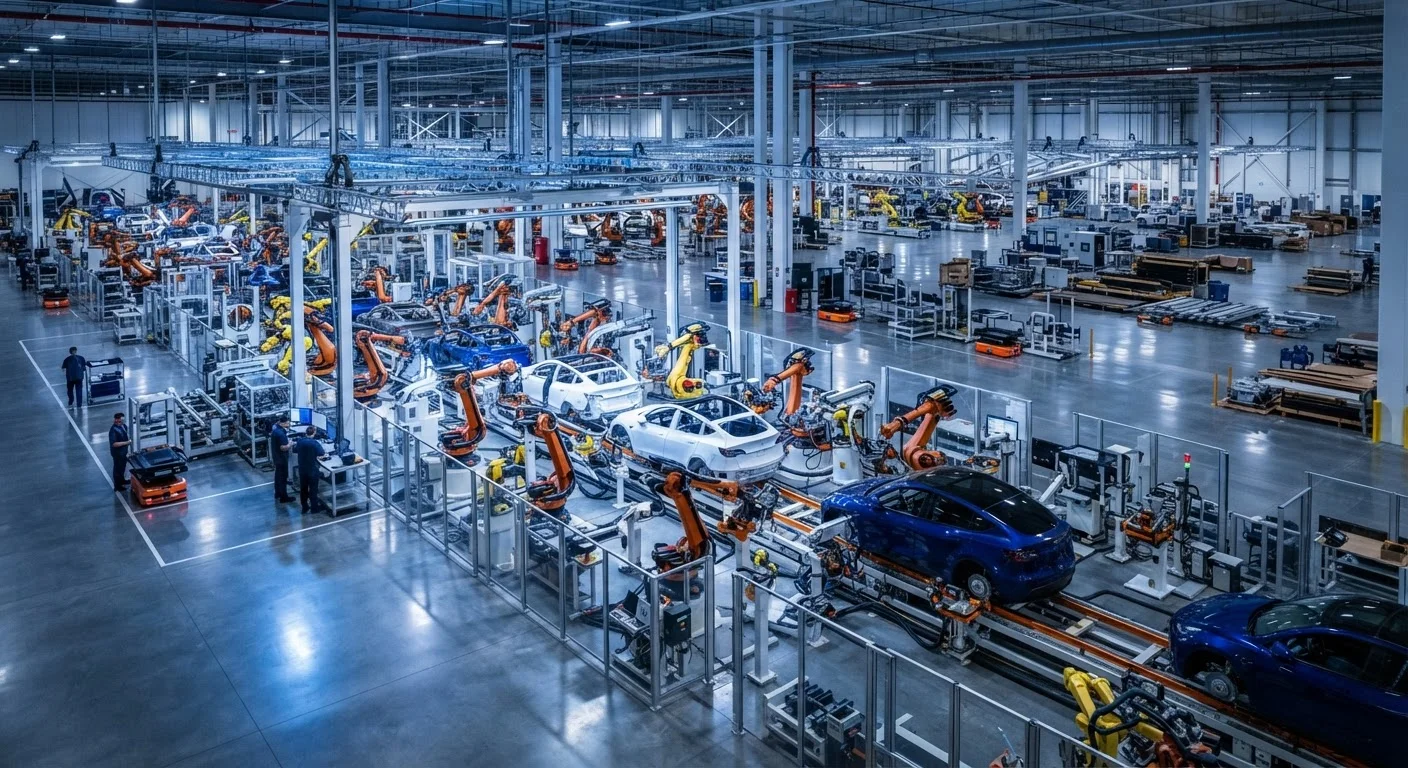
Two intertwined concepts explain much of Asian automakers' quality record. The first is kaizen - the philosophy of continuous, incremental improvement embedded across all levels of an organization. Rather than waiting for a major redesign to fix problems, kaizen encourages frontline workers to identify defects and inefficiencies in real time. Over years and model generations, small gains accumulate into substantial quality advantages.
The second is lean manufacturing, pioneered in its modern form by Toyota and widely adopted across the industry. Lean principles minimize production variation - a major source of defects - by standardizing processes, reducing unnecessary steps, and creating feedback loops that catch errors before they reach finished vehicles.
These approaches share an important engineering trait with fuel-efficiency leadership: both reward simplicity and precision over complexity. Asian brands' fuel-efficiency engineering choices reflect the same design discipline that also yields lower defect rates.
Look Beyond Brand Averages When Researching
Even within brands with strong overall reliability records, individual model years can vary significantly. Before making a purchase decision, check model-specific reliability data from Consumer Reports or J.D. Power for the exact year and trim you are considering. Brand reputation is a useful starting point, not a substitute for model-level research.
Strategic Context: Reliability as a Market-Entry Tool
Japanese automakers entered North American and European markets in significant volumes during the 1960s and 1970s, initially competing primarily on price and fuel economy. To sustain market share against established domestic brands, they needed a differentiating advantage that consumers could verify over time. Reliability became that advantage.
Investing in quality was not purely philosophical - it was strategic. A reputation for dependability lowers ownership costs, generates word-of-mouth referrals, and builds brand loyalty across generations of buyers. Once established, reliability reputations become self-reinforcing: engineers who take pride in that reputation apply greater scrutiny, and quality targets get ratcheted higher with each product cycle.
South Korean manufacturers followed a comparable playbook starting in the 1990s, backing aggressive quality investments with expanded warranties that gave buyers measurable assurance during a period when Korean reliability was still being established. The reliability reputation of American automakers developed along a different trajectory, shaped by distinct industrial and cultural pressures.
What Reliability Rankings Can and Cannot Tell You
Reliability surveys are powerful tools but carry important limitations. They measure average problem rates across large vehicle populations, which means a brand's strong overall score can mask weaker individual models - and vice versa. A buyer focused on a specific vehicle should consult model-year-level data rather than treating brand averages as guarantees.
Rankings also reflect the vehicles being sold in a given period. As Asian automakers have expanded into trucks, luxury segments, and electrified powertrains, maintaining the reliability margins established in simpler vehicle categories has become more complex. Newer technology - including advanced driver-assistance systems and electric drivetrains - introduces new reliability variables that surveys are still measuring across all manufacturers.
For those already driving high-mileage Asian brand vehicles, maintaining reliability past 150,000 miles requires consistent servicing regardless of brand reputation. Reliability potential and realized reliability are not the same thing - ownership habits matter considerably.
Reliability Rankings Evolve With Technology
As vehicles incorporate more software-driven features, over-the-air updates, and electrified powertrains, the factors that determine reliability are shifting. Early data suggests that the transition to EVs and advanced driver-assistance systems introduces new reliability variables that are still being measured across all manufacturers - including those with historically strong records. Consumers should monitor updated survey data as these technologies mature.