

Key Takeaways
What the TPMS Warning Light Is Actually Telling You
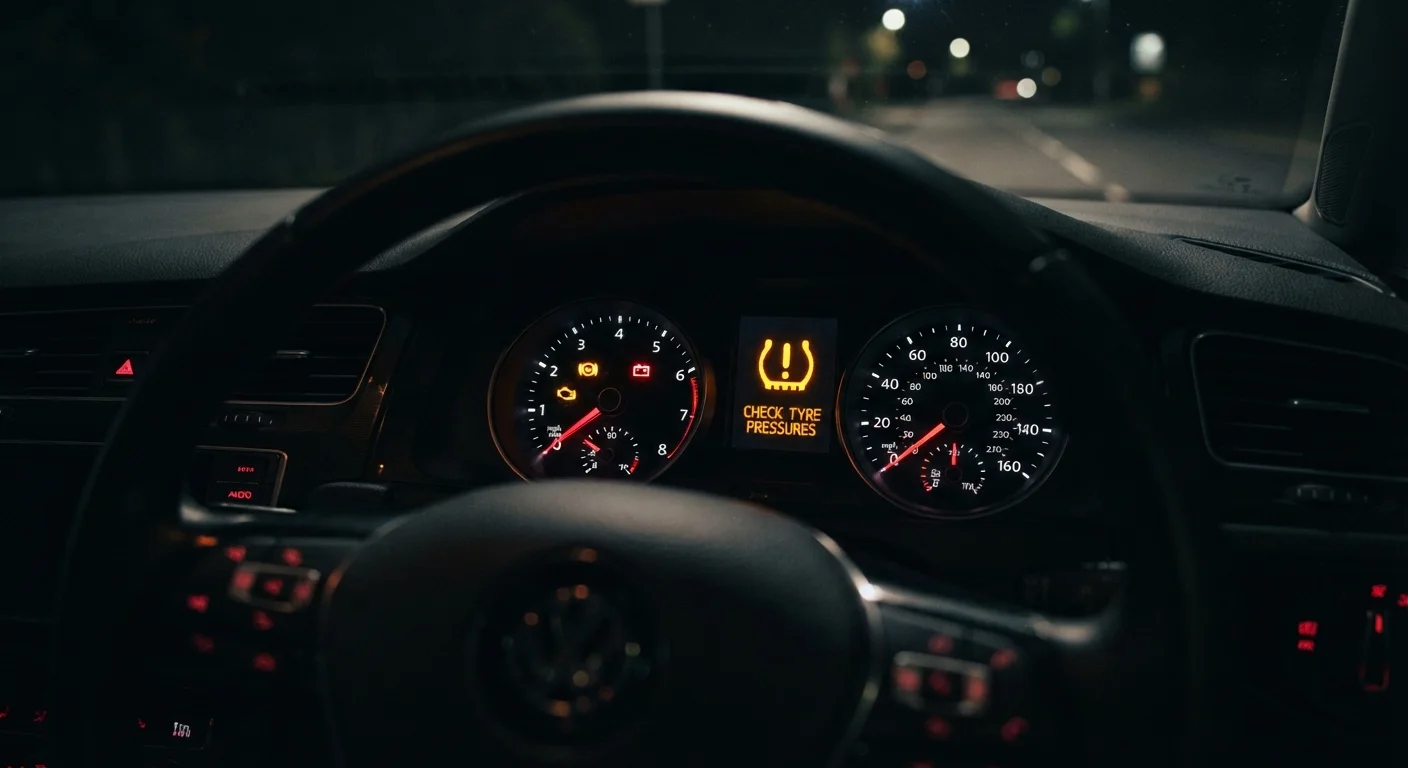
The Tyre Pressure Monitoring System (TPMS) became federally mandated on all new passenger vehicles sold in the US after September 2007. Its job is straightforward: alert you when tyre pressure drops to a level that could compromise safety or fuel efficiency. But the light doesn't always mean the same thing, and misreading it can lead to either unnecessary panic or dangerous inaction.
There are two distinct signals to recognize:
- Solid amber light: One or more tyres have dropped to approximately 25% below the vehicle manufacturer's recommended inflation level. This is the most common scenario and requires prompt attention.
- Flashing light (then steady): If the light blinks rapidly for 60-90 seconds when you start the car before going solid, this typically indicates a sensor fault - not a pressure problem. The system itself needs service.
Recommended tyre pressure figures are printed on the driver's door jamb sticker and in the owner's manual - not on the tyre sidewall, which shows the tyre's maximum pressure, a different figure entirely.
For a broader look at how dashboard warning symbols are categorized by urgency and color, see our guide to dashboard warning lights.
Check All Four Tyres, Not Just One
TPMS alerts are triggered when any single tyre drops sufficiently low, but that doesn't mean only one tyre needs attention. Temperature changes and gradual leaks can affect multiple tyres simultaneously. Make it a habit to check all four whenever the light appears - and consider checking pressures monthly as a preventive measure regardless of warning lights.
Why Conditions Can Trigger a False Alarm
Temperature plays a significant role in tyre pressure. As a general rule, tyre pressure drops roughly 1 PSI for every 10°F decrease in ambient temperature. On a cold morning after a warm spell, your TPMS light may illuminate even though no air has actually escaped. Once the tyres warm up after a few miles of driving, the pressure may recover and the light may turn itself off.
This is normal behavior - but it doesn't mean you should ignore it entirely. Use it as a prompt to check pressures manually with a gauge on your next stop. If pressures are within range and the light goes out, no further action is needed. If it stays on, the pressure genuinely needs attention.
Don't Rely Solely on the TPMS Light
TPMS is a safety backup, not a replacement for routine pressure checks. The system only activates once pressure is already significantly low. A tyre can be 10-15 PSI underinflated - enough to affect handling and fuel economy - without triggering the warning light. Check tyre pressures manually at least once a month and before long highway trips.
How to Respond to a TPMS Warning: Step by Step
The moment the TPMS light appears, follow a structured response rather than guessing. Here's the recommended sequence:
Note how the light is behaving
Before doing anything else, observe whether the TPMS light is solid or flashing. A solid light points to a pressure issue; a flashing light suggests a sensor fault. This distinction determines your next action. Check your owner's manual to confirm how your specific vehicle displays each scenario.
Pull over safely and do a visual tyre inspection
When it is safe to do so, exit the road and park. Walk around the vehicle and visually inspect all four tyres. Look for obvious deflation (a tyre sitting lower than the others), visible damage such as a nail or screw embedded in the tread, or sidewall bulges. Do not attempt to drive further on a visibly flat or bulging tyre.
Check tyre pressure with a gauge
Use a handheld tyre pressure gauge to measure the pressure in all four tyres - and the spare if your vehicle has one. Compare each reading against the recommended pressure printed on the driver's door jamb sticker. Note which tyres are low and by how much. A tyre at 25% below specification is the TPMS threshold; tyres below 50% of spec are in dangerous territory.
Inflate tyres to the correct pressure
Add air at a petrol station pump or with a portable inflator until each tyre reaches the door-jamb specification. Do not use the maximum pressure figure from the tyre sidewall - that is the tyre's structural limit, not the vehicle manufacturer's recommended operating pressure. Re-check with your gauge after inflating, as pumps vary in accuracy.
Drive briefly and confirm the light clears
After inflating all tyres, drive at normal road speeds for up to 10 minutes. The TPMS system needs time to sample new pressure data from the sensors and confirm the readings. On most vehicles, the light will turn off automatically once pressures are verified as acceptable. If the light remains on after 10-15 miles, recheck pressures and consult a professional.
If the light continues to return after you've inflated the tyres correctly, the causes go deeper than a simple pressure top-up. Learn why the TPMS light keeps coming back on and when it signals a more serious issue.
When the Warning Is a Blowout Risk - Not Just Low Air
Most TPMS activations are routine - a slow leak, temperature shift, or overdue inflation check. But some situations call for immediate action rather than a plan to deal with it later.
Pull over safely and do not continue driving if you notice any of the following alongside the warning light:
- The vehicle is pulling noticeably to one side
- Steering feels unusually heavy or vague
- You can hear or feel a rhythmic thumping from one corner of the car
- The ride height on one corner appears lower than the others
These physical symptoms suggest a tyre may already be severely underinflated or structurally compromised. Continuing to drive on a significantly underinflated tyre generates excess heat in the sidewall, which can lead to sudden tyre failure. This is a situation where stopping promptly and calling for roadside assistance is the appropriate response - not inflating and continuing.
Never Drive on a Compromised Tyre
If physical symptoms such as pulling, thumping, or visible deflation accompany the TPMS light, stop the vehicle as soon as it is safe to do so. Driving even short distances on a severely underinflated or damaged tyre can cause irreversible sidewall damage and sudden tyre failure at speed. Call roadside assistance or change to your spare - do not attempt to inflate and continue driving without first identifying the cause.
Understanding how to distinguish urgent from non-urgent warnings is a skill worth building across all dashboard alerts. The same principles that apply here apply to warnings like the check engine light and oil pressure alerts. Context and physical symptoms together tell the complete story.