

Key Takeaways
Factory Maintenance Schedule
A factory maintenance schedule is a manufacturer-prescribed timetable that specifies which service tasks - such as oil changes, filter replacements, and fluid checks - should be performed on your vehicle and at what mileage or time intervals. It is built around the engineering specifications of your exact engine and drivetrain. Following it helps preserve reliability, fuel efficiency, and warranty coverage.
Most modern vehicles use a dual-track schedule: a 'normal' interval for typical driving conditions and a 'severe' interval for stop-and-go traffic, towing, extreme temperatures, or dusty environments - the severe schedule typically calls for more frequent service.
What a Maintenance Schedule Actually Is
A factory maintenance schedule is a structured list of service tasks tied to specific mileage milestones or time intervals - whichever arrives first. Every automaker engineers one for each vehicle model, based on the tolerances of its engine, transmission, and supporting systems. It tells you not just what needs attention, but when.
Tasks on a typical schedule fall into three categories:
- Replacement items: Engine oil and filter, air filter, cabin air filter, spark plugs, and timing belt (where applicable).
- Fluid checks and exchanges: Coolant, brake fluid, transmission fluid, and power steering fluid.
- Inspection items: Brake pad thickness, tire tread and pressure, belts, hoses, and battery condition.
The schedule is not a suggestion - it reflects the engineering margins built into your specific powertrain. Ignoring it does not make those margins disappear; it simply erodes them faster.
Dealer-Recommended vs. Factory-Required
Service advisors at dealerships may recommend additional services not listed in the factory schedule - fuel system cleanings, transmission flushes, or coolant exchanges at intervals shorter than specified. These upsells are not inherently harmful, but they are not the same as manufacturer-required maintenance. When in doubt, compare any recommendation directly against your owner's manual.
How to Read the Schedule in Your Owner's Manual
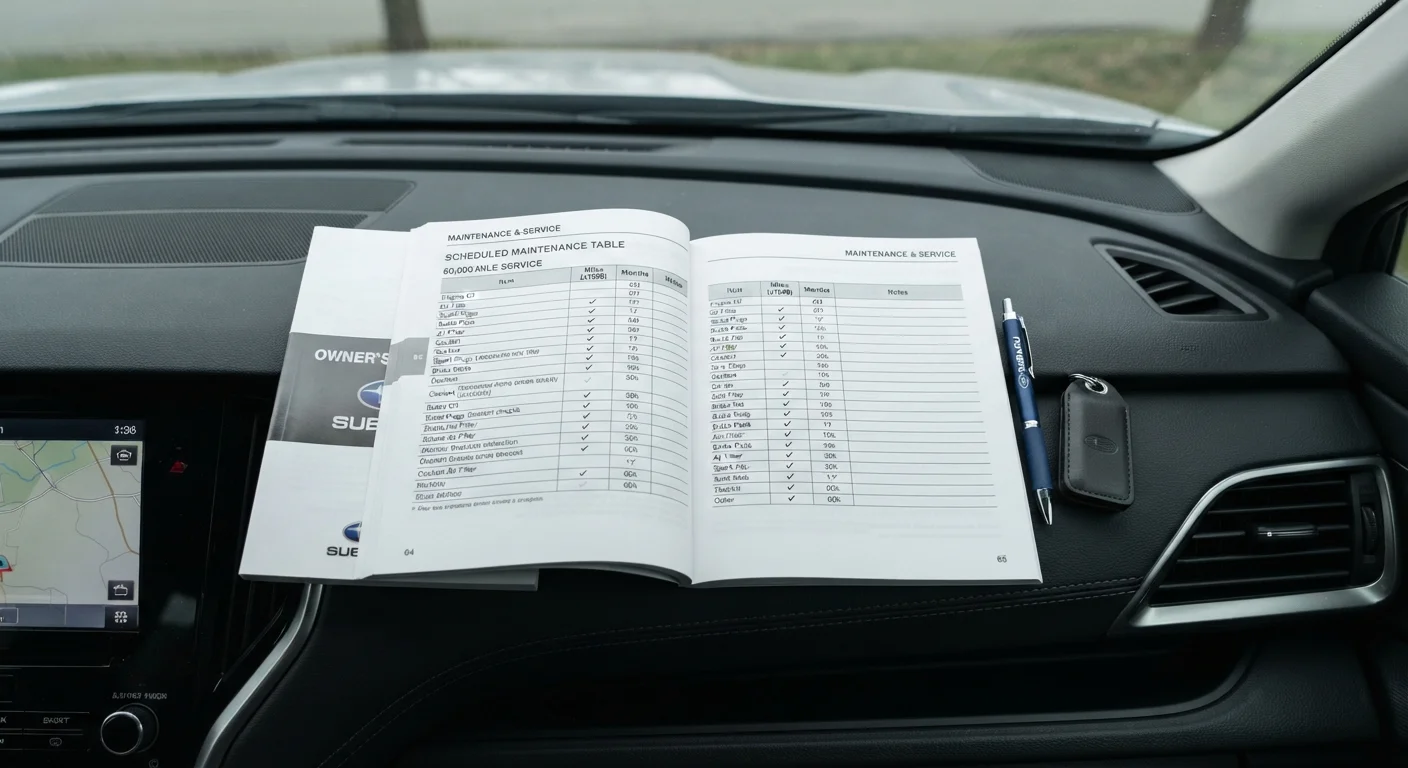
Open your owner's manual to the maintenance or scheduled service section. You will typically find a table organized by mileage intervals - commonly every 5,000, 7,500, 15,000, or 30,000 miles - with columns indicating which tasks apply at each point. Some manuals also include a time-based column (e.g., every 12 months), which applies if you drive fewer miles than the mileage trigger.
Two schedules are usually printed side by side: one for normal conditions and one for severe conditions. Read the definitions for each carefully - the manufacturer's definition of 'severe' often includes everyday urban commuting. For a deeper walkthrough of this section, see how to read your owner's manual's maintenance section.
Many vehicles built in the last decade also include a Maintenance Reminder System (sometimes called an Oil Life Monitor or Service Due indicator) that calculates service needs based on actual driving data. This system can complement the printed schedule, but it does not replace it - some items, such as tire rotations and brake inspections, may not trigger a dashboard alert.
Keep a Simple Service Log
Record every service - date, mileage, and task performed - in a notebook kept in your glove box or in a notes app. This log helps you track what's due next, provides proof of maintenance for warranty purposes, and can increase resale value by demonstrating consistent upkeep to a prospective buyer.
Mileage, Time, and Driving Conditions
Every scheduled service item has two triggers: a mileage figure and a time period. The rule is always to act on whichever arrives first. A driver who covers only 5,000 miles per year should still change the engine oil at the manufacturer's specified time interval - typically 12 months - even if the mileage threshold has not been reached. Oil degrades from heat cycling, moisture absorption, and oxidation regardless of how far the car travels.
Driving conditions have an outsized effect on how quickly components wear. Frequent short trips under 5 miles are particularly hard on an engine because the oil never fully heats up to burn off moisture and combustion byproducts. If this describes your daily driving, defaulting to the severe-condition schedule is a reasonable approach.
For a milestone-by-milestone breakdown of what gets serviced and when, the scheduled maintenance guide from first service to 100,000 miles provides a comprehensive reference.
7,500-10,000 mi
Typical modern synthetic oil change interval
Many current manufacturer specifications for full-synthetic oil fall in this range, replacing the outdated 3,000-mile guideline for most vehicles.
30,000 mi
Common interval for air filter replacement
Most factory schedules call for engine air filter inspection or replacement around 15,000-30,000 miles, though dusty driving conditions may shorten this interval.
2 years / 2 yrs
Typical brake fluid replacement interval
Many manufacturers recommend brake fluid replacement every two years regardless of mileage, as the fluid absorbs moisture from the air over time.
Why the Schedule Exists - and What Happens When You Ignore It
Automakers design maintenance schedules to match the service life of consumable components. A spark plug has a finite lifespan; a timing belt stretches and weakens over time. The schedule is calibrated so that each item is serviced just before, not after, the point at which failure risk increases meaningfully. Understanding whether your engine uses a timing belt or chain matters here - the two follow very different replacement logic. See how your timing belt or chain shapes your whole maintenance plan for context.
Neglecting the schedule has compounding consequences. Dirty oil accelerates bearing wear. A clogged air filter reduces combustion efficiency. Degraded brake fluid absorbs moisture and raises the risk of brake fade under heavy use. Beyond mechanical risk, most new vehicle warranties require documented adherence to the factory schedule. A warranty claim may be denied if a dealership can show that a required service was skipped.
Following the schedule is also one of the most cost-effective habits you can develop as a vehicle owner. Routine services cost a fraction of the component failures they are designed to prevent. For questions about which tasks you can handle yourself versus those that warrant a professional, DIY maintenance vs. workshop servicing offers a practical framework.