

Key Takeaways
Brake Fluid
Brake fluid is a hydraulic fluid that transmits the force of your foot pressing the brake pedal through the braking system to actually slow or stop your vehicle. It lives in a sealed reservoir under the hood and travels through brake lines to the calipers and wheel cylinders. Because it is hygroscopic - meaning it gradually absorbs moisture from the surrounding air - it degrades over time even without a visible leak.
Most passenger vehicles in the US use glycol-based brake fluid classified as DOT 3, DOT 4, or DOT 5.1; these grades differ primarily in their dry and wet boiling points, which determine how well they resist vapor lock under heat.
Why Brake Fluid Gets Overlooked
Oil changes, tire rotations, and air filter swaps are the maintenance tasks most drivers know by heart. Brake fluid rarely makes the mental checklist - and for understandable reasons. It doesn't burn off during normal operation, the reservoir is hidden under the hood, and the system is sealed. Nothing obviously announces that it needs attention.
Yet brake fluid quietly degrades with every passing month. Its hygroscopic nature means it pulls moisture from the air through microscopic permeation in rubber brake hoses. That absorbed water lowers the fluid's boiling point, increasing the risk of vapor lock - a condition where the fluid boils under hard braking, creating compressible gas bubbles in the lines and drastically reducing braking force.
Skipping this service is one of the maintenance habits that quietly shorten a car's life. The cost of a fluid flush is a fraction of what brake system repairs can run if components are damaged by contaminated fluid.
DOT Rating and Compatibility Matter
Always use the brake fluid grade specified in your owner's manual - typically DOT 3, DOT 4, or DOT 5.1 for most US passenger vehicles. Using a lower-rated fluid or mixing incompatible types can reduce system performance. DOT 5 (silicone-based) is not compatible with the glycol-based fluids used in most standard vehicles and should never be mixed with them.
How Moisture Contamination Happens
Brake systems are designed to be closed, but they are not perfectly sealed from the environment. Rubber hoses and seals are slightly permeable, and every time the reservoir cap is opened - during a top-off or inspection - humid air enters. Over two to three years of average driving, the water content in brake fluid can rise enough to reduce its boiling point by 100°F or more.
The consequences extend beyond vapor lock. Water in the system accelerates corrosion inside brake calipers, wheel cylinders, and the master cylinder. This internal corrosion can cause those components to seize or leak, turning a simple fluid flush into a much larger repair. For a deeper look at how the complete stopping system can be affected, see our guide on brake pads, rotors, and calipers.
100°F+
Boiling point drop in aged brake fluid
Industry testing has shown that brake fluid with around 3% water content can lose over 100°F of boiling point margin compared to fresh fluid.
2-3 years
Typical manufacturer-recommended flush interval
Many vehicle manufacturers specify a brake fluid replacement interval of two to three years, independent of mileage driven.
What Checking Brake Fluid Actually Involves
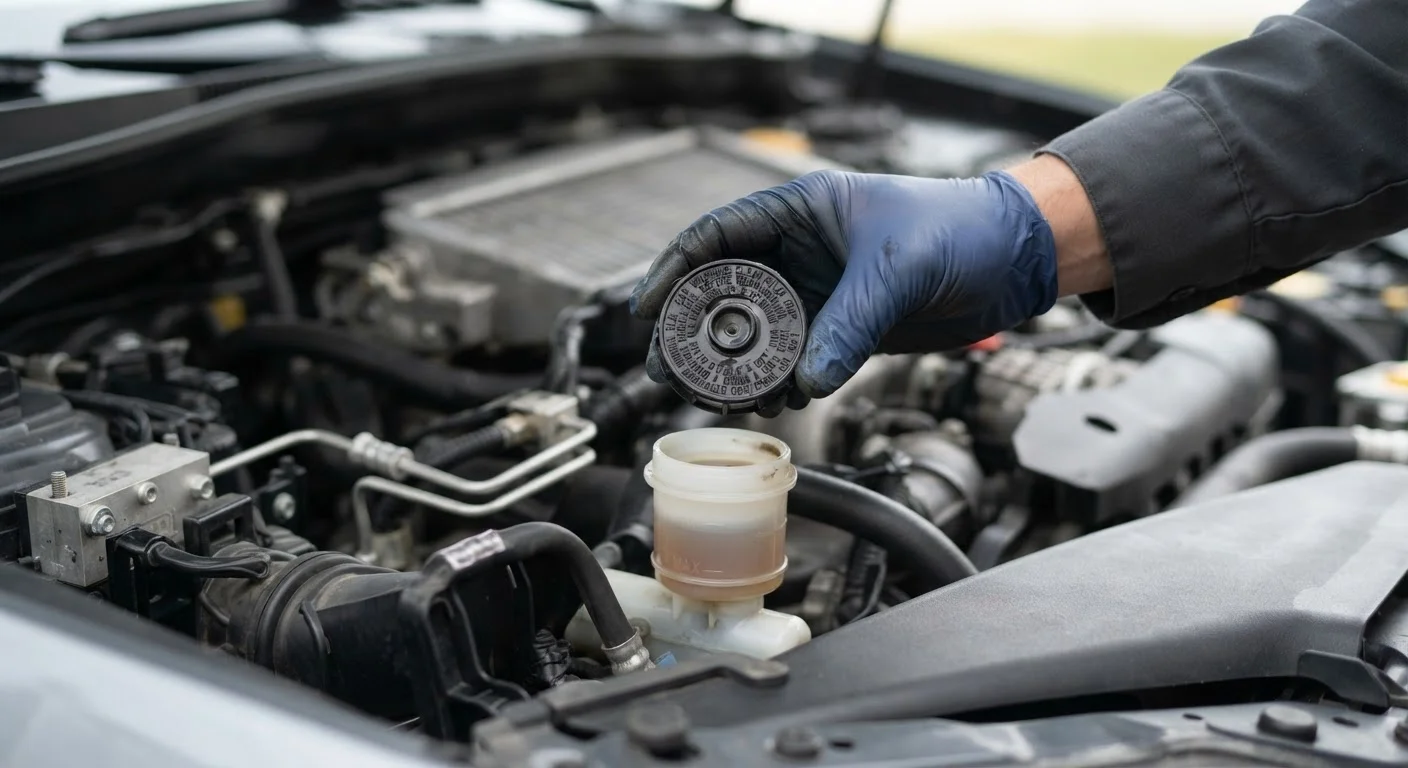
A basic brake fluid check is a visual inspection that takes less than two minutes. The reservoir is a small translucent plastic tank on top of the master cylinder, typically labeled and located near the firewall on the driver's side. Without removing the cap, you can observe two things: the fluid level against the MIN and MAX lines on the side of the reservoir, and the fluid's color through the translucent plastic.
Fresh fluid appears nearly clear or light yellow. Fluid that has turned amber to dark brown has absorbed significant moisture. Some repair shops use inexpensive test strips or electronic testers that measure moisture content more precisely - this is a useful check to request during any routine service visit.
If the level is low without a known recent brake service, that warrants investigation. It can indicate worn brake pads (which are expected to consume fluid as they wear) or a leak somewhere in the system. Our colour-by-colour guide to fluid leaks can help you identify what you might find underneath the vehicle.
Build the Check Into an Existing Habit
The easiest way to remember brake fluid is to check it at every oil change interval - that's roughly every three to six months for most drivers. A quick glance at the reservoir color and level takes under a minute. If the fluid looks dark or the level is dropping without a recent brake service, flag it for your mechanic.
When and How Often to Flush
Most vehicle manufacturers recommend a brake fluid flush every two to three years or roughly every 30,000 miles - whichever comes first. Your owner's manual is the authoritative source for the interval specific to your vehicle. Some European manufacturers specify shorter intervals, particularly for high-performance models that generate more braking heat.
During a flush, a technician purges the old fluid from the entire hydraulic circuit - calipers, lines, and master cylinder - and replaces it with fresh fluid meeting the grade your vehicle requires. This is distinct from a simple top-off, which only addresses level without removing degraded fluid. For a parallel example of this distinction in another fluid system, see our explainer on coolant flush vs. top-up.
If you notice a spongy pedal, longer stopping distances, or other brake warning signs, don't wait for the scheduled interval - have the system checked promptly by a qualified mechanic. Brake maintenance is safety-critical and is best performed by a professional if you are unfamiliar with hydraulic systems.
Making brake fluid part of your regular under-hood routine pays off. The monthly fluid check routine is a practical place to build this habit alongside coolant, power steering, and washer fluid checks.