

Key Takeaways
Auto Liability Coverage
Auto liability coverage pays for injuries and property damage that you cause to other people in a car accident. It does not pay for your own injuries or repairs to your own vehicle. Almost every state requires drivers to carry a minimum amount of liability coverage as a condition of legally operating a vehicle.
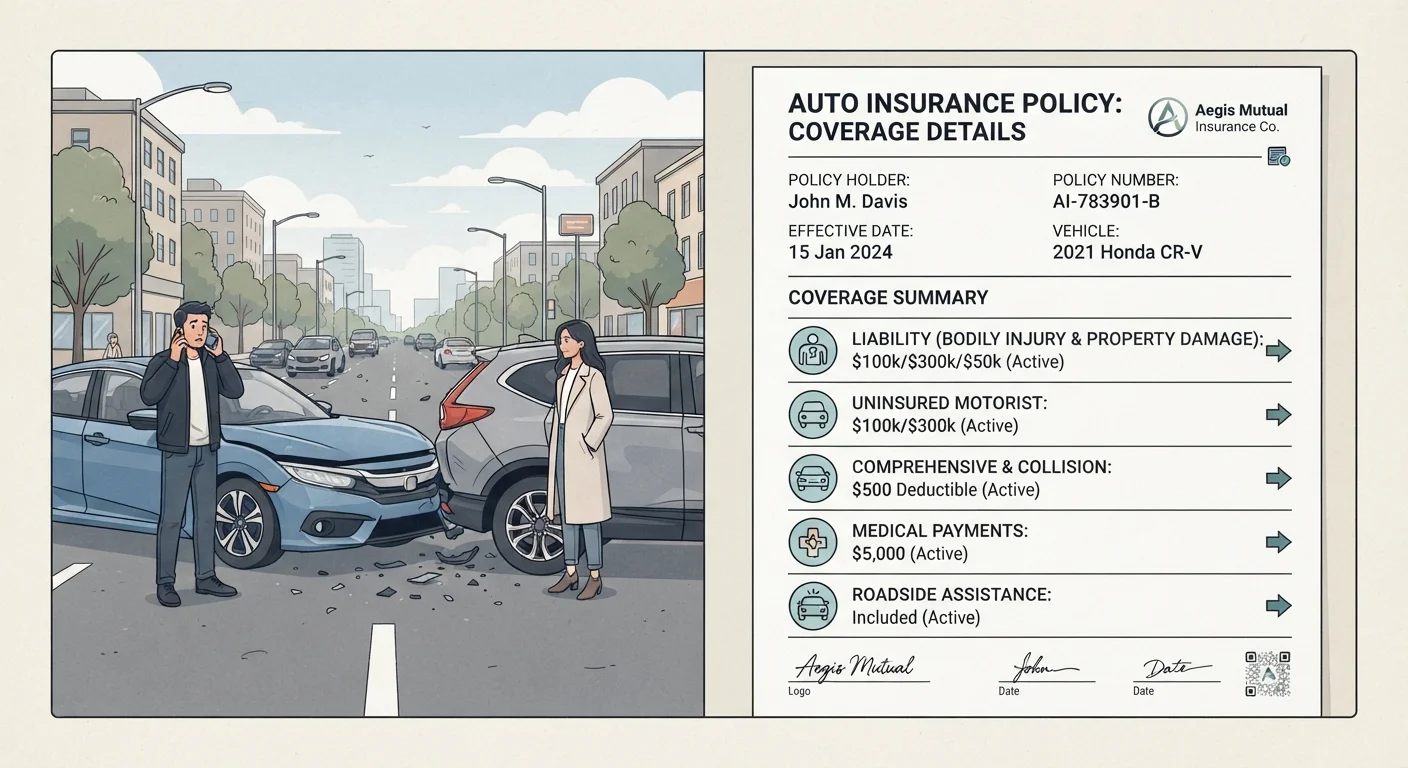
Liability coverage is typically expressed as three numbers (e.g., 25/50/25), representing per-person bodily injury limits, per-accident bodily injury limits, and property damage limits - all in thousands of dollars.
The Two Parts of Liability Coverage
Liability coverage has two distinct components, and understanding each one helps clarify both what you're protected from - and where the gaps are.
Bodily injury liability (BI) pays for medical expenses, lost wages, and in some cases pain and suffering for other people injured in an accident you caused. This includes the occupants of other vehicles, pedestrians, and cyclists. It can also cover your legal defense costs if the injured party sues you.
Property damage liability (PD) pays to repair or replace property belonging to others that you damage. The most common scenario is damage to another driver's vehicle, but it also extends to fences, guardrails, storefronts, and other structures.
Together, these two coverages form the backbone of virtually every auto insurance policy. For a broader look at how liability fits alongside other coverage types, see our overview of auto insurance coverage types.
49 of 50
States requiring minimum liability coverage
Nearly every U.S. state mandates that drivers carry a minimum level of liability insurance as a condition of vehicle registration or licensure.
$15,000
Lowest per-person bodily injury minimum in some states
Some states set their minimum bodily injury liability limit as low as $15,000 per person - an amount that can be quickly exhausted in a serious accident.
~38%
Drivers who carry only minimum required coverage
According to industry surveys, a significant share of insured drivers carry only state-minimum liability limits, leaving potential gaps in financial protection.
What Liability Coverage Does Not Pay For
One of the most persistent misunderstandings among drivers is believing that carrying insurance means they're covered for everything. Liability coverage is deliberately one-directional - it protects others from you, not you from accidents.
- Your own vehicle damage - If you cause a crash, collision coverage pays for your car repairs, not liability.
- Your own medical bills - These may be addressed by Personal Injury Protection (PIP) or Medical Payments (MedPay) coverage, depending on your state and policy. See how PIP and MedPay compare for more detail.
- Intentional damage - No standard liability policy covers damage you cause deliberately.
- Business use - Standard personal auto liability typically does not extend to commercial activities like ridesharing or delivery without a specific endorsement.
- Damages beyond your policy limits - Your insurer pays only up to the limit you purchased. Anything beyond that is your personal financial exposure.
Liability Doesn't Follow the Driver Everywhere
Personal auto liability coverage generally applies to personal use of your vehicle. If you use your car for business purposes - including app-based ridesharing or delivery services - your standard liability policy may not respond to a claim that occurs during that commercial activity. A rideshare endorsement or commercial auto policy may be required. Confirm the details with your insurer or a licensed agent.
Drivers who rely solely on state minimum liability limits are often underinsured for serious accidents. Understanding the gap between minimums and meaningful coverage is an important next step.
How Policy Limits Shape Your Real-World Exposure
Liability limits are typically written as three numbers - for example, 50/100/50. This means $50,000 per person for bodily injury, $100,000 per accident for bodily injury, and $50,000 for property damage. These caps are the maximum your insurer will pay, regardless of the actual damages incurred.
In a serious multi-vehicle crash, medical costs and repair bills can climb well into six figures. If you carry the state minimum - which in some states is as low as $15,000 per person for bodily injury - the gap between your coverage and the actual judgment could fall directly on your personal finances.
Understanding how policy limits work is essential before choosing coverage amounts. And if you want to compare how liability interacts with other core coverages, this breakdown of liability, collision, and comprehensive provides useful context.
“Liability limits are the single most consequential choice on an auto policy. Drivers often pick the minimum to save money on premiums, not realizing that in a serious accident, the savings can be dwarfed by the personal financial exposure that follows.”
— J. Robert Hunter, Former Insurance Commissioner and consumer advocate, Insurance Institute
This article provides general educational information about auto insurance liability coverage and is not a substitute for personalized advice from a licensed insurance agent. Coverage terms, limits, exclusions, and state requirements vary by provider and location. Always read your policy documents carefully and consult a licensed professional with questions about your specific situation.