

Key Takeaways
Policy Limit
A policy limit is the maximum dollar amount your auto insurance company will pay for a covered claim. Once a loss exceeds that cap, you are personally responsible for the remaining costs. Limits apply separately to different coverage types - such as bodily injury liability, property damage liability, and collision - and are spelled out clearly in your declarations page.
Liability limits are often expressed as a split format (e.g., 50/100/50), representing per-person bodily injury, per-accident bodily injury, and property damage maximums in thousands of dollars, respectively. A combined single limit (CSL) merges these into one pool.
How Policy Limits Are Structured
Every auto insurance policy includes multiple coverage sections, and each section carries its own limit. These aren't global caps - they work independently. Understanding how they're organized is the first step toward evaluating whether you're adequately covered.
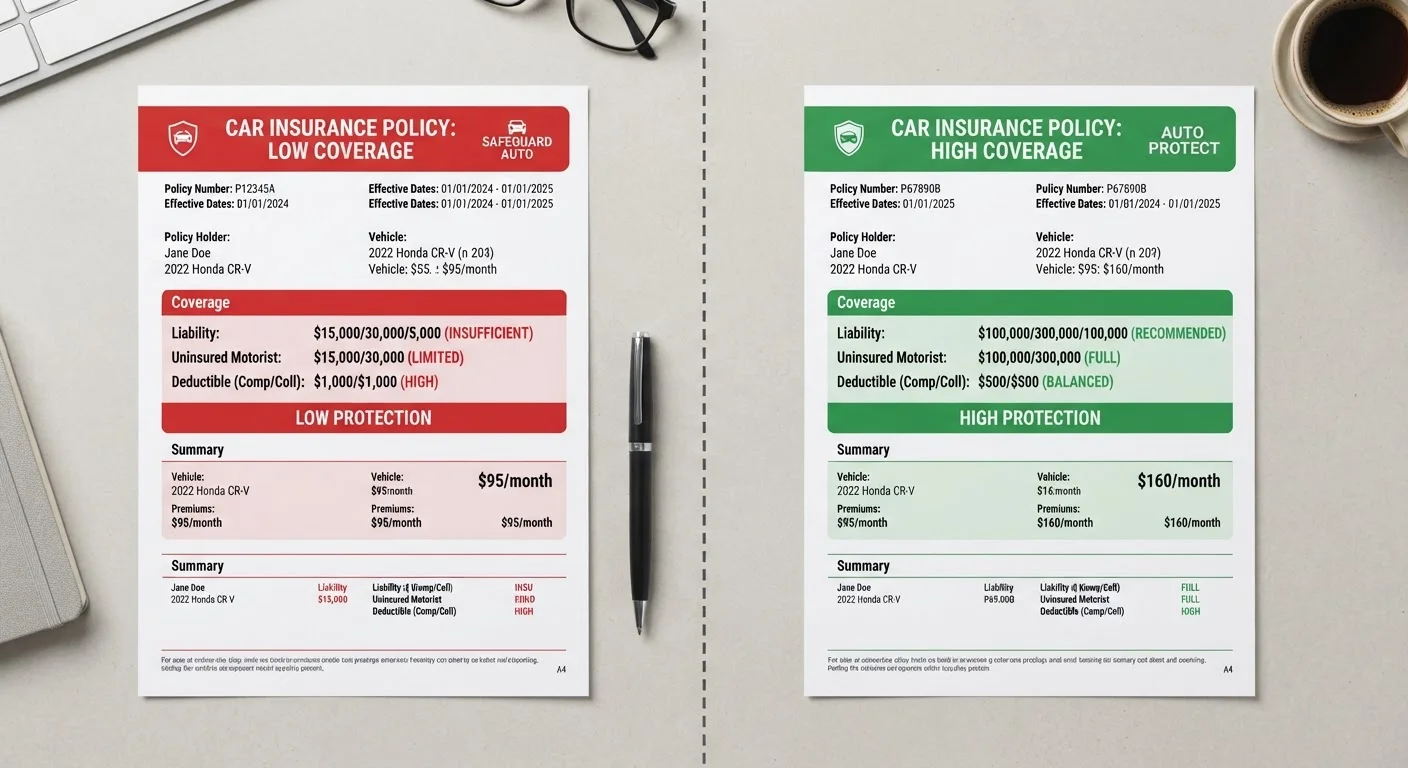
Liability coverage, which pays for injuries and property damage you cause to others, typically uses a split limit format. A common example: 100/300/100 means up to $100,000 per injured person, $300,000 per accident for all bodily injuries combined, and $100,000 for property damage. Some policies instead use a combined single limit (CSL), which pools these into one figure and offers more flexibility in how the money is allocated across a claim.
Collision and comprehensive coverage - which pay for damage to your own vehicle - carry separate per-occurrence limits, usually tied to the vehicle's actual cash value rather than a fixed dollar amount. Medical payments coverage and uninsured motorist coverage each have their own caps as well.
For a full breakdown of how each coverage section is organized within a policy, see Auto Insurance Policies, Decoded.
Declarations Page: Your Limit Summary
Your policy's declarations page (often called the 'dec page') lists every coverage type and its corresponding limit in one place. It's the fastest way to get a snapshot of how your protection is structured. Reviewing it at each renewal - or after any major life change - takes only a few minutes and can surface coverage gaps before they become expensive problems. See Reviewing Your Auto Insurance Policy for what to look for in each section.
Why Low Limits Create Real Financial Risk
State minimum liability limits exist to ensure every driver carries at least some coverage. But those minimums were often set decades ago and haven't kept pace with the rising costs of medical care, vehicle repair, and legal settlements. A serious accident - one involving injuries requiring surgery, extended rehabilitation, or multiple vehicles - can generate costs that dwarf minimum limits in a matter of hours.
When damages exceed your policy limit, you personally owe the difference. Depending on the state, an injured party can pursue a civil judgment against you, which may lead to wage garnishment, bank account levies, or liens on property. Choosing a limit based purely on premium cost without considering this exposure is a common and potentially costly miscalculation.
$24,000+
Average injury claim cost in auto accidents
According to the Insurance Research Council, the average bodily injury liability claim regularly exceeds many state minimum limits.
38 states
States with bodily injury minimums below $30,000 per person
Most U.S. states set minimum liability thresholds that were established before modern medical and vehicle costs, leaving significant coverage gaps.
Bodily injury liability deserves particular scrutiny. Emergency room visits, specialist care, lost wages for the injured party, and pain-and-suffering damages all factor into settlement amounts. Property damage limits matter too - newer vehicles are expensive to repair or replace, and a single-car impact in a parking lot can easily exceed a $10,000 property damage limit.
To understand exactly what liability coverage pays for and where its boundaries lie, Liability Coverage: What It Pays For and What It Doesn't offers a detailed walkthrough.
Choosing Limits That Match Your Exposure
Setting policy limits isn't one-size-fits-all. A useful starting point is to consider what you stand to lose if a judgment is entered against you. If your assets - savings, home equity, retirement accounts - exceed your liability limits, the gap between those two figures represents unprotected exposure.
Several principles can guide the decision:
- Match or exceed your net worth with your total liability coverage where possible.
- Consider an umbrella policy if you want protection beyond standard auto liability limits - umbrella policies extend liability coverage across multiple policies.
- Don't treat limits as fixed forever. Life changes - a home purchase, a salary increase, adding a teen driver - can shift your risk profile and warrant a coverage review.
Ask About Umbrella Coverage
If you want liability protection well above standard auto limits, a personal umbrella policy can provide an additional layer - typically starting at $1 million - that kicks in after your underlying auto limits are exhausted. Umbrella policies are a separate product with their own eligibility requirements; a licensed agent can explain whether one is appropriate for your circumstances.
A licensed insurance agent can help you model different limit scenarios against your specific financial picture. Keep in mind that coverage terms, pricing, and availability vary by insurer and state, so the right limit for one driver may differ substantially for another.
Before your next renewal, use our coverage review checklist to verify that each limit in your policy still reflects your needs. For a deeper look at how to think through coverage levels holistically, Building a Balanced Auto Insurance Policy covers the key principles.
This article provides general educational information about auto insurance concepts and is not personalized insurance, financial, or legal advice. Coverage terms, limits, exclusions, and regulations vary by provider and state. Always read your actual policy documents and consult a licensed insurance agent or adviser for guidance specific to your situation.