

Key Takeaways
Our Verdict
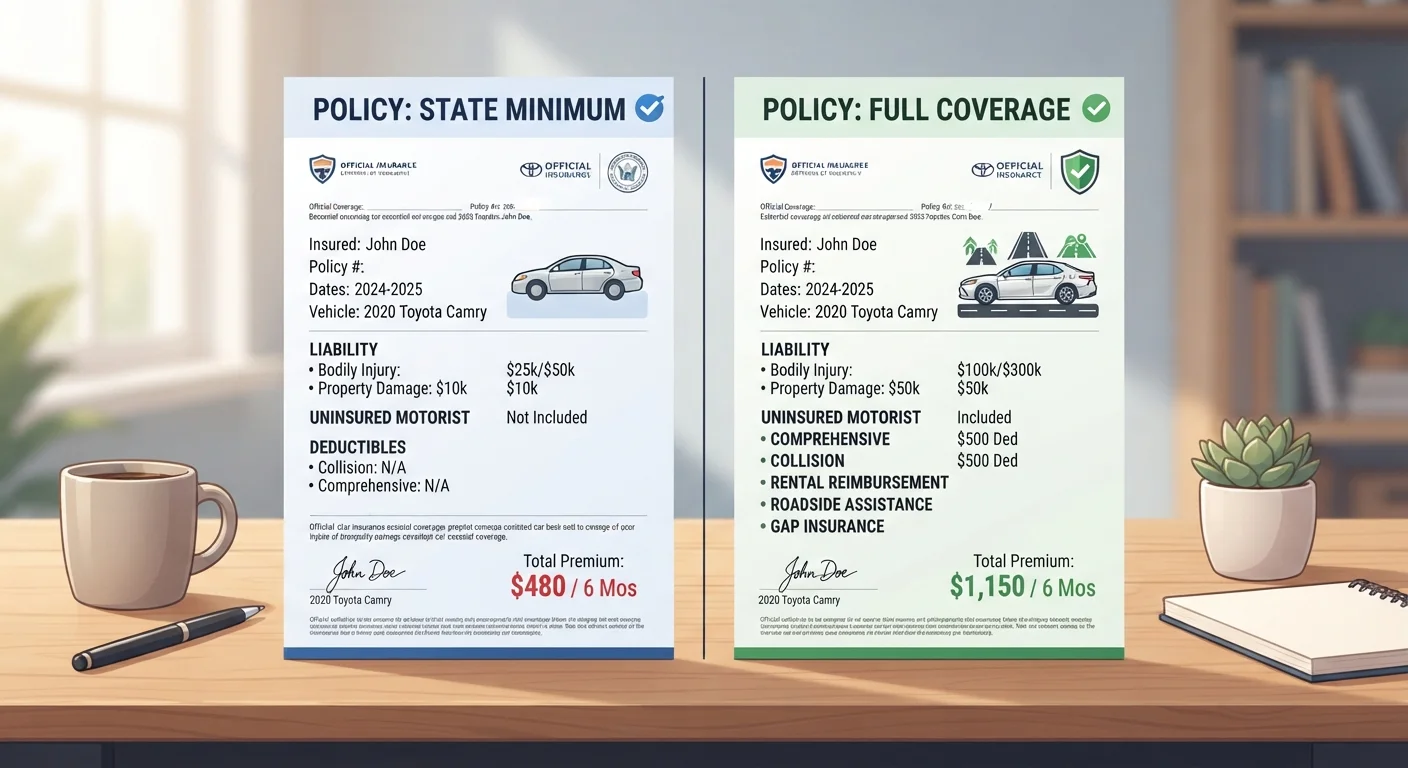
State minimum coverage satisfies legal requirements but offers limited financial protection if you cause a serious accident or your vehicle is damaged. What the industry calls 'full coverage' adds meaningful protection for your own car, but the term is not standardized - you must review actual policy documents to know what you're getting. Neither choice is universally right; the decision should reflect your vehicle's value, your savings, and the assets you need to protect.
| Best for | Recommended |
|---|---|
| Drivers with older, low-value vehicles and strong emergency savings | State Minimum Coverage |
| Drivers with newer or financed vehicles and assets to protect | Full Coverage (Collision + Comprehensive + Liability) |
| Those seeking protection against uninsured or underinsured drivers | Adding UM/UIM to either base policy |
What State Minimum Coverage Actually Means
Every U.S. state (except New Hampshire, which has unique rules) requires drivers to carry a minimum level of auto insurance. These mandated minimums are almost always liability-only coverage, meaning they pay for harm you cause to other people - not for damage to your own vehicle.
Liability coverage splits into two components: bodily injury liability, which pays for medical expenses and related costs if you injure someone in an at-fault accident, and property damage liability, which covers damage you cause to another person's vehicle or property. Minimums are expressed as split limits - for example, 25/50/25 means $25,000 per injured person, $50,000 per accident, and $25,000 for property damage. See our detailed breakdown of liability coverage for more on how these limits operate.
State minimums vary significantly by state. Some require uninsured motorist (UM) or personal injury protection (PIP) coverage as well. But the common thread is what's not included: no protection for your own car if it's stolen, damaged in a storm, or wrecked in a collision you caused.
Minimum Limits May Fall Far Short
A minor collision involving medical treatment can easily exceed a state's minimum bodily injury limit. When costs surpass your policy limits, you may be personally liable for the remainder. Selecting limits only because they are the legal minimum - without considering your actual financial exposure - can leave significant gaps in your protection.
What 'Full Coverage' Actually Means - and Doesn't
'Full coverage' is not a term defined by any insurance regulation or policy standard. It is shorthand commonly used by drivers, lenders, and even agents to describe a policy that pairs liability with collision and comprehensive coverage - the two types that protect your own vehicle.
- Collision coverage pays for damage to your car from a crash, regardless of fault.
- Comprehensive coverage pays for damage from non-collision events: theft, fire, hail, flooding, falling objects, and similar incidents.
Together, these three coverages (liability + collision + comprehensive) form the foundation of what most people mean by 'full coverage.' But there is no guarantee that a policy marketed this way includes medical payments, rental reimbursement, roadside assistance, or uninsured motorist protection - each of those is typically a separate add-on. For a plain-language explanation of how each coverage type functions, see what liability, collision, and comprehensive each one actually covers.
| State Minimum Coverage | Full Coverage (Liability + Collision + Comprehensive) | |
|---|---|---|
| Legally required | Yes, in most states | No, but often required by lenders |
| Covers damage you cause to others | Yes | Yes |
| Covers your vehicle in a crash | No | Yes (via collision) |
| Covers theft, weather, fire | No | Yes (via comprehensive) |
| Uninsured motorist protection | Only if state requires it | Not automatic - add-on required |
| Typical cost | Lower premium | Higher premium |
| Out-of-pocket risk if your car is totaled | Full vehicle value | Vehicle value minus deductible |
Key Gaps Drivers Often Overlook
The most significant gap in state-minimum-only policies is straightforward: your vehicle is unprotected. If you cause an accident, you pay for your own repairs out of pocket. If your car is stolen or flooded, you absorb the entire loss.
A less obvious gap affects drivers at both coverage levels: uninsured and underinsured motorist coverage. Roughly one in eight drivers on U.S. roads carries no insurance, according to estimates from the Insurance Research Council. If one of them hits you, your own liability policy offers zero help - you'd need UM/UIM coverage to recover costs. Learn how this protection works in our guide to uninsured and underinsured motorist coverage.
Even within 'full coverage' policies, deductibles matter. A $1,000 deductible on collision means you absorb the first $1,000 of every covered repair. Choosing a high deductible lowers premiums but increases out-of-pocket exposure when you file a claim.
Read the Declarations Page Carefully
Your policy's declarations page lists every coverage type, its limit, and its deductible. Before assuming you have 'full coverage,' review this page line by line. If collision, comprehensive, or UM/UIM do not appear, they are not included - regardless of what you were told at purchase. Your insurer or a licensed agent can walk you through any terms you do not recognize.
How to Think About Choosing Between Them
The right coverage level depends on several practical factors - none of which involve picking a label like 'minimum' or 'full coverage.'
- Vehicle value: If your car's market value is low, paying for collision and comprehensive may cost more over time than the coverage would ever pay out. As a general rule of thumb discussed by many financial planners, once a vehicle's value approaches a few thousand dollars, the math on comprehensive and collision becomes harder to justify - though this is a personal financial calculation, not a guarantee.
- Loan or lease requirements: Lenders and leasing companies almost always require collision and comprehensive as a condition of financing. This removes the choice until the loan is paid off.
- Asset exposure: State minimum liability limits may be far lower than the cost of a serious accident. If your assets exceed your liability limits, you could face personal financial liability for the difference. Higher limits cost more but provide a wider legal buffer.
- Risk tolerance and savings: Drivers with robust emergency funds may be more comfortable carrying a higher deductible or skipping certain add-ons. Those with limited liquidity benefit from more comprehensive protection.
For a principled framework on putting a policy together, see building a balanced auto insurance policy. And if you own multiple vehicles, consider how stacked vs. unstacked UM coverage could affect your protection.
1 in 8
U.S. drivers estimated uninsured
According to Insurance Research Council estimates, approximately 12-13% of motorists carry no auto insurance.
Varies by state
Minimum liability limits differ widely
State-mandated liability minimums range from as low as 10/20/10 in some states to substantially higher in others.
This article provides general educational information about auto insurance coverage options and is not personalized insurance, financial, or legal advice. Coverage terms, exclusions, limits, and availability vary by insurer and by state. Always read your actual policy documents and consult a licensed insurance agent or adviser to understand what your specific policy covers.