

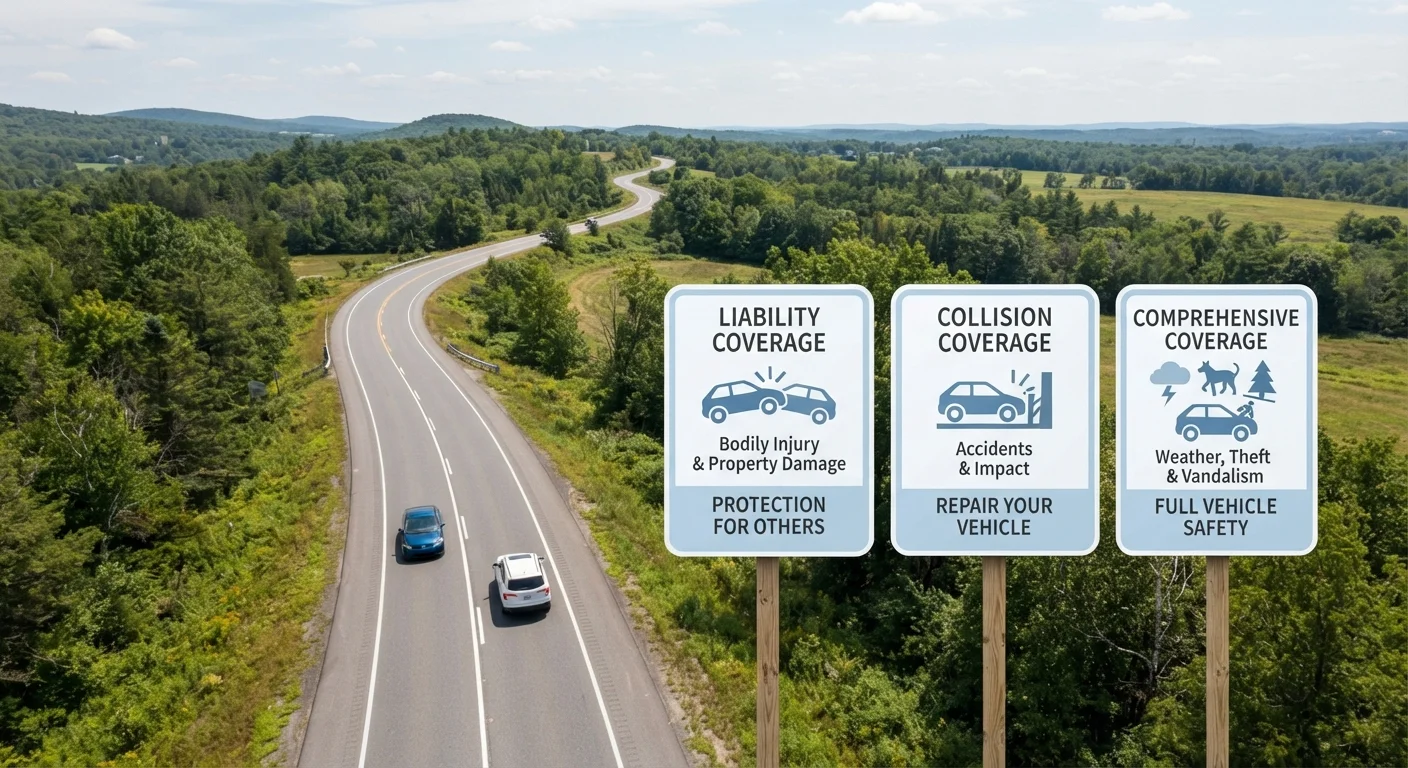
| Legal requirement | Liability coverage is required in nearly all U.S. states (Minimums vary by state) |
| Collision and comprehensive | Optional for most owners; typically required by lenders/lessors |
| Liability pays for | Other people's injuries and property damage when you are at fault |
| Collision pays for | Your vehicle after a crash, regardless of fault |
| Comprehensive pays for | Non-collision damage: theft, weather, fire, animal strikes |
| Claim payout cap | Actual cash value (ACV) of the vehicle at time of loss |
Three Coverages, Three Very Different Jobs
Most personal auto insurance policies are built on three foundational coverage types: liability, collision, and comprehensive. Drivers often treat these as interchangeable or assume one picks up where another leaves off. In practice, each covers a distinct category of loss - and the gaps between them are where financial surprises happen.
Understanding how these three work together (and separately) is the first step to knowing whether your policy actually matches your situation. For a broader look at how a full policy is structured, see how auto insurance policies are organized.
| Legal requirement | Liability coverage is required in nearly all U.S. states (Minimums vary by state) |
| Collision and comprehensive | Optional for most owners; typically required by lenders/lessors |
| Liability pays for | Other people's injuries and property damage when you are at fault |
| Collision pays for | Your vehicle after a crash, regardless of fault |
| Comprehensive pays for | Non-collision damage: theft, weather, fire, animal strikes |
| Claim payout cap | Actual cash value (ACV) of the vehicle at time of loss |
Liability Coverage: When You Cause the Damage
Liability coverage pays for harm you cause to other people and their property when you are at fault in an accident. It does not pay anything toward your own vehicle or your own medical bills.
It is divided into two components:
- Bodily injury liability (BI): Covers medical expenses, lost wages, and legal costs for people you injure. Limits are typically expressed per-person and per-occurrence (e.g., 25/50 means $25,000 per injured person, $50,000 per accident).
- Property damage liability (PD): Covers repair or replacement costs for vehicles or property you damage - another car, a fence, a storefront.
Liability coverage is legally required in nearly every U.S. state, though minimum limits vary significantly by state. Carrying only minimum limits often leaves a meaningful gap between what the policy pays and the actual cost of a serious accident. For a deeper look, see what liability coverage actually pays for.
State Minimums Are a Floor, Not a Recommendation
Every state sets its own minimum liability limits, but those minimums are often far below the cost of a serious accident. A $15,000 property damage limit, for example, may not fully cover the repair bill for a newer vehicle. Drivers who want meaningful financial protection typically carry limits well above the state-required minimum. Talking through appropriate limits with a licensed agent can help clarify what level of coverage suits your circumstances.
Collision and Comprehensive: Protecting Your Own Vehicle
Where liability ends - at your own car - collision and comprehensive begin. Both are optional in most states, though lenders and lessors routinely require them when a vehicle is financed or leased.
Collision
Collision coverage pays to repair or replace your vehicle after it is damaged in a crash - regardless of fault. That includes accidents with other vehicles, single-car rollovers, and impacts with stationary objects like guardrails or telephone poles.
Comprehensive
Comprehensive covers damage from causes that have nothing to do with driving into something. Common examples include theft, vandalism, fire, flooding, hail, falling objects, and animal strikes. If a tree branch falls on your parked car overnight, comprehensive is the coverage that applies - not collision.
Both coverages are subject to a deductible - the amount you pay out of pocket before the insurer covers the rest. Higher deductibles generally lower your premium; lower deductibles raise it. For a side-by-side comparison of how each coverage applies in real scenarios, see collision vs. comprehensive explained.
Liability coverage
Insurance that pays for injuries and property damage you cause to others in an at-fault accident. It does not cover your own vehicle or injuries.
Collision coverage
Optional coverage that pays to repair or replace your vehicle after a crash with another vehicle or object, regardless of who is at fault.
Comprehensive coverage
Optional coverage that pays for damage to your vehicle from non-collision events such as theft, fire, hail, flooding, or animal strikes.
Deductible
The fixed dollar amount you agree to pay out of pocket on a claim before your insurer covers the remaining loss. Applies to collision and comprehensive, not liability.
Actual cash value (ACV)
The market value of your vehicle at the time of loss, accounting for depreciation. Insurers use ACV - not replacement cost - when settling total-loss claims.
Bodily injury liability (BI)
A component of liability coverage that pays for medical expenses, lost wages, and legal defense costs for people you injure in a covered accident.
What None of These Coverages Includes
Even with all three in place, there are losses a standard policy will not cover. Common exclusions include:
- Your own medical costs - handled by medical payments (MedPay) or personal injury protection (PIP) coverage, where available
- Mechanical breakdowns - wear-and-tear, engine failure, and maintenance issues are not insurable events
- Custom parts or aftermarket equipment - often excluded unless a separate endorsement is added
- Rental car costs during repairs - requires rental reimbursement coverage; see what rental reimbursement and roadside add-ons cover
Policies also pay no more than the vehicle's actual cash value (ACV) - market value at the time of the loss, not replacement cost. If your car is totaled and its ACV is lower than what you owe on a loan, you may face a gap. That scenario is what gap insurance is designed to address.
Coverage terms, exclusions, and state-specific requirements vary by insurer and policy. Always read your declarations page and policy documents carefully, and consult a licensed insurance agent or adviser with questions specific to your situation.
This article is for general informational purposes only and does not constitute personalized insurance, legal, or financial advice. Coverage details, limits, and availability differ by provider and state. Consult a licensed insurance professional and review your actual policy documents before making coverage decisions.