

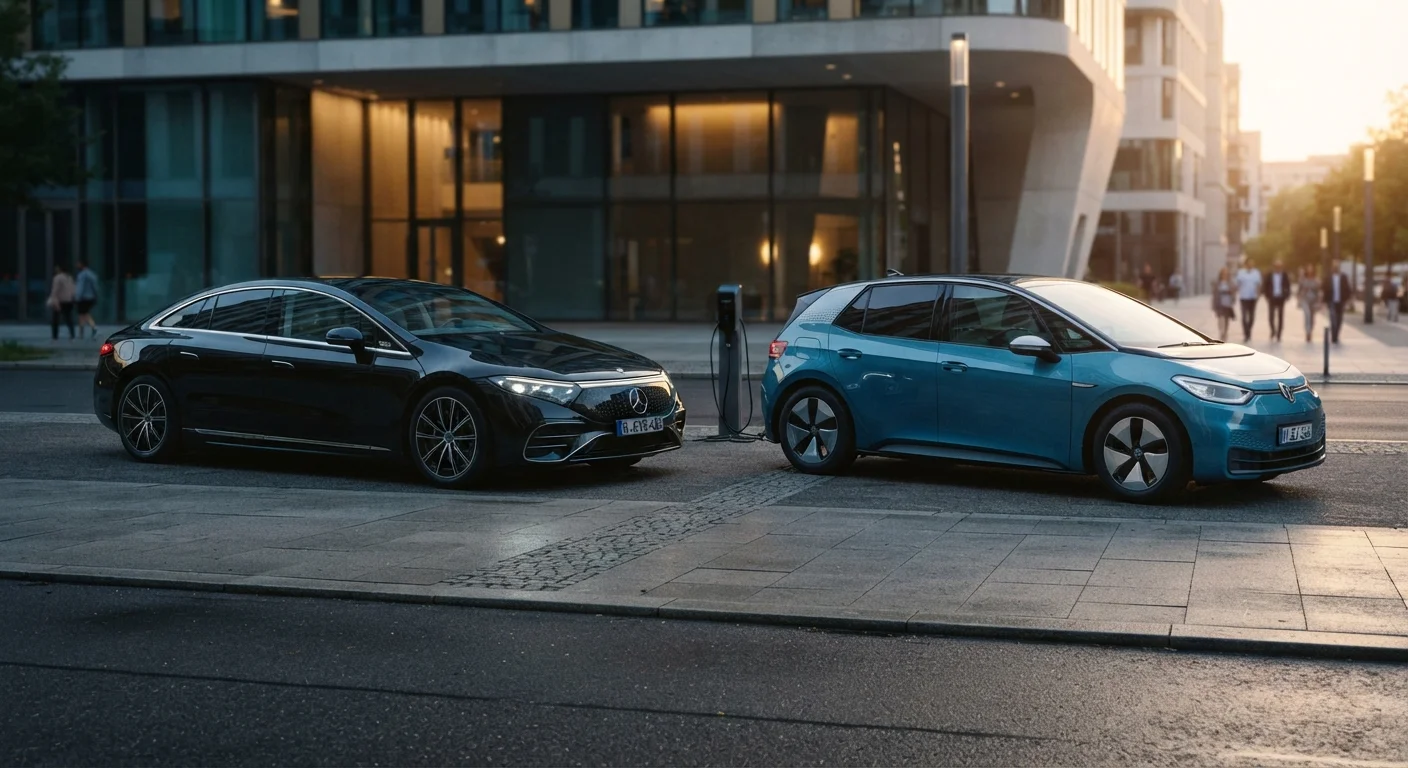
Key Takeaways
Option A
Luxury EVs
The engineered-for-refinement, premium-tier choice.
Best for: Buyers who prioritize long-range capability, superior NVH isolation, advanced materials, and a tailored ownership experience.
Option B
Mainstream EVs
The accessible, practical-first electric alternative.
Best for: Commuters and daily drivers who want reliable electric mobility with solid technology at a lower total cost of entry.
If you prioritize daily commuting efficiency on a practical budget
Mainstream EVs
Mainstream EVs cover typical commute distances reliably and offer modern tech at a lower purchase price, making them well-suited for cost-conscious daily driving.
If long interstate trips and cabin quietness matter most to you
Luxury EVs
Larger battery packs and advanced acoustic engineering make luxury EVs far more capable on extended highway drives where range buffer and interior tranquility count.
If interior materials and ride comfort are deciding factors
Luxury EVs
Premium suspension tuning, genuine leather or sustainable high-grade alternatives, and sound-deadened cabins create a substantially different ownership experience.
If you want a capable EV for urban and suburban use without premium overhead
Mainstream EVs
Mainstream models balance adequate range, solid safety ratings, and modern infotainment without the ownership complexity of the luxury segment.
Range: How Battery Architecture Separates the Two Tiers
Range remains one of the most scrutinized metrics in the EV market, and it is also one of the starkest dividing lines between luxury and mainstream vehicles. Luxury EVs commonly deploy battery packs in the 100–120 kWh range, while mainstream models typically sit between 50–82 kWh. That difference is not incidental — it reflects deliberate engineering investment in cell chemistry, thermal management, and pack integration.
Real-world range, as opposed to EPA-estimated figures, tends to track these differences faithfully. Mainstream EVs generally produce competitive range for urban and suburban commuting, but their buffer shrinks notably at highway speeds or in cold weather. Luxury platforms, by contrast, often incorporate more sophisticated battery thermal management systems that sustain efficiency across a broader temperature range.
For buyers who regularly make longer trips, the EV Range & Charging hub offers detailed guidance on how real-world range expectations should factor into your decision. Understanding that EPA figures can diverge from actual driving outcomes by 10–20% in challenging conditions is essential context before committing to either tier.
| Criterion | Luxury EVs | Mainstream EVs |
|---|---|---|
| Typical Battery Size | 100–120 kWh (common range) | 50–82 kWh (common range) |
| Real-World Range | 300–400+ miles (varies by model) | 150–300 miles (varies by model) |
| NVH Engineering Depth | Laminated glass, active noise cancel | Basic sound dampening |
| Suspension System | Air or adaptive damping standard | Fixed or basic multi-link |
| Interior Materials | Premium leather, wood, metal accents | Durable plastics, simulated textures |
| OTA Update Depth | Feature unlocks, system evolution | Bug fixes, incremental updates |
| Starting Price Range | Typically $70,000 and above | Typically $30,000–$55,000 |
Refinement: NVH Engineering and Interior Quality
The word "refinement" in automotive engineering has a precise meaning: the suppression of noise, vibration, and harshness (NVH) that intrudes into the cabin. Because electric drivetrains eliminate engine noise, road and wind noise become the dominant acoustic challenge — and this is where luxury and mainstream EVs diverge sharply.
Luxury EV manufacturers typically invest in laminated acoustic glass, additional sound-deadening layers in door panels and floor sections, and active noise cancellation systems. Mainstream models apply some of these techniques but at reduced depth, meaning wind rush and tire roar are more audible, particularly at highway speeds. The anatomy of a luxury EV interior — from door seal engineering to headliner materials — reflects this investment directly.
Interior materials reinforce the perception gap. Luxury EVs are more likely to feature open-pore wood veneers, full-grain leather or premium sustainable upholstery, and soft-touch surfaces across high-contact zones. Mainstream cabins prioritize durability and ease of cleaning, using more hard plastics and simulated textures. Neither approach is wrong, but they serve different expectations.
NVH: Why It Matters More in EVs
In combustion vehicles, engine noise masks many road and wind sounds. Electric drivetrains remove that masking effect entirely, meaning every tire roar and wind whistle becomes more perceptible. This is why NVH investment is proportionally more impactful in EVs than in equivalent ICE vehicles, and why the gap between luxury and mainstream EV cabins can feel more pronounced than in traditional segments.
Ride Quality and Suspension Philosophy
Suspension tuning is an area where mainstream and luxury EVs express fundamentally different engineering priorities. Mainstream platforms often use torsion beam rear axles or cost-optimized multi-link configurations tuned for predictability and low maintenance. Luxury EVs more frequently employ air suspension or adaptive damping systems that adjust rebound and compression rates in real time based on road inputs and speed.
The practical result is that luxury EVs can absorb pavement imperfections with a composure that mainstream models generally cannot match, while still offering dynamic handling when desired. This dual capability — boulevard comfort and confident cornering — is explored further in the comparison of performance-focused vs. comfort-focused luxury EVs.
It is worth noting that ride quality is not solely a function of suspension hardware. Tire specification matters considerably: luxury EVs often come fitted with lower-rolling-resistance tires that are also acoustically optimized, reducing cabin roar without sacrificing grip. Mainstream models may use similar tire sizes but with less acoustic engineering baked in.
10–20%
Typical real-world vs. EPA range variance
Industry analysis consistently shows EV real-world range can fall 10–20% below EPA estimates under cold weather or sustained highway driving conditions.
~$40,000
Average price gap between luxury and mainstream EVs
Based on broad US market positioning, luxury EVs typically start around $70,000 while mainstream EVs cluster between $30,000–$55,000 before incentives.
3–5 dB
Cabin noise reduction via laminated acoustic glass
Automotive acoustic engineers generally attribute a 3–5 decibel reduction in wind and road noise to laminated acoustic glass versus standard tempered glass, a common luxury EV specification.
Software, Technology, and Long-Term Ownership
Software capability is an increasingly important dimension of the luxury-versus-mainstream comparison. Over-the-air (OTA) update infrastructure exists across both segments, but luxury platforms tend to deploy it more ambitiously — unlocking new features, refining suspension maps, and expanding driver assistance capabilities post-purchase. The role of software in reshaping premium EVs is evolving rapidly, making long-term vehicle evolution a genuine differentiator.
Warranty structures also vary. Luxury EV makers sometimes offer more comprehensive battery warranty terms or concierge-level service programs, though this varies by manufacturer and should be evaluated on a model-by-model basis. Buyers considering the full ownership picture — including charging access, service availability, and resale positioning — should consult the end-to-end luxury EV buyer's reference for a structured framework.
Mainstream EVs, for their part, have made significant strides in driver assistance technology and infotainment capability, narrowing the gap with luxury tiers in pure feature counts if not in execution depth. Understanding what actually makes a car luxury beyond the badge helps buyers evaluate whether premium pricing reflects genuine engineering investment or primarily brand positioning.
This article provides general educational information about EV categories and is not a recommendation to purchase any specific vehicle. Features, specifications, and availability vary by manufacturer, model year, and region. Consult manufacturer documentation and independent automotive resources for current, model-specific details.