

Key Takeaways
Luxury Vehicle
A luxury vehicle is one that delivers a measurably superior experience across materials quality, ride refinement, noise suppression, technology integration, and personalization — beyond what the mainstream market offers. The distinction is not purely about price but about deliberate engineering choices made at every level of the vehicle. Luxury automakers invest heavily in what you see, hear, feel, and control inside the cabin.
In industry terminology, luxury vehicles often target specific NVH (Noise, Vibration, and Harshness) thresholds and use multi-layer acoustic glass, active road-noise cancellation, and premium damping compounds that are cost-prohibitive in volume segments.
Why 'Luxury' Is More Than a Marketing Label
When automakers position a vehicle as luxury, they're making a claim that touches every part of the ownership experience — not just the sticker price. Yet the word is used so broadly that it risks losing meaning. Understanding the actual criteria behind the designation helps buyers evaluate whether a vehicle genuinely delivers, or whether the badge is doing most of the work.
The luxury segment is best understood as a set of measurable engineering and design commitments. These include how the cabin sounds at highway speed, what your hand touches on every surface, how quickly and intuitively the infotainment system responds, and how precisely the suspension absorbs imperfections. Price is often a consequence of those commitments — not the definition of them.
For EV buyers specifically, the concept of luxury is evolving. Software capabilities, charging speed, and digital integration have become new axes of premium differentiation. See our exploration of how over-the-air updates are reshaping premium EVs for a closer look at how this shift is unfolding.
~$70,000
Common entry threshold for recognized luxury EV segment
Industry analysts generally place the luxury EV segment entry point around this figure, though price alone does not determine classification.
30–40%
Additional acoustic damping material in luxury vs. mainstream vehicles
Luxury vehicles typically incorporate significantly more sound-deadening material by weight compared to volume-segment equivalents, according to automotive engineering analyses.
3–5x
Display responsiveness gap between luxury and mainstream infotainment
Consumer testing and automotive media evaluations consistently find measurable latency differences between premium and volume-segment touch interfaces.
The Four Core Criteria That Define Luxury
1. NVH Engineering
Noise, Vibration, and Harshness suppression is among the most expensive and technically demanding investments a manufacturer makes. Luxury vehicles typically feature laminated acoustic glass, active road-noise cancellation, additional body deadening, and multi-stage adaptive suspension systems. The result is a cabin that feels insulated from the outside world — a silence that electric drivetrains amplify by removing engine noise from the equation entirely.
2. Material Authenticity
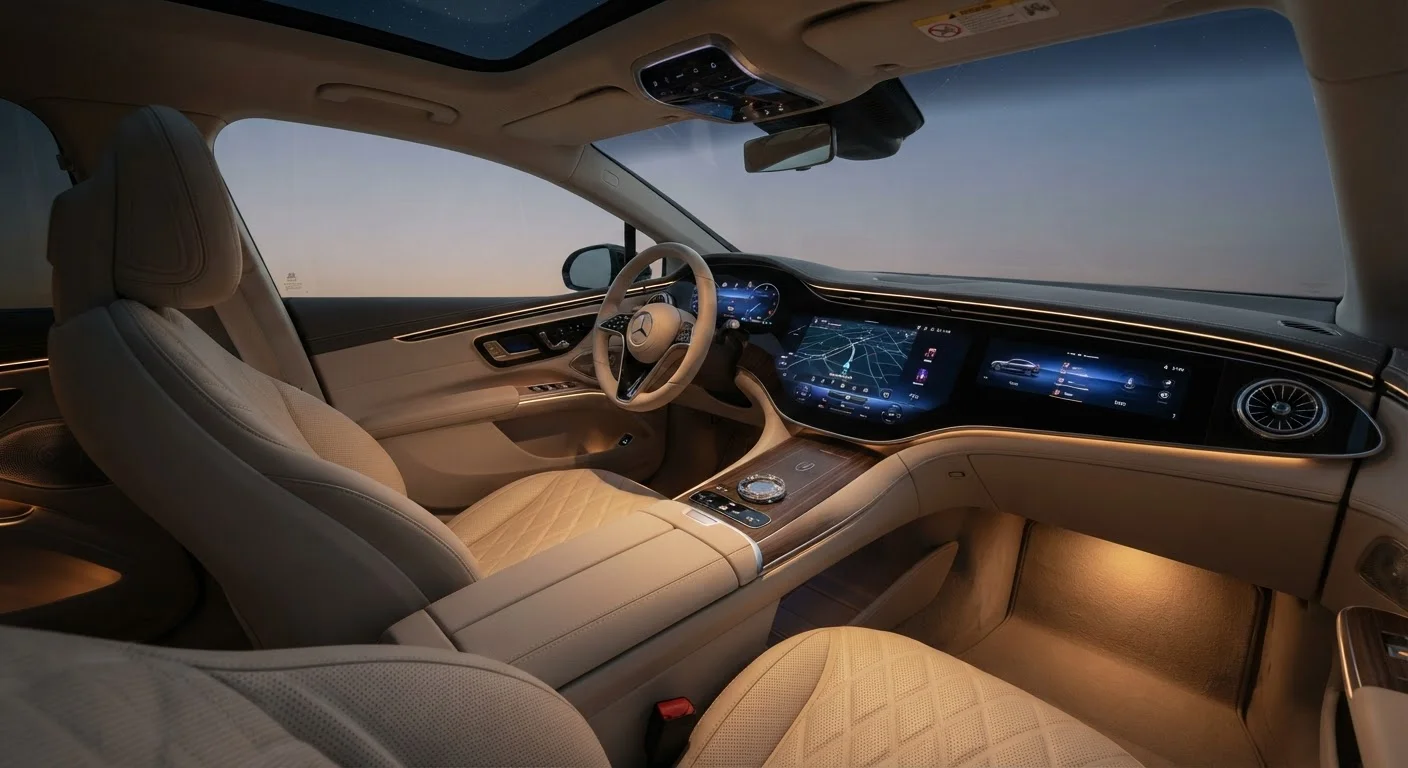
Genuine leather, real wood veneers, machined metal controls, and consistent soft-touch surfaces define the tactile identity of a luxury interior. Critically, it's not just the prominent surfaces — door cards, pillar trims, seatbacks, and overhead liners all reflect the same standard in a true luxury vehicle. Aspirational vehicles often apply premium materials selectively, which trained eyes and hands detect immediately.
3. Technology Integration Depth
Luxury technology isn't about having the most features — it's about how seamlessly those features operate. Display responsiveness, haptic feedback quality, interface logic, and the coherence of the driver-assist suite all factor in. Confused by the terminology around these systems? The driver assistance and autonomy features glossary defines every major term clearly.
4. Personalization and Craftsmanship
Luxury vehicles offer meaningful configuration depth — not just color choices, but seat adjustability ranges, massage functions, ambient lighting zones, and audio system tuning. Hand-finishing, stitching quality, and panel fit tolerances are examined with a level of scrutiny that volume production lines simply cannot sustain economically.
Test NVH at Highway Speed
The most revealing luxury test isn't in a showroom — it's on the highway at 65–70 mph with the audio off. Wind noise intrusion around the A-pillars and door seals, road noise transmission through the floor, and suspension harshness over expansion joints are all audible and felt clearly at speed. This single test exposes more about a vehicle's actual NVH investment than any spec sheet figure.
How These Criteria Apply to Luxury EVs Specifically
Electric vehicles introduce a distinct context for evaluating luxury. The absence of a combustion engine eliminates one noise source but can expose others — road noise, wind noise, and suspension thud become more perceptible, raising the stakes for NVH investment. Automakers building luxury EVs must engineer acoustic insulation more comprehensively than their combustion counterparts.
Battery architecture also affects the luxury experience. Larger battery packs enable longer range but add weight, which influences suspension tuning and ride quality. A genuinely luxurious EV balances range, ride refinement, and handling in a way that feels effortless — not compromised by the powertrain layout.
On the technology side, the top electric vehicle models that compete in the luxury segment are increasingly differentiated by software update cadence, feature unlock capabilities, and the sophistication of their digital ecosystems. Connectivity, companion app quality, and in-car AI integration are becoming meaningful luxury markers.
Heritage and design language also play a role. European automakers with deep engineering histories bring established luxury reputations that shape buyer expectations — though engineering execution, not origin, remains the decisive factor.
Putting It Into Practice Before You Commit
Knowing the criteria is only the first step. Applying them in a real evaluation — during a test drive, a showroom visit, or a specification review — requires a structured approach. Luxury claims in marketing materials don't always survive contact with the actual vehicle.
Pay close attention to cabin sound at idle and at speed, the resistance and feel of every physical control, and whether soft-touch materials extend to secondary surfaces. Sit in the rear seat. Open and close every door. These interactions reveal manufacturing tolerance and material investment more honestly than any specification sheet.
For a comprehensive framework, our structured assessment checklist for luxury EVs walks through range claims, charging compatibility, warranty terms, and cabin quality in sequence — giving you a repeatable method for separating genuine luxury from positioning.
This article provides general educational information about vehicle classification and is not a guarantee of any specific vehicle's performance, quality, or value. Individual experiences vary; consult manufacturer specifications and conduct your own evaluation before making any purchasing decision.