

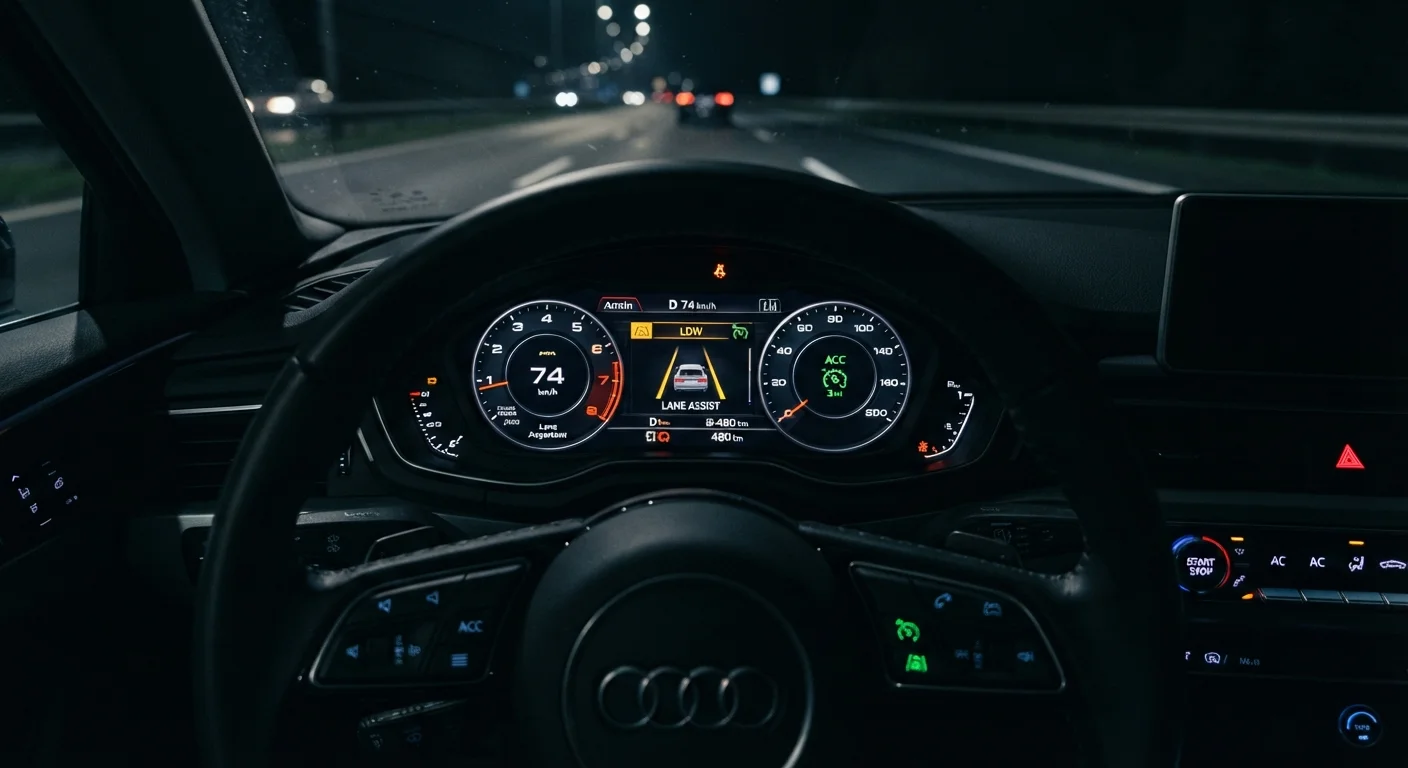
Key Takeaways
Option A
Lane Departure Warning (LDW)
The passive alerter - it warns you, then waits.
Best for: Drivers who want a safety net that flags unintentional drift without any steering input from the vehicle.
Option B
Lane-Keeping Assist (LKA)
The active intervener - it warns you and helps steer.
Best for: Drivers who want the vehicle to apply corrective steering or braking when a lane drift is detected.
If you want a minimal safety net without automated steering input
Lane Departure Warning (LDW)
LDW keeps you informed and in control, issuing alerts while leaving all corrective action entirely to the driver.
If you want active assistance during long highway drives where fatigue is a factor
Lane-Keeping Assist (LKA)
LKA's corrective steering torque can help counteract unintentional drift, giving drivers an additional physical layer of intervention.
If your vehicle has both systems and you are unsure which is active
Lane-Keeping Assist (LKA)
Confirming LKA is enabled - not just LDW - ensures you have the highest level of lane-related intervention your vehicle offers.
What Each System Actually Does
Both Lane Departure Warning and Lane-Keeping Assist use forward-facing cameras - and sometimes radar - to monitor lane markings. That shared sensor foundation is where the similarity largely ends. For a deeper look at how these sensors work together, see how cameras, radar, and lidar power your car's safety systems.
Lane Departure Warning (LDW) is a passive advisory system. When the vehicle begins to cross a lane marking without an active turn signal, it issues an alert - typically an audible chime, a steering wheel vibration, or a visual indicator on the instrument cluster. The vehicle itself takes no corrective action. LDW, standardized as a federal requirement for new passenger cars in many configurations, is essentially a highly attentive co-pilot that can only tap you on the shoulder.
Lane-Keeping Assist (LKA) is an active intervention system. It detects the same drift condition but then applies a measured amount of steering torque to guide the vehicle back toward the lane center, or selectively brakes individual wheels to produce a corrective yaw effect. The driver remains responsible for steering, but the car is physically participating in the correction.
| Criterion | Lane Departure Warning (LDW) | Lane-Keeping Assist (LKA) |
|---|---|---|
| Primary action | Issues alert only | Applies steering torque or braking |
| Driver intervention required | Yes - driver must correct | Partially - system assists correction |
| SAE automation level | Level 0 (warning only) | Level 1 (single-axis assist) |
| Alert types | Audio, visual, haptic | Audio, visual, haptic + physical input |
| Override by driver | N/A - no system input to override | Yes - deliberate steering overrides it |
| Requires clear lane markings | Yes | Yes |
| Common availability | Standard on most new vehicles | Standard or optional on many new vehicles |
How Intervention Levels Affect Real-World Safety
The distinction between alerting and intervening has meaningful safety implications. Research from NHTSA and IIHS has explored the role of lane-keeping technologies in reducing roadway departure crashes - one of the deadliest crash categories on U.S. roads. LDW relies on the driver responding quickly enough to the alert, which is problematic if the drift is caused by distraction, microsleep, or medical impairment.
LKA introduces a physical buffer, but it carries its own considerations. Steering torque applied at highway speed can feel unexpected to drivers who are unaware the system is active, and the intervention force is intentionally limited - it can be overridden by deliberate steering input. This is by design: LKA is a supplement to driver control, not a substitute.
~26,000
Annual U.S. roadway departure fatalities
NHTSA data consistently identifies roadway departure crashes as responsible for roughly half of all traffic fatalities in the United States.
11%
Reduction in lane-departure injury crashes with LKA
IIHS research has found that lane-keeping assist with active steering intervention is associated with a measurable reduction in lane-departure crashes involving injury.
It is also important to understand that LKA does not constitute autonomous driving. It is classified as SAE Level 1 assistance - the driver must remain engaged at all times. Confusing LKA with a hands-free system is one of the most documented forms of ADAS misuse. For a full glossary of driver-assist terminology, this driver-assistance reference glossary provides useful definitions.
Shared Limitations Both Drivers Should Know
Regardless of whether your vehicle has LDW, LKA, or both, these systems depend on the camera being able to clearly read lane markings. Faded paint, heavy rain, snow-covered roads, construction zones with temporary striping, and sharp curves can all degrade performance. Situations where ADAS underperforms covers these edge cases in detail.
Both systems typically deactivate or reduce sensitivity above certain speed thresholds, or when the turn signal is active - a built-in assumption that intentional lane changes should not trigger corrections. Neither system can reliably function on roads with no lane markings. Drivers should treat any dashboard indicator that suggests a system is unavailable as meaningful information, not a nuisance. Our hub on dashboard warning signs can help you interpret those alerts correctly.
Understanding what your specific vehicle's system can and cannot do - using the owner's manual as the authoritative source - is the most practical step any driver can take. Getting the most from your car's safety tech offers practical habits for maximizing these systems on every drive. For a broader map of how LDW and LKA fit among dozens of other driver-assistance features, see ADAS Decoded.