

Key Takeaways
Start here
How EV Batteries and Range Actually Work
Next
Understanding Charging: Levels, Speeds, and Networks
Then
What to Look for in Your First EV Model
Also consider
Ownership Costs and Incentives at a Glance
Ready to act
Next Steps Before You Commit
How EV Batteries and Range Actually Work
At the core of every electric vehicle is a lithium-ion battery pack measured in kilowatt-hours (kWh) - the unit that describes how much energy the pack stores. Think of kWh the way you'd think of gallons in a gas tank: more capacity generally means more range. But capacity alone doesn't tell the full story. A vehicle's efficiency rating, expressed in miles per kWh, determines how far that stored energy actually takes you.
The EPA publishes range estimates for every EV sold in the US, but those figures are tested under controlled lab conditions. In practice, highway driving at 75 mph, cold weather, and heavy climate control use can each reduce real-world range by a meaningful margin. A vehicle rated at 260 miles might deliver closer to 210-230 miles in winter highway conditions.
kWh (kilowatt-hour)
A unit of energy that describes how much electricity an EV battery can store. Larger kWh values generally mean more range, similar to a bigger fuel tank.
EPA Range Rating
The official range estimate published by the US Environmental Protection Agency based on standardized lab testing. Real-world range often differs due to temperature, speed, and driving habits.
Onboard Charger
A component inside the EV that converts AC electricity from a wall outlet or Level 2 station into DC power the battery can store. Its capacity (measured in kW) limits how fast the car charges at home.
Regenerative Braking
A system that recovers kinetic energy when the car slows down and converts it back into electricity stored in the battery, extending range and reducing brake wear.
DC Fast Charging
A high-speed public charging method that delivers direct current (DC) straight to the battery, bypassing the onboard charger for much faster charging than home outlets.
NACS / CCS
Two common connector standards for EV charging in North America. NACS (North American Charging Standard) and CCS (Combined Charging System) determine which public chargers a vehicle can use natively.
For a deeper look at how range and charging interact in everyday driving scenarios, see our complete EV range and charging guide.
Understanding Charging: Levels, Speeds, and Networks
Charging infrastructure is often the biggest concern for first-time EV buyers, and understanding the three levels clarifies most of the confusion.
- Level 1 (120V): Uses a standard household outlet. Adds roughly 3-5 miles of range per hour - practical only for very low daily mileage.
- Level 2 (240V): Requires a dedicated circuit, similar to a dryer outlet. Delivers 15-30 miles per hour and is the standard home setup for most EV owners.
- DC Fast Charging (Level 3): Found at public charging stations along highways and in commercial areas. Can add 100-200 miles in 20-40 minutes, though not all EVs accept the highest speeds.
Public charging networks vary by region and connector type. Many newer EVs have adopted the NACS connector, while others use CCS. Before choosing a vehicle, verify which network connectors it natively supports and whether adapters are available.
Make Home Charging Your Default Plan
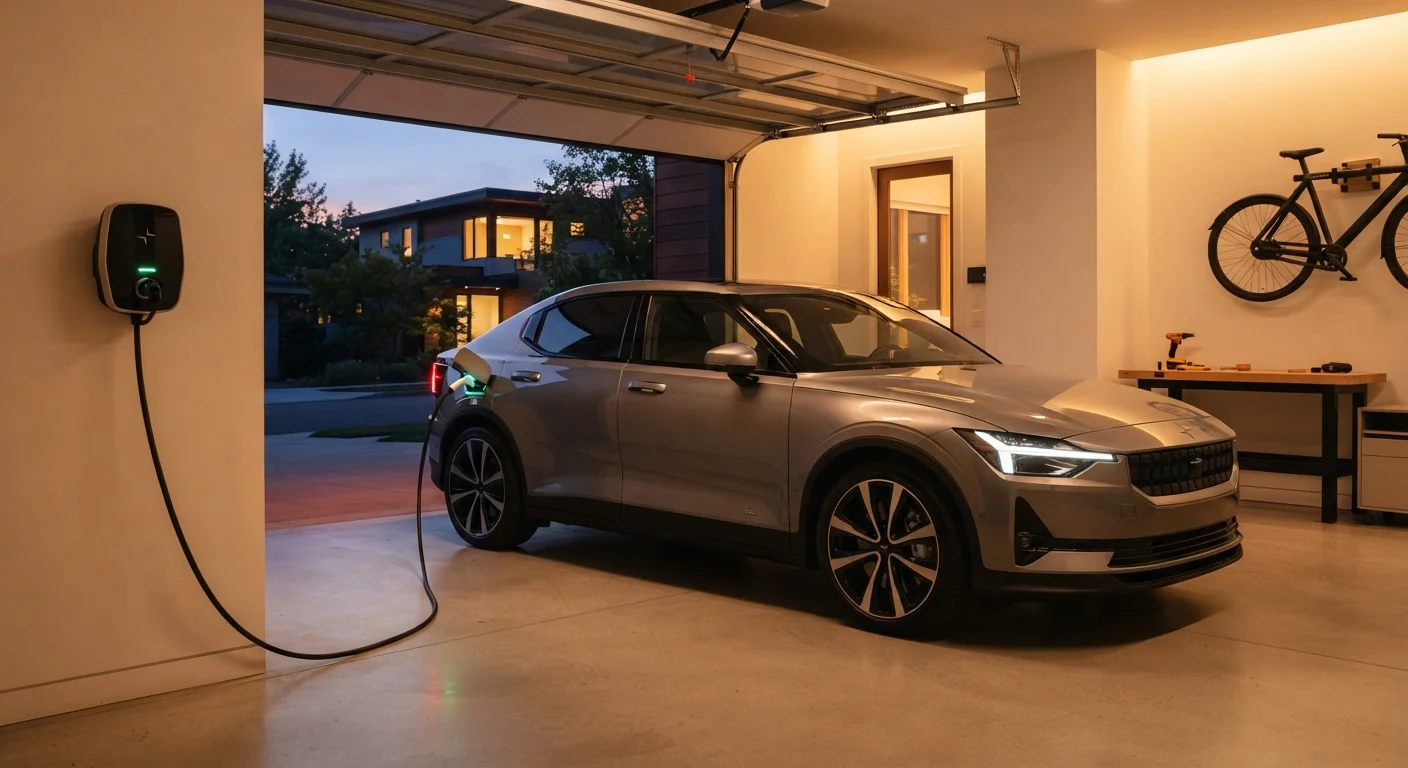
The most stress-free EV ownership experience starts with reliable home charging. If you have a garage or dedicated parking space, budgeting for a Level 2 charger installation at purchase time means you'll start every day with a full charge - eliminating most public charging dependence for routine driving.
Explore the EV range and charging hub for network comparisons and home installation guidance.
What to Look for in Your First EV Model
When evaluating EV models as a first-time buyer, focus on these core dimensions rather than getting distracted by headline specs:
- Usable battery range vs. your actual commute
- Add a 20-30% buffer to your daily roundtrip mileage to account for weather and detours. An EV should comfortably cover that distance on a single charge.
- Onboard charger capacity
- This determines how fast the vehicle accepts Level 2 power. A 7.2 kW onboard charger charges significantly slower than an 11 kW unit from the same Level 2 source.
- Cargo space and seating
- Battery placement under the floor improves weight distribution but can affect cargo depth or third-row headroom in SUVs. Always check interior dimensions, not just total volume.
- Software and over-the-air updates
- Many EVs receive feature improvements, range optimizations, and bug fixes remotely. This is a meaningful ownership advantage absent from most gas vehicles.
Before visiting a showroom, use our EV test drive checklist to structure your evaluation.
Ownership Costs and Incentives at a Glance
The total cost of EV ownership involves more variables than a sticker price comparison. Electricity costs replace fuel costs, and rates vary significantly by region and time of day - many utilities offer off-peak rates that make overnight charging considerably cheaper. Routine maintenance costs (no oil changes, reduced brake wear due to regenerative braking) are generally lower for EVs than comparable gas vehicles, though this advantage varies by model and driving pattern.
On the purchase side, the federal Clean Vehicle Credit - currently up to $7,500 for qualifying new EVs under US law - is subject to income thresholds, vehicle MSRP caps, and domestic content requirements that change periodically. State-level rebates and utility incentives can layer on top, but rules differ significantly by location.
Incentive Rules Change - Verify Before You Buy
Federal and state EV incentives are tied to specific eligibility criteria that can change with new legislation or regulation. A vehicle that qualifies today may not qualify next quarter, and income limits apply to the buyer as well. Always verify current eligibility directly with the IRS website or a qualified tax professional before making a purchase decision based on available credits.
For a structured walkthrough of how these programs work, see making sense of EV incentives as a first-time buyer. The EV costs and incentives hub tracks the broader cost landscape.
Next Steps Before You Commit
Transitioning from gas to electric is a significant shift, but it's one that becomes straightforward once the fundamentals are clear. A structured approach helps: understand your daily mileage, assess your home charging options, shortlist models that meet your range buffer, then verify incentive eligibility for those specific vehicles before visiting a dealer.
If you're also considering European-manufactured EVs, our introduction to the European car market provides useful context on brand families and segment structure. For those interested in premium options, the electric luxury car landscape guide maps the high-end segment in depth.
EV Range & Charging Hub
A structured resource covering real-world range expectations, home charging setup, and public network options for drivers going electric for the first time.
EV Test Drive Checklist
A practical checklist of questions and scenarios to evaluate during an EV test drive, covering range simulation, software features, and comfort factors.
EV Incentives Guide for First-Time Buyers
Plain-language explanation of federal tax credits, state rebates, and utility programs available to US drivers considering their first electric vehicle.
This article provides general educational information about electric vehicles and is not a substitute for personalized financial, tax, or purchasing advice. Incentive eligibility, vehicle availability, and specifications vary and are subject to change. Consult a licensed tax professional or financial adviser regarding your specific situation.