

Key Takeaways
European Automotive Safety Standards
European automotive safety standards are regulatory requirements and independent testing protocols - most notably Euro NCAP and EU type-approval legislation - that define minimum crashworthiness, occupant protection, and active safety criteria for vehicles sold in Europe. These frameworks have shaped not only European-market cars but the design priorities of automakers globally, because manufacturers building for Europe typically engineer those features into their worldwide platforms.
Euro NCAP (European New Car Assessment Programme) is an independent consumer-safety body, while EU type-approval regulations are legally binding directives enforced under the General Safety Regulation (GSR).
The Origins of Europe's Safety-First Approach
European vehicle safety regulation has roots in the United Nations Economic Commission for Europe (UNECE), which began harmonising automotive standards among member nations in the 1950s. These early agreements standardised technical requirements - seatbelt anchorages, lighting, and glazing - across borders, creating the regulatory infrastructure that later generations would build on.
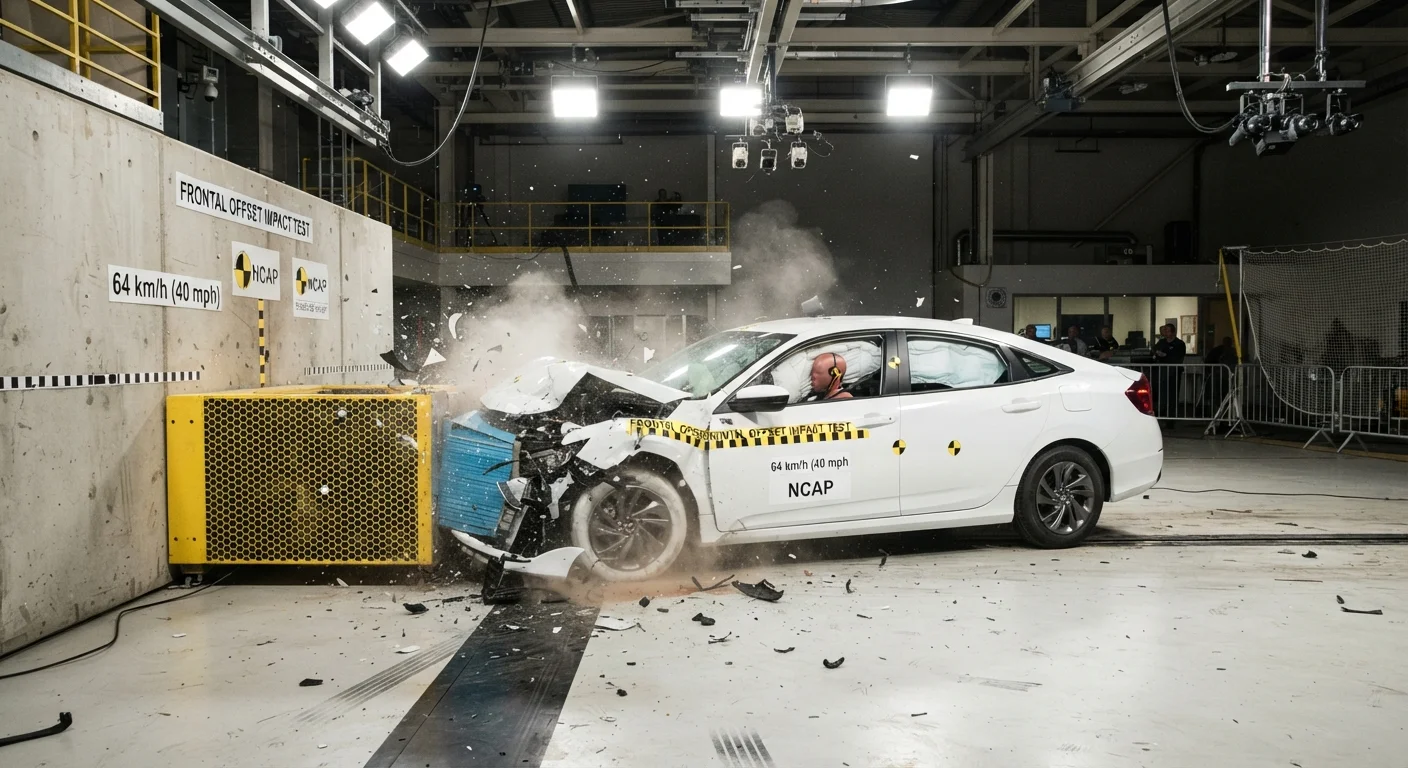
The pivotal shift came in 1997, when Euro NCAP published its first crash-test results. By giving consumers a transparent star rating, the programme reframed safety as a competitive differentiator rather than a minimum compliance threshold. Manufacturers who scored poorly faced measurable commercial pressure, while those who invested in structural engineering and airbag systems gained a marketing advantage. The incentive structure fundamentally changed how engineers prioritised cabin design.
European automakers' broader engineering culture - emphasising rigorous testing and iterative refinement - made European brands early leaders in translating these requirements into tangible product improvements.
How EU Legislation Extended Beyond Crash Tests
Consumer-facing ratings like Euro NCAP influenced design choices voluntarily, but EU type-approval legislation made certain features legally mandatory. The EU's General Safety Regulation (GSR), which phased in requirements from 2022 onward, mandated advanced driver-assistance systems - including autonomous emergency braking (AEB), lane-keeping assist, driver drowsiness monitoring, and intelligent speed assistance - across all newly type-approved vehicles sold in Europe.
This regulatory approach differed meaningfully from the US model, where the National Highway Traffic Safety Administration (NHTSA) has historically relied more on minimum performance standards and consumer information programmes than on mandatory technology requirements. The EU's prescriptive mandates meant that by the time these features became legally required, European-market vehicles had effectively normalised technology that remained optional elsewhere.
1997
Year Euro NCAP published its first consumer ratings
Euro NCAP's debut results, covering five models, were the first independent consumer-facing crash-test scores in Europe, fundamentally changing manufacturer incentives.
2022
EU General Safety Regulation phase-in began
The EU's GSR mandated AEB, lane-keeping assist, and other driver-assistance systems as standard equipment for newly type-approved vehicles across the European market.
40+
Countries participating in NCAP-aligned programmes
Regional programmes modelled on Euro NCAP now cover Australasia, Latin America, Southeast Asia, China, and South Korea, expanding European-style safety evaluation globally.
To understand how crash-test methodology itself evolved in parallel, tracing how test scenarios have grown more demanding over three decades provides essential context.
The Global Ripple Effect: Platform Economics and the Brussels Effect
The mechanism by which European standards cross borders is partly regulatory and partly economic. Automakers - whether German, Japanese, Korean, or American - engineer vehicles on shared global platforms. When the European version of a platform must carry AEB, reinforced side-impact structures, or specific pedestrian crumple zones, incorporating those features across all regional variants of the same architecture is usually more cost-efficient than engineering them out for other markets.
Legal scholar Anu Bradford's concept of the Brussels Effect captures this dynamic precisely: the EU's large, affluent, highly regulated market creates strong incentives for global companies to adopt EU-compliant designs as their universal standard. In automotive safety, this has meant that crash avoidance and occupant-protection technologies pioneered under European regulatory pressure have progressively appeared in vehicles sold in markets where they were not legally required.
“The EU does not need to engage in costly and cumbersome efforts to coordinate with other states or to negotiate international treaties. Instead, its market power combined with the global reach of multinational corporations allows it to regulate global markets unilaterally.”
— Anu Bradford, Professor of Law, Columbia Law School; author of 'The Brussels Effect'
Regional testing programmes in Australasia (ANCAP), Latin America (Latin NCAP), and Southeast Asia (ASEAN NCAP) also adopted Euro NCAP's core methodology, effectively extending European test protocols to dozens of additional markets. How Asian brands perform across these programmes illustrates how global manufacturers now engineer to meet expectations that trace back to the European model.
What This Means for Consumers Comparing Vehicles Today
For US consumers evaluating vehicles, the practical takeaway is that the global spread of European-originated safety standards has generally elevated baseline protection across mainstream segments. Features that were European premium-trim items in the early 2000s - AEB, side curtain airbags, electronic stability control - are now widely expected across most new-vehicle categories in the US market.
However, parity is not uniformity. Specific features mandated under EU legislation may still be configured differently or may be optional rather than standard on non-European trim levels of the same model. Comparing detailed specifications - rather than relying solely on nameplate recognition - remains the sound approach.
The complete reference on vehicle safety ratings covers how to cross-reference NHTSA, IIHS, and global NCAP data when evaluating a specific model. The crash test ratings hub offers further resources on interpreting scores across programmes.
Check Market-Specific Specifications
When comparing vehicles, look up the trim-level specification sheet for your specific market rather than assuming European-market features carry over. Manufacturer websites for the US market list standard and optional equipment separately from European or global press materials, which may describe features not available in your region.
This article is for general informational purposes. Safety rating outcomes and feature availability vary by model year, trim level, and regional market. Always verify specifications with manufacturer documentation and consult current programme results before making decisions based on safety scores.