

Key Takeaways
Toyota Production System (TPS)
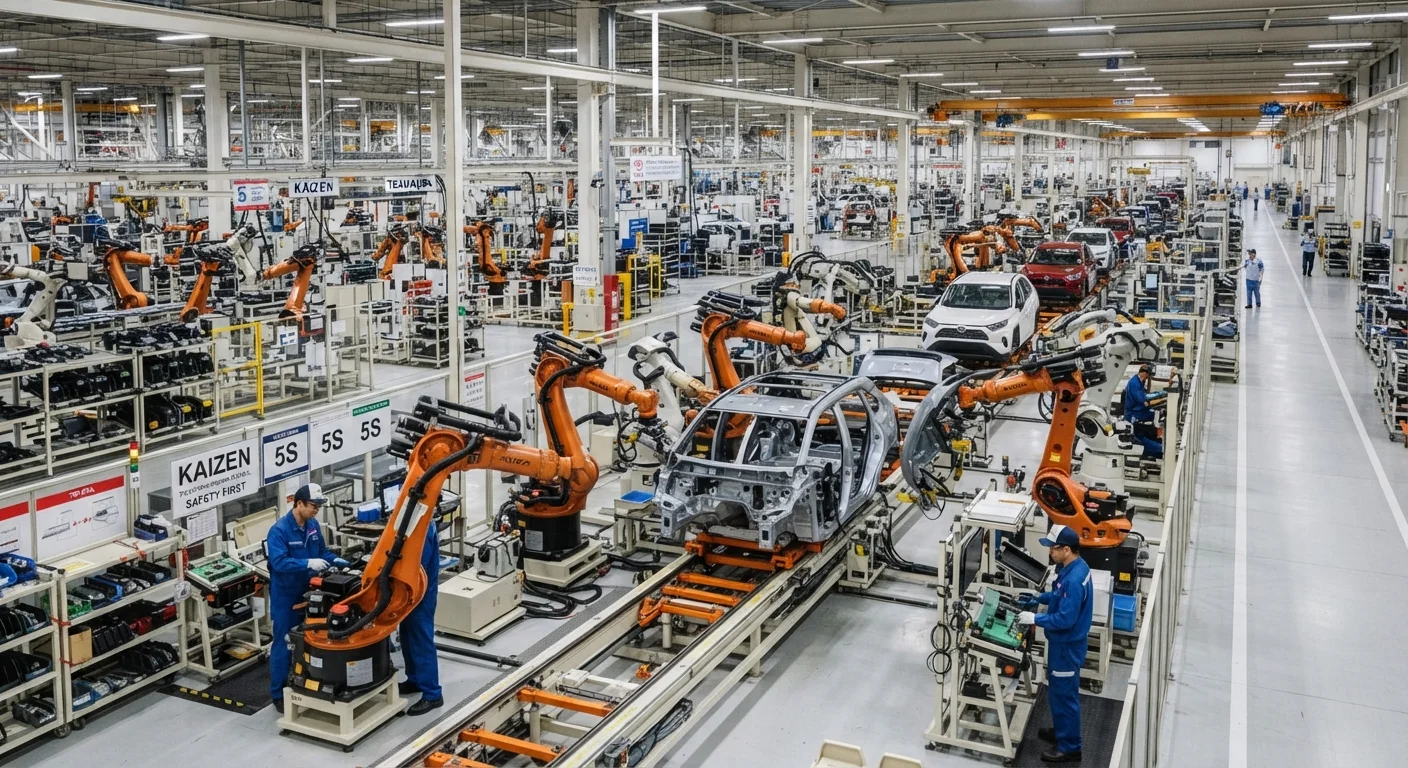
The Toyota Production System is a manufacturing philosophy developed by Toyota that focuses on eliminating waste, improving efficiency, and maintaining consistent quality at every stage of production. It is built on two core principles: jidoka (building quality in rather than inspecting it out) and just-in-time production (delivering exactly what is needed, when it is needed). TPS transformed Toyota from a regional automaker into one of the world's most reliable automotive brands.
TPS is the practical foundation of what management theorists later codified as 'Lean Manufacturing' - a broader framework now adopted across industries far beyond automotive.
Origins: How TPS Was Developed
The Toyota Production System emerged from necessity. Post-war Japan faced severe resource constraints, making the mass-production model pioneered by American automakers economically impractical for Toyota. Engineers Taiichi Ohno and Shigeo Shingo responded by developing a system designed to produce high-quality vehicles with minimal material, time, and labor waste.
Central to this effort was the concept of kaizen - continuous, incremental improvement involving every worker on the factory floor, not just management. This cultural dimension distinguished TPS from purely mechanistic efficiency programs. Workers were expected to identify problems, surface them immediately, and participate in solving them. The result was an organization capable of learning and self-correcting at a structural level.
For context on how this philosophy contrasts with the craft-intensive traditions of continental automakers, see the engineering philosophy behind European automakers.
The Two Pillars: Just-in-Time and Jidoka
Just-in-time (JIT) production means components arrive at each assembly station precisely when they are needed - no earlier, no later. This eliminates the need for large parts inventories, reduces storage costs, and forces suppliers and internal processes to maintain consistent quality. A defective component cannot be hidden behind a warehouse buffer; it immediately disrupts flow, making problems visible and urgent.
Jidoka - sometimes translated as 'autonomation' or 'intelligent automation' - means machines and workers have the authority and responsibility to halt production when a defect is detected. Rather than passing a problem downstream, the line stops, the issue is investigated, and a root cause is identified. This principle inverts the traditional inspection model: instead of catching errors at the end, quality is built into every step.
1990
Year 'lean manufacturing' entered mainstream management vocabulary
The term was introduced in 'The Machine That Changed the World,' based on a five-year MIT study of global auto plants published that year.
~50%
Reduction in manufacturing defects in early TPS adoption studies
MIT researchers found Toyota plants produced significantly fewer defects per 100 vehicles than comparable US and European facilities studied in the mid-1980s.
Multiple industries
Sectors now using lean principles derived from TPS
Aerospace (Boeing), healthcare, software development (Agile methodology), and consumer electronics have all adapted TPS-derived lean frameworks.
Together, these pillars create a system where efficiency and quality reinforce each other rather than trade off - a relationship that has proven durable across decades and global expansion.
How TPS Spread Across the Automotive Industry
The global influence of TPS accelerated after a landmark five-year research project at MIT, summarized in the 1990 book The Machine That Changed the World by Womack, Jones, and Roos. The study directly compared Toyota's manufacturing output and quality metrics with those of American and European plants, finding substantial gaps in productivity and defect rates. The term 'lean manufacturing' was coined to describe the distilled principles for a Western audience.
American automakers responded by incorporating lean concepts into their own operations throughout the 1990s and 2000s. Yet observers and industry analysts have noted that adopting the tools of TPS - kanban cards, andon cords, value-stream mapping - without embedding the underlying cultural commitment to continuous improvement often produced limited results. The system's effectiveness is inseparable from the organizational discipline that surrounds it.
“Adopting the tools of the Toyota Production System without understanding the thinking behind them is like copying the symptoms of health without addressing the underlying causes.”
— James P. Womack, Co-author, 'The Machine That Changed the World'; founding researcher, MIT International Motor Vehicle Program
This gap helps explain why Asian brands continue to outperform in long-term reliability studies. For a deeper look at the data, see why Asian automakers have dominated reliability rankings for decades.
TPS and Its Lasting Impact on Quality and Efficiency
The measurable legacy of TPS shows up consistently in owner satisfaction surveys and third-party reliability studies, where Toyota vehicles regularly appear among the highest-rated in their segments. The system's emphasis on defect prevention - rather than defect correction - means quality issues are structurally less likely to reach the consumer in the first place.
Fuel efficiency has also benefited. Lean production reduces the energy and material inputs required per vehicle, and the discipline of waste elimination extends naturally into product engineering, encouraging powertrain teams to pursue efficiency gains with the same rigor applied to factory floors. This engineering mindset is one reason Toyota was an early leader in hybrid technology.
For consumers navigating model choices across Asian brands, understanding TPS helps explain why reliability is a defining characteristic rather than a marketing claim. See navigating the model range of major Asian brands for a practical lineup comparison. Those curious how these values play out differently at Honda can explore Honda vs. Toyota's approach to building cars.
What to Look for When Evaluating Manufacturing Quality
When researching a vehicle's reliability, look beyond warranty length to third-party owner satisfaction surveys and long-term dependability studies. Brands with deeply embedded quality-control cultures tend to show consistent performance across model lines, not just in flagship vehicles. This consistency is a more reliable signal than any single model's review.
TPS also stands in instructive contrast to the volume-and-power priorities that have historically shaped American automotive brands - a comparison explored in American vs. Japanese brand philosophies.