

Key Takeaways
Our Verdict
American and Japanese automakers each excel within their own design philosophies. Japanese brands have a well-documented edge in long-term dependability and fuel efficiency, while American brands lead in truck capability, towing capacity, and bold styling. Buyers who prioritize low ownership costs and compact efficiency will find strong options among Japanese marques; those who need heavy-duty hauling or prefer large-format vehicles will find American brands hard to beat.
| Best for | Recommended |
|---|---|
| Drivers prioritizing long-term reliability and fuel economy | Japanese brands |
| Buyers needing heavy-duty trucks or large SUVs | American brands |
| Those seeking hybrid and electrified mainstream options | Japanese brands |
| Performance enthusiasts who want V8 muscle or towing capability | American brands |
Design Philosophy: Scale vs. Efficiency
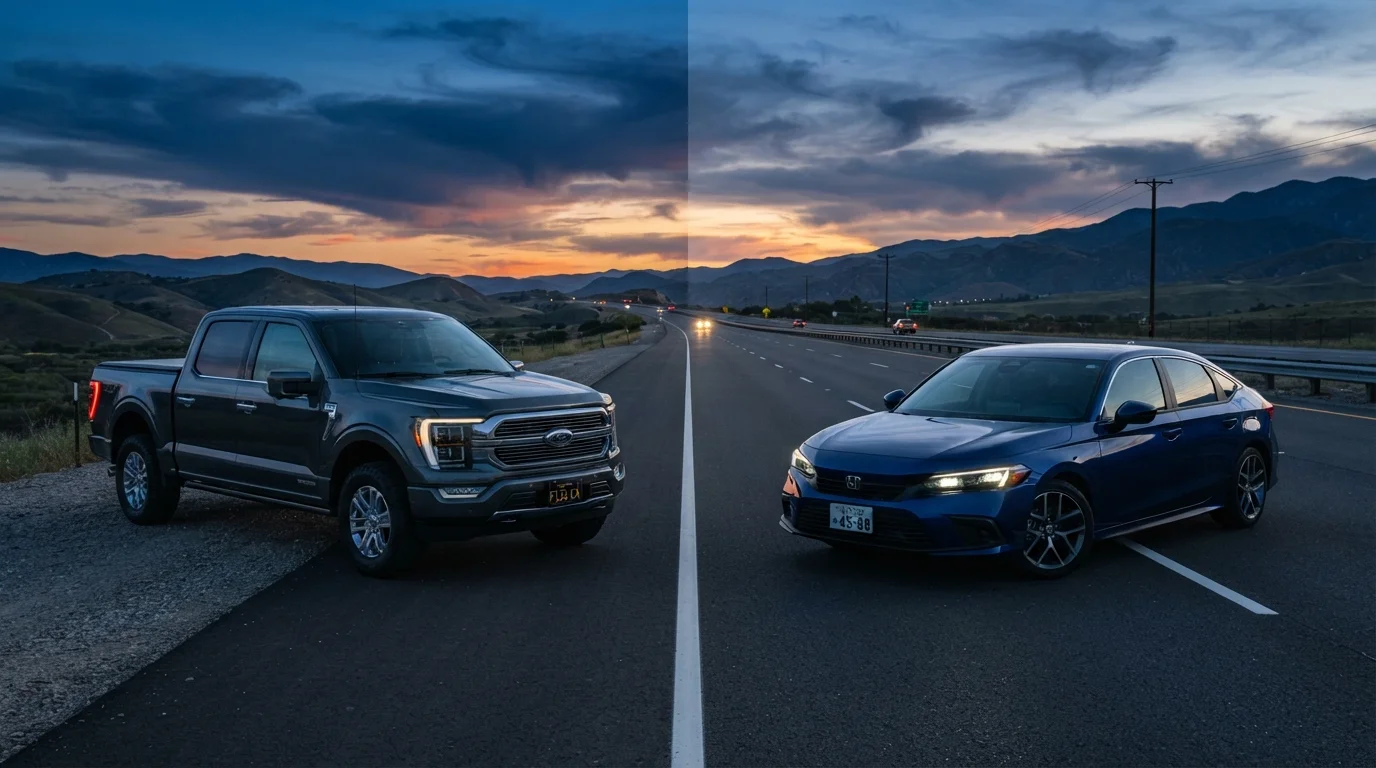
The most visible difference between American and Japanese automakers is their foundational design priority. US brands - Ford, General Motors, and Stellantis - have long built their lineups around large-format vehicles. Trucks, full-size SUVs, and high-displacement engines are not peripheral offerings; they are the commercial and cultural core of each company. As explored in our look at how American brands built their identities, this orientation traces back decades and shapes engineering investment to this day.
Japanese automakers - Toyota, Honda, Nissan, Mazda, and Subaru among them - built their reputations on a different premise: deliver dependable, fuel-efficient vehicles that cost less to own over time. This philosophy emerged partly from resource constraints in post-war Japan and was reinforced by fuel crises in the 1970s that made compact, efficient cars suddenly attractive to American consumers.
The result is two camps with genuinely different strengths rather than one simply outperforming the other.
| American Brands | Japanese Brands | |
|---|---|---|
| Core strength | Trucks, large SUVs, performance | Efficiency, reliability, compact/mid-size cars |
| Reliability track record | Improved; variable by segment | Consistently strong across most surveys |
| Hybrid/EV lineup depth | Growing but still developing | Extensive, especially Toyota and Honda |
| Towing and payload capability | Class-leading in full-size trucks | Competitive in mid-size; limited at top end |
| Resale value | Strong for trucks; variable for cars | Consistently strong across segments |
| Manufacturing philosophy | Platform flexibility, scale production | Lean manufacturing, process standardization |
Reliability and Manufacturing Quality
Reliability data has long been one of the most debated dimensions of this comparison. Consumer Reports and J.D. Power surveys have historically placed Japanese nameplates - particularly Toyota and Honda - at or near the top of long-term dependability rankings. The Toyota Production System, with its emphasis on eliminating waste and standardizing processes, is widely credited as a structural reason for this consistency.
American brands faced significant reliability criticism through the 1980s and 1990s, a perception that still lingers despite measurable improvements. Our deeper look at the reliability reputation of American cars examines where that narrative came from and what more recent data suggests. In segments like full-size trucks, where American manufacturers have decades of engineering focus, the quality gap is considerably narrower.
Top 3
Japanese brands in J.D. Power dependability rankings
Toyota and Honda have regularly placed in J.D. Power's Vehicle Dependability Study top rankings across multiple recent years.
#1
Best-selling vehicle in the US for 40+ consecutive years
The Ford F-Series has held the top-selling vehicle position in the United States for over four decades, reflecting American brands' dominance in the truck segment.
It is worth noting that reliability is not monolithic - it varies by model, model year, and ownership conditions. Blanket conclusions about either camp can mislead buyers evaluating specific vehicles.
Lineup Breadth: Trucks, Sedans, and the Hybrid Middle Ground
American brands own the full-size truck segment in a way their Japanese counterparts simply do not challenge. The Ford F-Series, Chevrolet Silverado, and Ram 1500 have held the top sales positions in the US market for decades. Toyota's Tundra and Tacoma compete credibly in this space, but the scale and depth of American truck engineering - towing ratings, payload options, powertrain variety - remains a genuine differentiator. The truck-first philosophy of US automakers means resources and innovation flow heavily into these platforms.
Japanese brands, meanwhile, have shaped the hybrid mainstream in ways American manufacturers are still working to match. Toyota's Prius established hybrid credibility in the early 2000s, and the brand has since expanded electrified options across nearly its entire lineup. For buyers navigating sedans, SUVs, and hybrids across Asian brands, the breadth of electrified choices is notably wider than in American lineups - though that gap is closing. See how American brands are approaching the EV era for a fuller picture of where US manufacturers stand.
Match the Vehicle to Your Primary Use
If your driving is predominantly urban or suburban with occasional highway trips, Japanese compact and mid-size options typically offer lower operating costs and strong resale value. If you regularly haul equipment, tow trailers, or need a vehicle that doubles as a work tool, American full-size trucks deliver capabilities that few Japanese models can match. Clarifying your primary use case before comparing specs will narrow the field considerably.
Value and Ownership Costs
Purchase price, depreciation, fuel costs, and maintenance expenses all factor into total ownership cost - and the two camps diverge here as well. Japanese vehicles have historically held their resale value strongly, a function of their reliability reputation and broad market demand. American trucks and large SUVs also retain value well in the current market, partly due to sustained demand in their core segments.
Maintenance costs tend to favor Japanese brands for compact and mid-size cars, where parts are widely available and service intervals are often longer. American vehicles, particularly trucks, can incur higher fuel costs given their larger engine displacements, though many now offer turbocharged four- and six-cylinder options that improve efficiency without sacrificing utility.
For buyers comparing Japanese and Korean automakers or weighing European alternatives, the ownership cost calculation should include insurance, local parts availability, and anticipated use - variables that shift the math considerably depending on the buyer's situation.
This article provides general educational information about automotive brands and their characteristics. It does not constitute personalized purchasing, financial, or legal advice. Vehicle reliability, costs, and ownership experience vary by model, year, and individual circumstances.