

Key Takeaways
Why Segment Identity Matters for American Brands
Unlike many European or Japanese manufacturers that built reputations on engineering philosophy or fuel efficiency, American automakers have historically defined themselves through the types of vehicles they championed. Chevrolet, Ford, Dodge, and their parent companies didn't just build cars - they created cultural artifacts that aligned with specific American lifestyles: speed, work, freedom, and capability.
That segment-first identity is why buyers still feel tribal loyalty toward particular nameplates. A Ford F-Series owner and a Dodge Challenger enthusiast may both be loyal to American brands, yet they're drawn by entirely different promises. Understanding those promises is the clearest lens through which to evaluate any US automaker's strengths.
For a deeper look at how American brands' broader reputations formed and evolved, see our reliability history guide. And if you're comparing how US brands stack up philosophically against competitors from abroad, this brand philosophy comparison offers useful context.
Ford and the Full-Size Pickup Truck
No single product has done more to define an American automaker's identity than the Ford F-Series. In continuous production since 1948, it has been the best-selling vehicle in the United States for over four decades - a record unmatched by any car, truck, or SUV from any country of origin. Ford built its modern brand around work-ready capability: payload capacity, towing ratings, and cab configurations that appeal equally to tradespeople and families hauling recreational equipment.
The F-Series also established Ford's engineering credibility. The shift to an aluminum-alloy body on the F-150 in 2015 was a watershed moment - a structural gamble that prioritized weight savings and fuel efficiency without sacrificing payload ratings. That willingness to make bold engineering choices in a legacy product reflects Ford's broader brand character. Explore the full SUV and truck landscape to understand where the F-Series sits relative to competing platforms.
The F-Series' unbroken sales leadership reflects Ford's defining commitment to workhorse capability over generations.
Chevrolet and the All-Things-to-All-People Strategy
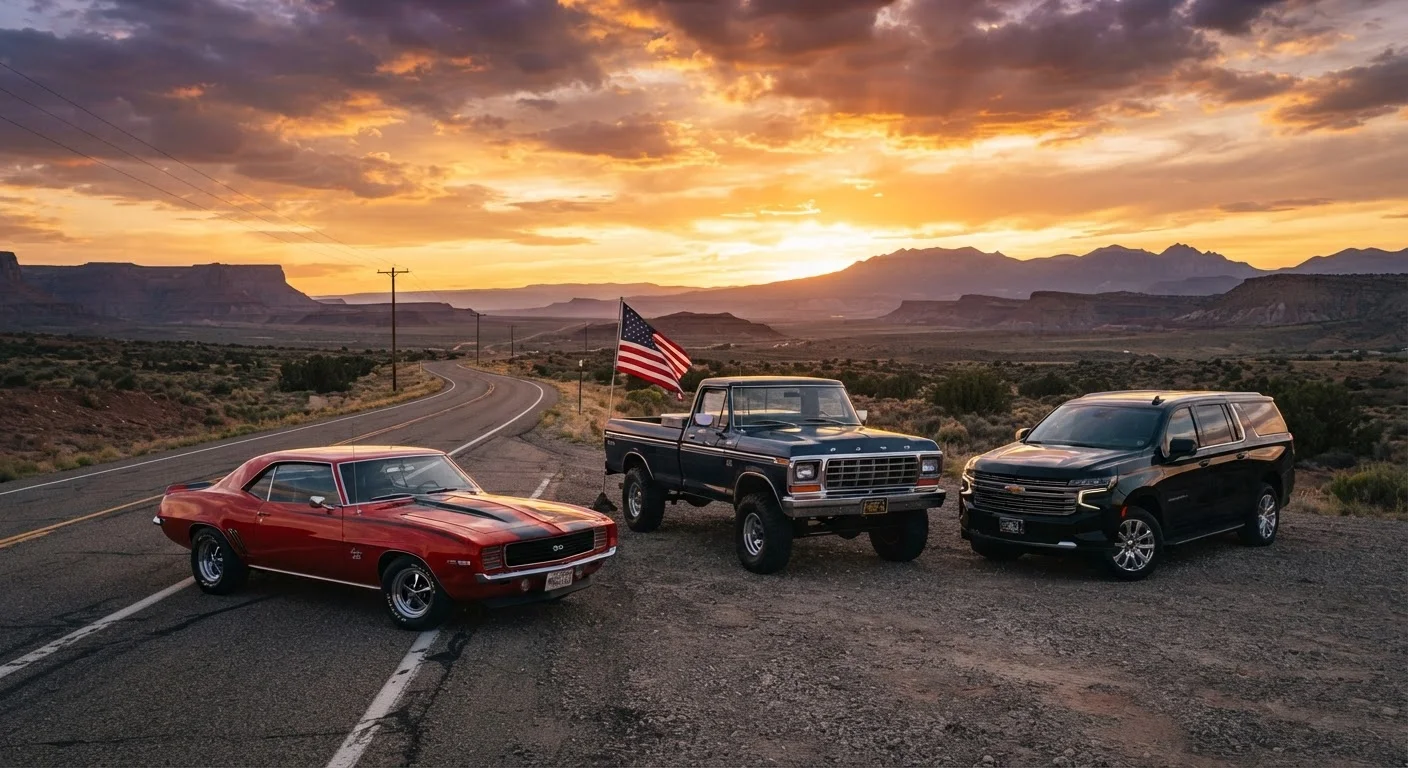
Chevrolet occupies a unique position among American brands: it is simultaneously a muscle car nameplate (Camaro), a full-size truck maker (Silverado), an SUV manufacturer (Tahoe, Suburban), and an entry-level passenger car brand. That breadth is both a strength and a complexity. Chevrolet's identity is perhaps best summarized as democratic American motoring - practical, accessible, and deeply rooted in mainstream culture.
The Corvette represents the brand's performance crown jewel, a sports car that has competed on international tracks while remaining attainable relative to European exotic alternatives. Meanwhile, the Silverado has pushed Ford's F-Series consistently, keeping both brands innovating in the heavy-duty truck space. General Motors' brand portfolio explains how Chevrolet fits within GM's broader strategy of segmenting buyers across Chevy, GMC, Buick, and Cadillac.
Chevrolet's breadth - from the Corvette to the Silverado - reflects a brand built for the full spectrum of American buyers.
Dodge and the Muscle Car Ethos
If Ford owns trucks and Chevrolet owns volume, Dodge owns attitude. The brand's identity crystallized around high-displacement V8 performance - the Charger and Challenger nameplates carrying Dodge's muscle car heritage from the 1960s into the present. Few automakers have sustained a performance identity as consistently, or with as much cultural resonance, as Dodge has through these two models.
The Challenger in particular represents an unusual product decision: a rear-wheel-drive, large-platform muscle car that survived long after most of its competitors exited the segment. Its longevity is a testament to the loyalty Dodge cultivated among performance enthusiasts who prioritized engine character over efficiency or agility. The heritage behind American muscle explores how Dodge's rivalry with Ford and Chevrolet defined this segment's lasting appeal.
Dodge built its modern identity on sustained commitment to V8 muscle when most rivals were walking away from the segment.
Jeep and the Off-Road Utility Niche
Jeep's brand identity is arguably the most singular in American automotive history. Born from military utility vehicles in World War II, Jeep cultivated an off-road authenticity that no amount of marketing can replicate - it is written into the brand's founding purpose. The Wrangler remains one of the few body-on-frame, solid-axle SUVs available in a market that has largely shifted to unibody crossovers optimized for on-road comfort.
That technical conservatism is deliberate. Jeep buyers often choose the Wrangler because it retains traditional off-road architecture - removable doors, fold-down windshield, low-range transfer case - rather than despite it. The brand's expansion into the Grand Cherokee, Gladiator, and Compass models has broadened its reach, but the Wrangler remains the identity anchor. This is an instructive contrast to European brand philosophies, where off-road credentials are more often expressed through sophisticated all-wheel-drive electronics than mechanical simplicity.
Jeep's identity rests on mechanical authenticity that dates to military origins - a foundation no competitor has fully replicated.
Cadillac and Lincoln: Competing Visions of American Luxury
American luxury has historically meant something distinct from European premium - larger cabins, smoother rides, and a focus on comfort over driver engagement. Cadillac and Lincoln each interpreted that promise differently. Cadillac pursued a performance-infused luxury identity through its V-Series lineup, positioning the brand closer to European sport-luxury competitors. Lincoln moved toward serene, technology-forward comfort with models like the Navigator and Aviator.
Both paths reflect the tension within American luxury: whether to compete with BMW and Mercedes-Benz on European terms or to double down on a distinctly American vision of premium motoring. The diverging paths of Cadillac and Lincoln makes this strategic split concrete, illustrating how two brands from the same market arrived at very different answers.
Cadillac and Lincoln each answered the question of American luxury differently - one leaning into sport, the other into serenity.
What These Identities Mean for Today's Buyers
Segment identity isn't just marketing - it translates into real engineering priorities. A brand that has spent decades refining pickup truck towing architecture invests differently in chassis design, powertrain tuning, and cab ergonomics than one focused on sports coupes. Those accumulated decisions show up in capability specs, ownership costs, and long-term durability patterns.
Match the Brand's Strength to Your Use Case
When evaluating an American brand, identify the segment it has historically prioritized - that's typically where its engineering investment runs deepest. A brand renowned for heavy-duty trucks will generally reflect that expertise in chassis tuning, towing technology, and dealer service infrastructure. Align your primary use case with a brand's proven strengths rather than peripheral models it has added for market coverage.
If navigating this landscape feels complex, this practical lineup guide can help you cut through the clutter. For those curious about how trim levels within American brands translate segment identity into feature tiers, decoding American trim levels is worth exploring. It's also worth noting that what "Made in America" actually means is more nuanced than a label suggests - supply chains have become genuinely global even for the most iconic domestic nameplates.
This article is for informational purposes only and reflects general editorial analysis of American automotive brand histories and segment positioning. Individual vehicle performance, reliability, and value vary by model year and configuration.