

Key Takeaways
Option A
OEM Parts
The factory-matched, manufacturer-approved option.
Best for: Vehicles still under warranty, safety-critical systems, and owners who prioritise exact-fit reliability.
Option B
Aftermarket Parts
The flexible, widely available alternative.
Best for: Older vehicles, non-critical repairs, and situations where cost and availability are primary concerns.
If your vehicle is still under the manufacturer's warranty
OEM Parts
Using non-OEM parts on a warranted vehicle can complicate or void specific warranty coverage. Sticking with OEM keeps your factory protections intact.
If you drive an older vehicle and want to manage repair costs
Aftermarket Parts
For vehicles past their warranty period, reputable aftermarket parts can offer comparable performance at a lower price point - especially for wear items.
If the repair involves a safety-critical system
OEM Parts
Brake components, airbag modules, and steering parts demand precise fitment. OEM sourcing removes uncertainty about compatibility and performance tolerances.
If you want wider availability and faster sourcing
Aftermarket Parts
Aftermarket suppliers often stock parts for discontinued or hard-to-find models, making repairs possible when OEM supply chains have gaps.
What OEM and Aftermarket Actually Mean
OEM stands for Original Equipment Manufacturer. An OEM part is made either by the vehicle's manufacturer or by the same supplier that produced the part installed on the assembly line. It carries the automaker's part number, meets their specifications, and is typically sold through dealerships.
Aftermarket parts are produced by independent companies not directly affiliated with the vehicle manufacturer. They are designed to fit and function like the original but are engineered and sold separately. Aftermarket is a broad category - it includes everything from premium-grade components used by professional repair shops to budget-priced alternatives of uncertain quality.
Neither category is uniformly superior. The right choice depends on the repair type, vehicle age, warranty status, and the specific component involved. Understanding this distinction helps you make an informed decision when reviewing a repair estimate - and helps you ask the right questions before authorising work. See our guide to reading a repair invoice to understand how parts choices appear on the paperwork.
How the Difference Affects Fit, Function, and Longevity
OEM parts are built to match your vehicle's exact tolerances - the measurements, materials, and performance characteristics dialled in during engineering. This precise fitment reduces the risk of installation issues and is especially relevant for complex assemblies like suspension components, sensors, and transmission parts.
Aftermarket parts vary considerably. A reputable aftermarket manufacturer invests in engineering testing and quality control; their parts may perform identically to OEM and sometimes outlast the original. A lower-tier supplier may cut corners on material grade or dimensional accuracy, leading to premature wear, poor fitment, or repeated repairs.
| Criterion | OEM Parts | Aftermarket Parts |
|---|---|---|
| Manufacturer specification match | Exact - same spec as factory | Varies by supplier quality |
| Typical price | Generally higher | Often lower, range is wide |
| Availability | Through dealerships; can be limited | Broad - including older/rare models |
| Warranty compatibility | Preserves factory warranty | May affect specific warranty claims |
| Quality consistency | Consistent - controlled by OEM | Inconsistent across brands |
| Best use case | Warranted vehicles, safety systems | Older vehicles, wear items, cost management |
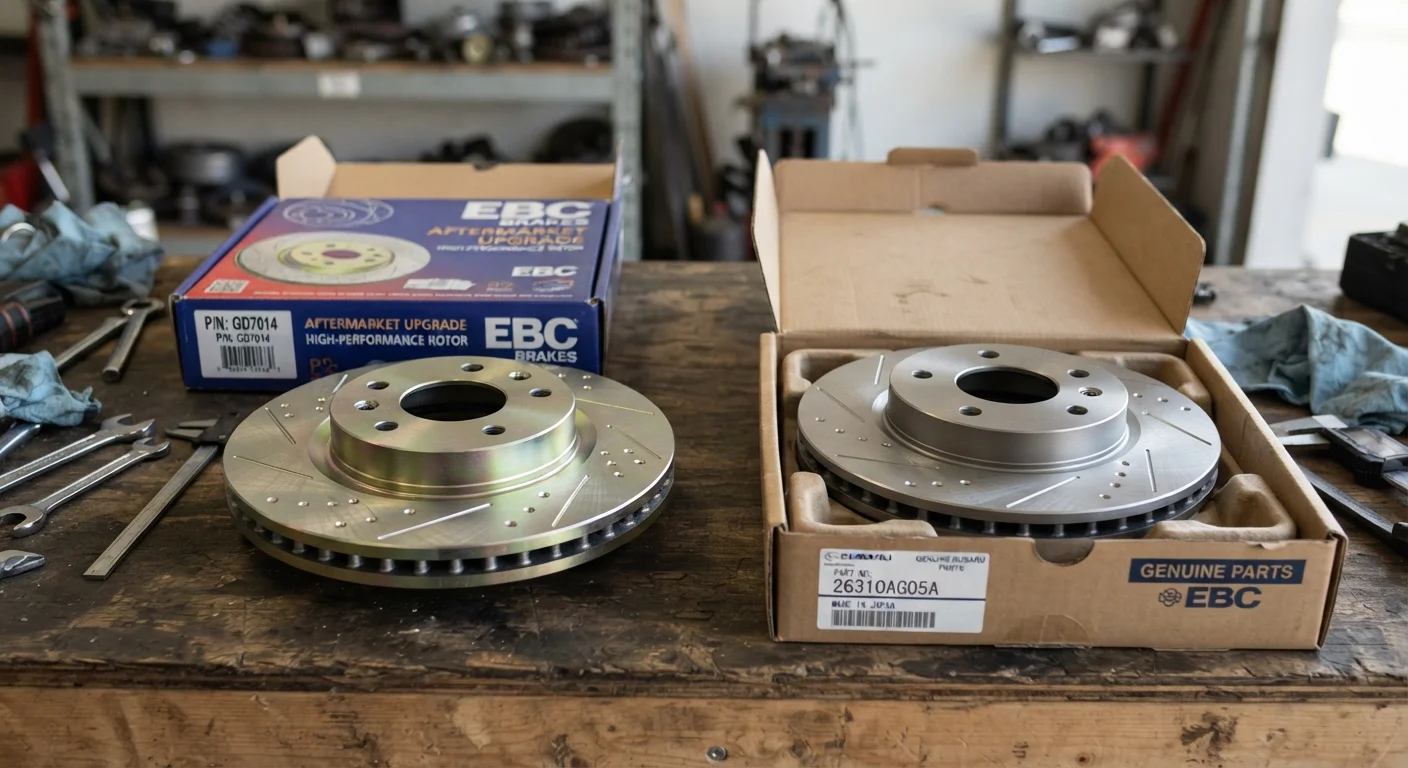
Longevity is where the gap shows most. A well-sourced aftermarket brake rotor from a recognised supplier may last as long as an OEM rotor. A bargain-bin version of the same part could warp or wear unevenly within a fraction of that lifespan. Asking your mechanic about the brand and grade of aftermarket part being used is always reasonable - and a good shop will answer clearly. Our article on questions to ask before approving repairs covers exactly this scenario.
Warranty Implications You Should Understand
For vehicles still within the manufacturer's new-car warranty, part choice carries real consequences. Under the Magnuson-Moss Warranty Act in the US, manufacturers generally cannot void an entire warranty simply because aftermarket parts were used - but they can deny warranty claims on specific components if an aftermarket part is shown to have caused the failure.
In practice, this means a dealer could decline to cover a transmission warranty claim if an aftermarket transmission fluid cooler is implicated in the damage. The burden of proof matters, and disputes can be time-consuming. When a vehicle is under factory warranty, using OEM parts is the lower-risk path.
The Magnuson-Moss Act: What It Does and Doesn't Cover
The Magnuson-Moss Warranty Act protects consumers from blanket warranty voids due to aftermarket part use alone. However, it does not prevent a manufacturer from denying coverage on a specific component if a non-OEM part is linked to that failure. The law applies to written warranties and is enforced through the Federal Trade Commission. If a warranty dispute arises, documentation of all repairs and parts used becomes important evidence.
Once a vehicle is out of warranty, the calculus shifts. Aftermarket parts become a practical option for managing costs on routine maintenance and wear items - particularly relevant when evaluating used car value over time.
When the Choice Matters Most
Not every repair carries equal stakes. Here's a practical breakdown:
- Safety-critical systems - brakes, steering, airbag modules, wheel bearings: OEM or verified premium aftermarket only. Fitment and material integrity are non-negotiable.
- Powertrain components - timing chains, water pumps, sensors: OEM is generally preferred, particularly on newer or complex engines.
- Wear items - wiper blades, cabin air filters, bulbs: quality aftermarket is widely accepted and cost-effective.
- Body and trim parts - bumper covers, mirrors, trim clips: aftermarket is common; fitment can vary, so verify before installation.
European vehicles with tightly integrated engineering - discussed in our overview of European brand differences - often have narrower tolerances, making part sourcing more consequential than on mass-market models.
~68%
Share of repair shops using aftermarket parts
Industry estimates suggest a large majority of independent repair shops use aftermarket parts for at least some repairs, reflecting their broad availability and cost advantages.
2-3x
Typical OEM price premium over aftermarket
Dealership service departments often price OEM parts at roughly two to three times the cost of equivalent aftermarket alternatives, though this varies significantly by component and vehicle.