

Key Takeaways
Where the Tier Gap Actually Begins
The distance between a mid-premium electric vehicle and a tier-one luxury EV is rarely visible in a spec sheet. Range figures overlap. Screen sizes compete. Both segments offer driver-assistance suites that would have seemed futuristic a decade ago. Yet experienced buyers consistently report that stepping into a flagship luxury EV feels categorically different — and that gap is engineered deliberately, not incidentally.
Understanding what produces that difference requires looking past headline numbers at the engineering decisions, material hierarchies, and ownership infrastructure that define the top tier. As our guide on what actually makes a car 'luxury' explains, price alone is an unreliable proxy — the real markers lie in NVH control, material provenance, platform architecture, and the depth of personalization available to the buyer.
The list below identifies the specific features where tier-one luxury EVs consistently diverge from mid-premium competitors — not as marketing categories, but as measurable engineering and experiential distinctions.
Dedicated Luxury EV Platform Architecture
Tier-one luxury EVs are almost universally built on platforms designed from the ground up for electric powertrains — not adapted from existing internal-combustion architectures. This distinction has cascading consequences. A purpose-built EV platform positions the battery pack within a structural floor, lowering the center of gravity and enabling a longer wheelbase for the vehicle's footprint. The result is rear-seat legroom and flat-floor usability that mid-premium vehicles built on shared or converted platforms often cannot match.
Platform architecture also determines how suspension geometry, thermal management, and structural rigidity interact. Flagship EV platforms typically integrate the battery as a structural element, improving torsional stiffness — a metric that directly affects both ride quality and the acoustic experience inside the cabin. For a broader look at how platform choices shape the ownership experience, see how luxury EVs differ from mainstream EVs.
Purpose-built EV platforms enable flat floors, lower centers of gravity, and structural rigidity that adapted platforms rarely match.
Multi-Layer Acoustic Engineering
Cabin quietness in a tier-one luxury EV is not the passive byproduct of eliminating an engine — it is an active engineering discipline. Manufacturers at this level employ layered NVH (noise, vibration, and harshness) suppression systems that include acoustic laminated glass, foam-injected body cavities, decoupled subframe mounts, and active road-noise cancellation via the audio system's speakers. Mid-premium EVs typically implement one or two of these measures; flagship models deploy all of them in combination.
The difference becomes most apparent at highway speeds, where tire and wind noise dominate. Tier-one vehicles in this segment invest in aerodynamic sealing around door and window frames, use tire compounds selected specifically for low rolling noise, and calibrate active noise cancellation algorithms to the specific resonant frequencies of their body structure. The interior materials themselves contribute — the anatomy of a luxury EV interior details how upholstery density and trim panel construction affect acoustic performance.
Active noise cancellation, acoustic glazing, and foam-injected cavities combine to create cabin quietness that is engineered, not accidental.
Predictive Air Suspension Systems
Adaptive air suspension is available across multiple price tiers, but the implementation at the top of the luxury EV segment introduces a meaningful qualitative difference: road-preview or predictive suspension. These systems use forward-facing cameras or GPS map data to read road surface conditions ahead of the vehicle and pre-adjust damper settings before the wheel reaches an imperfection, rather than reacting after contact.
The practical outcome is a ride character that feels more composed at all speeds — particularly over urban surfaces, expansion joints, and highway irregularities. Mid-premium air suspension typically reacts within milliseconds; predictive systems act in advance. Paired with the low center of gravity afforded by dedicated EV platforms, this produces handling confidence and ride compliance that is difficult to approximate through hardware upgrades alone.
Predictive suspension pre-adjusts dampers using camera or GPS data before a wheel contacts a road imperfection.
Bespoke Material Sourcing and Finishing
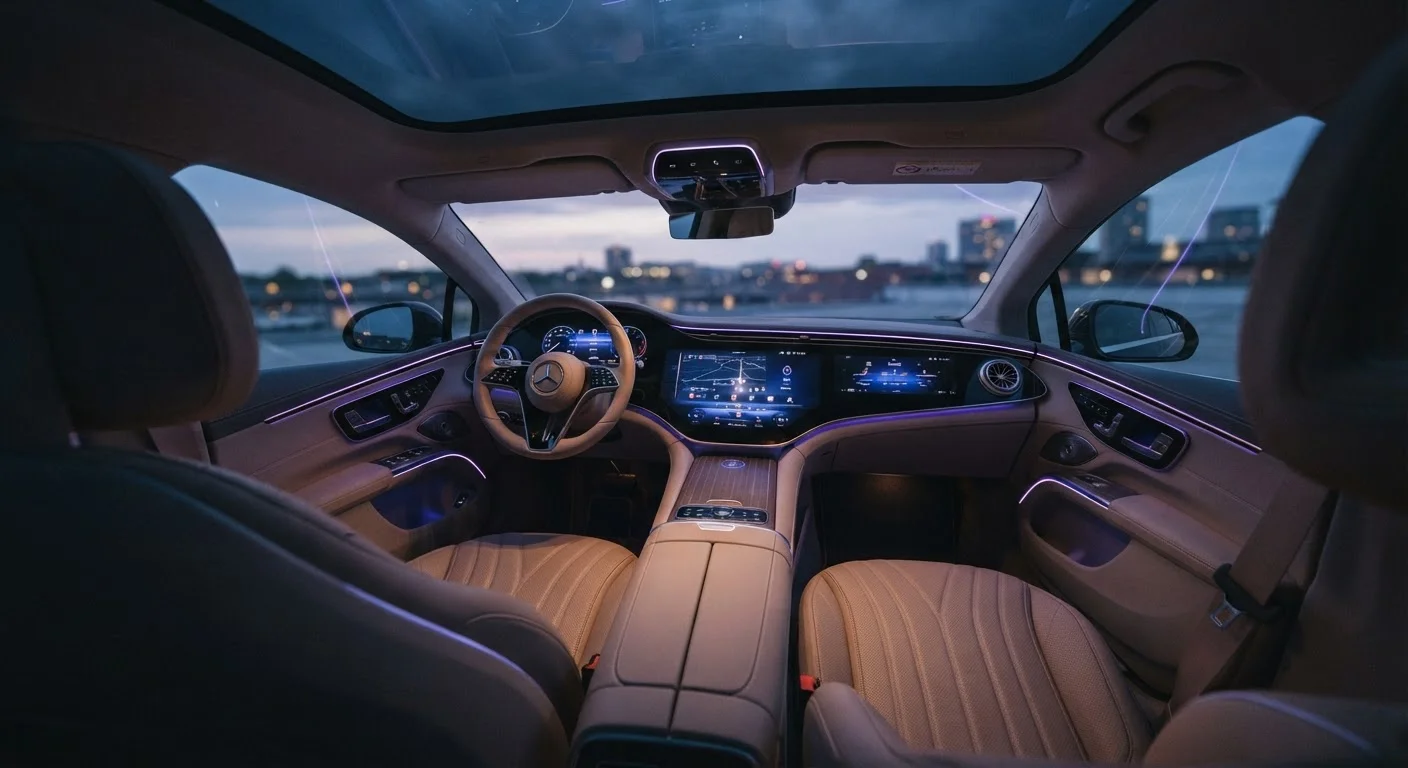
The material hierarchy in tier-one luxury EVs extends well beyond selecting premium trim packages. At the flagship level, manufacturers source full-grain or open-pore leather with visible grain consistency, specify wood veneers that are book-matched across panels, and use machined aluminum or milled metal for controls rather than die-cast substitutes. In some cases, materials are sourced from named tanneries or forestry programs and that provenance is disclosed to buyers as part of the product story.
Finishing tolerances also differ. Panel gaps, stitch spacing, and the tactile weight of switches and controls are quality-controlled to specifications that mid-premium production volumes make difficult to sustain. For buyers who have never compared these details directly, the defining criteria for luxury vehicles provides useful benchmarks for evaluating material quality objectively during a physical inspection.
Book-matched veneers, named-provenance leather, and machined metal controls signal material investment that production-line trims cannot replicate.
Proprietary or Privileged Charging Infrastructure
Charging experience is an ownership differentiator that mid-premium EV buyers sometimes underestimate until they live with a vehicle daily. Several tier-one luxury EV manufacturers have established proprietary charging networks, negotiated priority access agreements, or offer concierge charging services that reduce the friction of public charging substantially. Some programs include home charger installation, network membership, or valet charging services as part of the vehicle's ownership package.
Beyond network access, flagship EVs at this tier tend to offer higher peak DC fast-charging rates — often 250 kW or above — combined with more sophisticated thermal pre-conditioning that prepares the battery for fast charging while en route rather than after arrival. The combination of network access and hardware capability creates a charging experience that is meaningfully more convenient than what the mid-premium tier typically provides. See the end-to-end buyer's reference for how charging infrastructure fits into total cost-of-ownership evaluation.
Proprietary networks, concierge charging, and peak rates above 250 kW distinguish the ownership experience well beyond the vehicle itself.
Deep Personalization and Bespoke Configuration Programs
At the tier-one luxury level, personalization extends from a standard option list to genuine bespoke programs. Some manufacturers offer exterior paint mixed to individual specifications, interior trim sourced from customer-selected materials, and commissioning processes in which buyers work directly with design teams. Even manufacturers without full bespoke programs at this tier typically offer exclusive paint collections, extended leather color ranges, and individual-order options unavailable on standard production vehicles.
This depth of personalization reflects a fundamentally different relationship between manufacturer and buyer — one in which the vehicle is treated as a long-term personal object rather than a configured product. It also has downstream implications: software-defined luxury through OTA updates is increasingly extending this personalization into the digital layer, allowing feature configurations to evolve after purchase. The combination of physical and software personalization depth is a defining characteristic of the top luxury EV tier that the mid-premium segment has not yet fully replicated.
Bespoke paint programs, individual-order options, and evolving software configurations treat ownership as a long-term, personalized relationship.
Making a Well-Informed Decision
Recognizing these distinctions matters most when you are evaluating vehicles side by side. A mid-premium EV with strong range figures and a competitive interior can still fall short on acoustic refinement, ride programmability, or the depth of material choice that defines the ownership experience over years, not weeks. Our structured assessment checklist provides a point-by-point framework for testing these qualities before committing.
Test the Cabin at Highway Speed
Many of the acoustic and ride-quality differences between tiers are only apparent above 55 mph. If an extended test drive is available, prioritize time at highway speeds over urban evaluation. Listen for wind and tire noise at the door seals and A-pillar, and note how the suspension handles freeway surface transitions — these conditions reveal refinement differences that parking-lot impressions mask entirely.
For buyers approaching the luxury EV segment for the first time, the complete landscape guide for first-time buyers offers broader context on how the segment is organized, what body styles are available, and how to identify which tier genuinely fits your priorities. The engineering details outlined here are most valuable once that foundational framework is in place.
This article is for informational and educational purposes only. Vehicle features, specifications, and availability vary by manufacturer, model year, and market. Consult manufacturer documentation and conduct independent verification before making any purchasing decision.