

| Federal new EV credit (max) | Up to $7,500 (Inflation Reduction Act, IRS) |
| State rebate range (varies widely) | $500–$5,000+ (DSIRE database, program-specific) |
| Sales-tax exemption states | Approx. 10 states (DSIRE, state revenue departments) |
| HOV lane access states | 16+ states (U.S. Department of Energy, AFDC) |
| Utility charger rebates | $200–$1,000 typical (Individual utility programs vary) |
Why State Incentives Matter as Much as Federal Credits
Most EV shoppers know about the federal clean vehicle tax credit — up to $7,500 for qualifying new electric vehicles — but the complete financial picture depends heavily on where you live. State-level programs can add thousands of dollars in additional savings through rebates, tax exemptions, reduced registration fees, and non-monetary perks like carpool-lane access. See our Federal EV Tax Credits Explained for the baseline federal program details before layering in state benefits.
Unlike the federal credit, which flows through your income tax return, state incentives arrive in varied forms: direct rebates paid after purchase, sales-tax exemptions applied at the dealership, income-tax credits claimed annually, and utility rebates credited to your electricity bill. Understanding the form each incentive takes matters because it affects when you receive the money and whether your tax situation allows you to capture the full benefit.
| Federal new EV credit (max) | Up to $7,500 (Inflation Reduction Act, IRS) |
| State rebate range (varies widely) | $500–$5,000+ (DSIRE database, program-specific) |
| Sales-tax exemption states | Approx. 10 states (DSIRE, state revenue departments) |
| HOV lane access states | 16+ states (U.S. Department of Energy, AFDC) |
| Utility charger rebates | $200–$1,000 typical (Individual utility programs vary) |
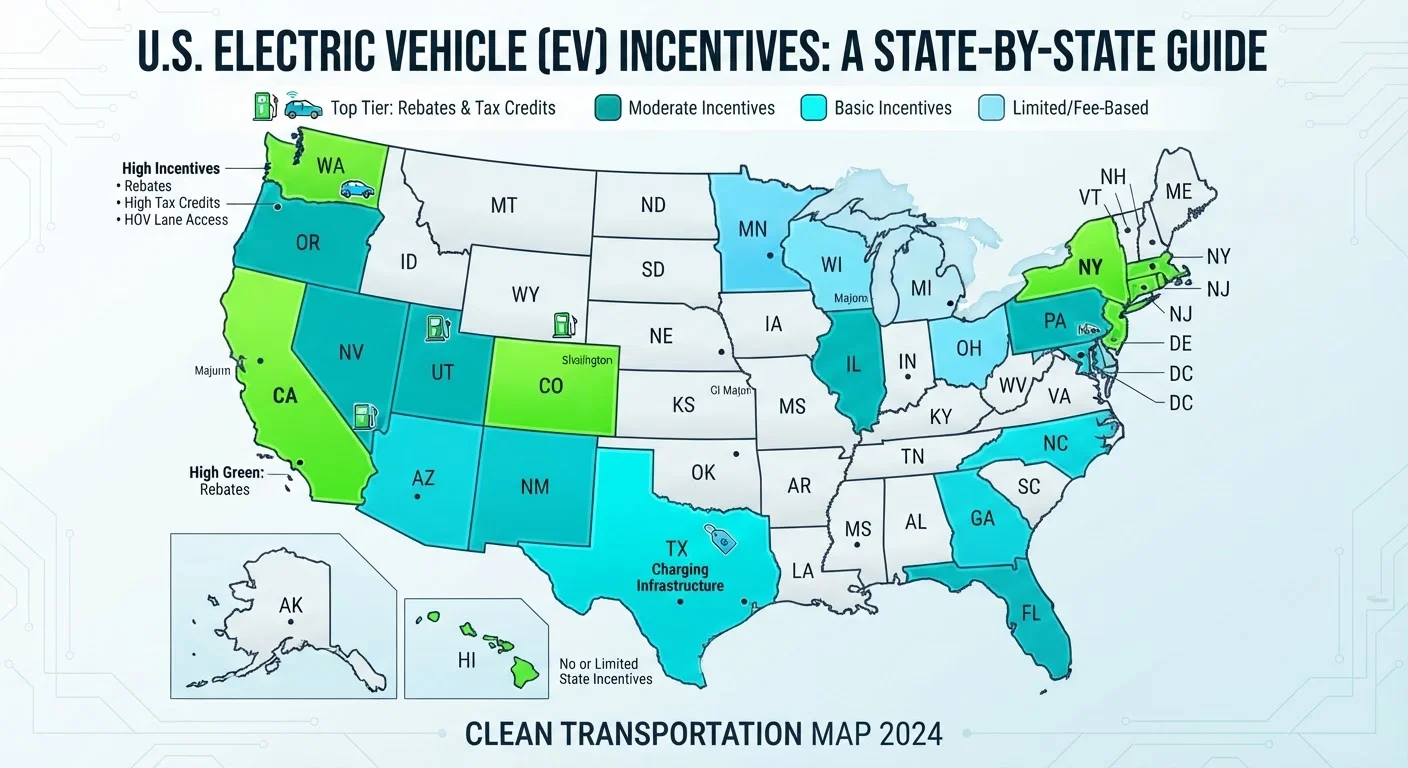
A Regional Breakdown of State EV Programs
State programs differ dramatically by region. The following categories represent the primary incentive types you'll encounter:
- Direct rebates: States like California (through the Clean Vehicle Rebate Project's successor programs), Colorado, and New York have offered point-of-sale or post-purchase rebates ranging from $1,000 to $5,000 depending on income and vehicle type. Eligibility rules and funding availability change frequently — always verify current status directly with the administering state agency.
- Sales and use tax exemptions: Several states, including Washington and New Jersey, exempt EVs from state sales tax entirely. On a $45,000 vehicle, that alone can represent $2,700 to $4,000 in savings depending on the state rate.
- Income-tax credits: States such as Colorado provide income-tax credits (separate from rebates) that reduce your state tax liability in the year of purchase. These interact with your personal tax situation similarly to the federal credit.
- HOV and toll benefits: Georgia, Virginia, California, and others grant EV drivers access to high-occupancy vehicle lanes regardless of passenger count. Some states also offer toll discounts or exemptions, a tangible ongoing value for daily commuters.
- Reduced registration fees: A handful of states offer lower annual registration costs for EVs, partially offsetting the higher registration fees some states charge to compensate for lost fuel-tax revenue.
For a full breakdown of how financing decisions interact with these programs, the Financial Questions to Resolve Before Switching to an EV is a useful companion resource.
EVSE
Electric Vehicle Supply Equipment — the technical term for a home or public EV charging unit. Rebates commonly apply to Level 2 EVSE installations.
DSIRE
Database of State Incentives for Renewables and Efficiency, a federally funded resource maintained by NC State University that catalogs state, utility, and local EV and clean energy incentives.
HOV Lane Access
The privilege of driving in high-occupancy vehicle lanes without the required number of passengers. Many states grant this to EVs as a non-monetary incentive to encourage adoption.
Point-of-Sale Rebate
A rebate applied directly at the time of vehicle purchase, reducing the upfront price rather than requiring the buyer to file for reimbursement afterward.
Time-of-Use (TOU) Rate
An electricity pricing structure where rates vary by time of day. EVs charged overnight during off-peak hours can benefit from significantly lower per-kWh costs.
Stacking Incentives
The practice of combining multiple incentive programs — federal, state, and utility — on a single vehicle purchase to maximize total savings. Most programs permit stacking, though rules vary.
Utility Company Programs: The Often-Overlooked Layer
Beyond state government programs, your electric utility may offer its own incentives that compound state savings. Common utility-level benefits include rebates on home EV charger (EVSE) equipment, installation credits, and discounted off-peak electricity rates specifically structured for overnight charging. Some utilities in California, Michigan, and the Pacific Northwest offer time-of-use rate plans where overnight EV charging can cost significantly less per kilowatt-hour than peak daytime rates.
Utility programs are hyperlocal — they vary not just by state but by individual provider and sometimes by service territory within a state. Our guide on how utility companies incentivize EV adoption explains the program structures in detail. Contact your utility provider directly or check the Database of State Incentives for Renewables and Efficiency (DSIRE) to identify what's currently available at your address.
$10,000+
Potential combined incentive value in top states
In states like Colorado, combined federal, state, and utility incentives can exceed $10,000 on qualifying vehicles, according to the U.S. Department of Energy's Alternative Fuels Data Center.
16+
US states offering EV HOV lane access
The U.S. Department of Transportation tracks states that grant single-occupant EV access to HOV lanes as an ongoing non-monetary benefit.
~10
States with full or partial EV sales-tax exemptions
Approximately ten states provide sales or use tax exemptions for EV purchases, per the DSIRE database.
How to Stack and Verify Incentives Before Buying
Most state rebates and tax credits can be stacked on top of the federal clean vehicle credit, though specific stacking rules vary. When calculating your true net cost, work through incentives in this order: federal credit first (apply income and vehicle eligibility rules), then state income-tax credits or rebates, then utility rebates, and finally any municipal programs that exist in your city or county.
Key verification steps before finalizing a purchase:
- Check the administering agency's website directly — rebate funds are often capped and can be exhausted mid-year.
- Confirm whether the incentive applies to leases as well as purchases. The Leasing vs. Buying an Electric Vehicle explains how federal and state credits interact differently with leased vehicles.
- Review income thresholds — many state rebates are tiered, offering higher amounts to lower-income buyers.
- Verify vehicle eligibility separately for each program; a model qualifying for the federal credit may not qualify for a particular state rebate.
DSIRE (dsireusa.org) and your state's energy or revenue department websites are the most authoritative sources for current program details. For broader context on EV model compatibility with these programs, explore the Electric Models hub.
This article is for general informational purposes only. Incentive programs, eligibility rules, and funding availability change frequently. Consult your state's official energy or revenue agency and a qualified tax professional before making purchasing decisions based on available incentives.