

Key Takeaways
Federal EV Tax Credit
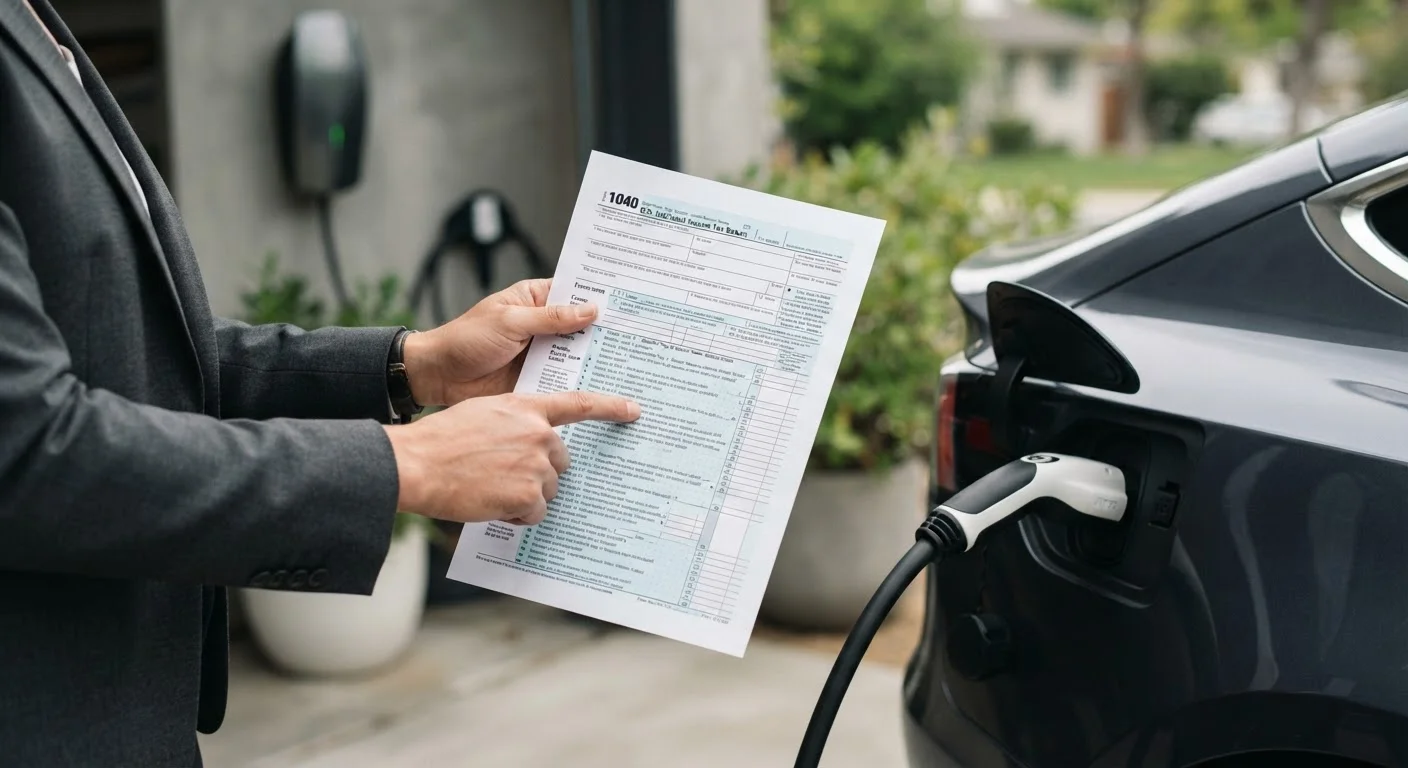
The federal EV tax credit is a dollar-for-dollar reduction in the federal income tax you owe when you purchase a qualifying new or used electric vehicle. Under the Inflation Reduction Act, the credit for new EVs is worth up to $7,500, while used EVs may qualify for up to $4,000. Unlike a rebate, this credit reduces your tax liability rather than lowering the vehicle's sticker price directly.
Starting in 2024, buyers may transfer the credit to a participating dealer at the point of sale, effectively receiving it as a price reduction - known as the 'transferability' provision. Eligibility depends on the buyer's modified adjusted gross income, vehicle MSRP caps, and North American assembly requirements.
How the Federal EV Tax Credit Works
The federal EV tax credit operates as a non-refundable credit - it offsets the amount of federal income tax you owe for the year in which you purchase the vehicle. If your tax liability is $6,000 and your credit is $7,500, you eliminate that $6,000 bill but do not receive the remaining $1,500 as a refund.
This distinction matters more than many buyers realize. Someone purchasing an EV with a low federal tax burden may capture only a fraction of the advertised credit. Consulting a tax professional before purchase helps clarify your realistic benefit.
One meaningful update that took effect in 2024: the IRS now permits buyers to transfer the credit to a qualifying dealer at point of sale. This means the dealer reduces the vehicle's purchase price by the credit amount, and the buyer receives the benefit immediately rather than waiting until they file their annual return. The IRS then reimburses the dealer directly.
Use the IRS Vehicle Eligibility Tool
The IRS maintains an online tool at fueleconomy.gov that lists currently eligible vehicles for both the new and used EV tax credits. Because qualifying models change as battery sourcing rules are updated, checking this list close to the time of purchase - rather than relying on older sources - gives you the most accurate picture of what qualifies.
For a deeper look at how EV financing choices interact with this credit, see our guide on leasing vs. buying an electric vehicle.
Eligibility Requirements: Income, Vehicle, and Assembly Rules
Three overlapping sets of rules determine whether a buyer and vehicle combination qualifies for the full credit.
Income Limits
The IRS uses your MAGI - which is roughly your adjusted gross income before certain deductions - to determine eligibility. For new EVs, the limits are:
- $150,000 - single filers
- $225,000 - heads of household
- $300,000 - married filing jointly
For used EVs, the thresholds are lower: $75,000 (single), $112,500 (head of household), and $150,000 (married filing jointly). Exceeding these limits in either the year of purchase or the prior year disqualifies you entirely.
Vehicle MSRP Caps
New EVs must also fall below IRS price ceilings: $80,000 for SUVs, vans, and pickup trucks; $55,000 for sedans and other vehicles. Vehicles priced above these caps are ineligible regardless of how much tax you owe.
North American Assembly and Battery Sourcing
Under current rules, a qualifying new EV must undergo final assembly in North America. Additionally, battery component and critical mineral sourcing rules affect whether a buyer receives the full $7,500 or a reduced $3,750 credit. The IRS maintains a current list of qualifying vehicles, which changes as manufacturers adjust their supply chains.
$7,500
Maximum federal tax credit for new EVs
Set by the Inflation Reduction Act; the exact amount depends on battery sourcing and vehicle assembly rules.
$4,000
Maximum federal tax credit for used EVs
Capped at the lesser of $4,000 or 30% of the vehicle sale price for qualifying pre-owned EVs purchased from a dealer.
$25,000
Used EV maximum eligible sale price
Vehicles priced above this threshold do not qualify for the used EV federal tax credit.
Used EV Credit: A Different Set of Rules
Buyers purchasing a pre-owned EV from a licensed dealer may qualify for a separate credit worth up to $4,000, or 30% of the vehicle's sale price - whichever is less. The vehicle must be at least two model years old, priced at $25,000 or below, and this must be the first time the credit has been claimed on that specific vehicle.
The income limits for used EVs are stricter than for new ones (see above), and the credit may also be transferred to the dealer at point of sale under the same transferability rules introduced in 2024.
It is worth noting that the used EV credit applies only to dealer sales - private-party transactions are not eligible.
Leasing Changes the Credit Equation
When you lease an EV, the leasing company is considered the owner and claims any available credit - not the individual lessee. Some lessors pass this savings along through lower monthly payments or reduced capitalized cost, but there is no requirement to do so. Always ask your lender how the credit is handled in your specific lease agreement. For more detail, see our article on leasing vs. buying an EV.
Stacking Credits: Federal, State, and Utility Programs
The federal credit does not exist in isolation. Many states offer their own rebates, tax credits, or exemptions that can be layered on top of the federal benefit. Some utility companies also provide additional incentives for EV purchases or home charger installations.
For example, a buyer in a state with a $2,500 EV rebate who also qualifies for the full $7,500 federal credit could reduce their effective vehicle cost by $10,000 or more before factoring in any utility incentives - though the specifics vary considerably by location and income level.
To explore what may be available beyond the federal program, see our state-by-state EV incentives guide. And for first-time EV buyers working through the full landscape of incentive programs, making sense of EV incentives offers a plain-language overview.
This article provides general educational information about federal EV tax credits and is not tax or financial advice. Tax laws change, eligibility rules are subject to IRS interpretation, and individual circumstances vary. Consult a qualified tax professional for guidance specific to your situation.