

Key Takeaways
Why Mechanical Architecture Drives Long-Term Costs
When evaluating SUV reliability, most buyers focus on brand reputation or initial quality surveys. But the more durable predictor of ownership costs is mechanical architecture - specifically the drivetrain layout, transmission type, and engine configuration an SUV ships with from the factory.
An SUV's reliability trajectory isn't random. It follows the complexity of its systems. More components in motion mean more components that can wear, leak, or fail. Understanding which mechanical decisions create durable vehicles - and which create expensive ones - gives buyers a more honest framework than brand loyalty alone. See how reliability survey methodology actually works to understand what those rankings are and aren't measuring.
~40%
Of unplanned SUV repairs tied to fluid neglect
Industry repair data aggregated by independent service networks consistently identifies deferred fluid maintenance as a leading driver of preventable drivetrain and transmission failures.
2x
Cost difference between AWD and FWD drivetrain repairs
Automotive repair cost analyses from major service aggregators indicate AWD-related drivetrain repairs average roughly twice the cost of comparable FWD repairs at equivalent mileage.
Drivetrain Complexity and Its Reliability Trade-Offs
All-wheel drive (AWD) is among the most consequential mechanical choices in an SUV purchase. Not all AWD systems are equal in design complexity or maintenance demand. Full-time AWD systems with center differentials, electronically controlled multi-plate clutches, and active torque vectoring introduce more serviceable components than simpler rear-biased, on-demand AWD setups.
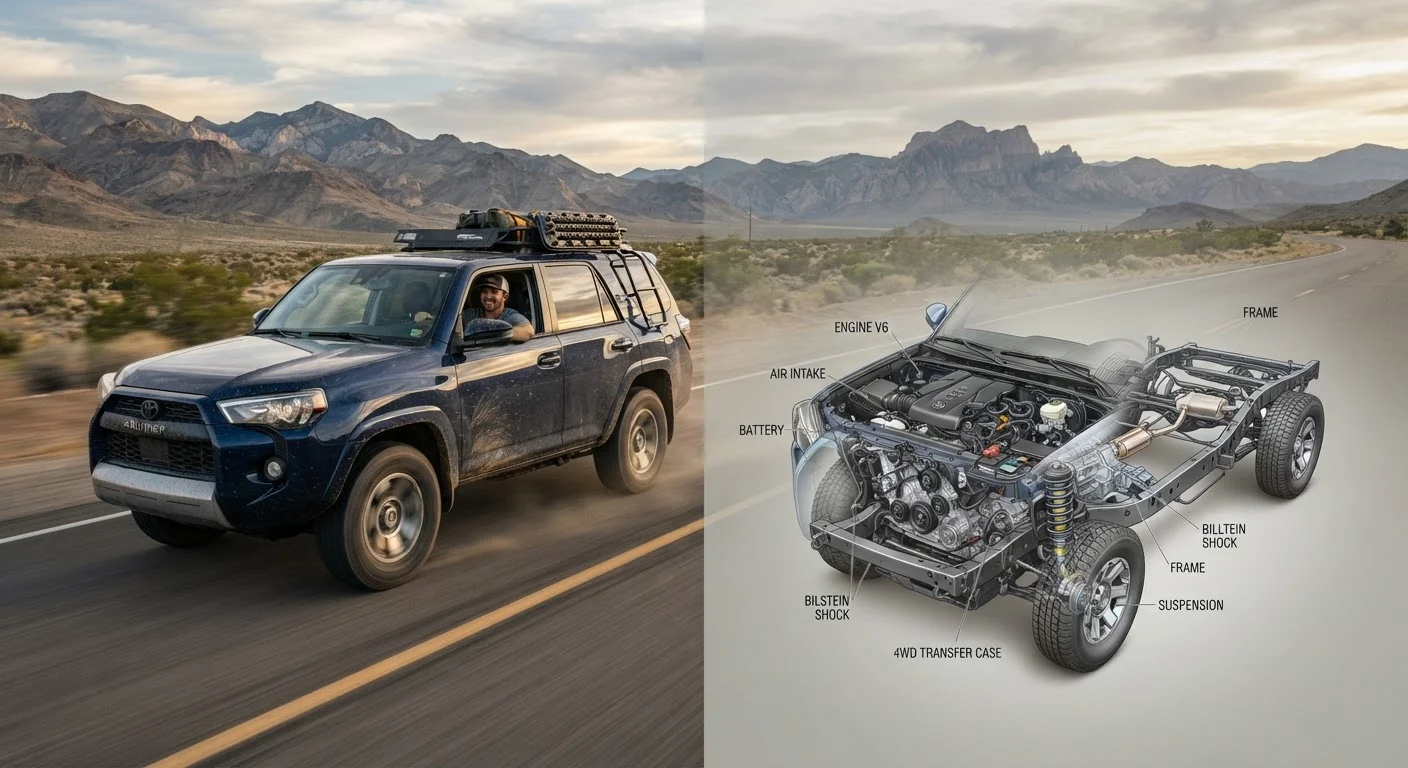
Part-time four-wheel drive (4WD) systems, common in body-on-frame truck-based SUVs, are mechanically simpler in their engaged state but add a transfer case that requires periodic fluid service. Neglecting transfer case and front differential fluid changes is one of the most frequently cited causes of expensive drivetrain failures in higher-mileage SUVs.
For buyers who rarely use off-road capability, a front-wheel-drive variant of a given model will almost always carry a lower long-term repair probability than its AWD counterpart - a trade-off worth weighing honestly. How body-on-frame and unibody construction differ also matters here, as each platform ages differently under stress.
Match AWD system complexity to your actual driving demands before purchase.
AWD systems vary widely in component count and maintenance requirements. Selecting a more complex system than your use case requires adds cost without adding utility, and introduces additional failure points over time.
Follow manufacturer-specified transmission fluid change intervals - never extend them.
Transmission fluid degrades thermally and loses its friction-modifier properties over time. Degraded fluid causes clutch pack wear in automatics and premature belt wear in CVTs, often resulting in repairs that exceed the cost of a full transmission replacement.
Change engine oil on a shortened interval if the SUV is turbocharged or used for towing.
Turbochargers spin at extremely high speeds and rely on oil for bearing lubrication and heat dissipation. Towing also elevates oil temperatures. Both conditions accelerate oil degradation beyond what standard change intervals assume.
Service transfer case and differential fluids at the intervals specified in the owner's manual.
These fluids are frequently overlooked because they have no dashboard warning light and their degradation is invisible. Contaminated or depleted differential fluid is a leading cause of expensive drivetrain repairs in AWD and 4WD SUVs beyond 100,000 miles.
Address suspension wear items - bushings, ball joints, and links - before they compound into costlier failures.
Worn bushings and ball joints alter suspension geometry, accelerating tire wear and stressing adjacent components such as wheel bearings and steering rack ends. Timely replacement of individual wear items is substantially cheaper than the cascading repairs deferred replacement causes.
Transmission Types and Engine Design Considerations
Transmission choice is another key reliability variable. Traditional six- or eight-speed automatic transmissions have decades of refinement behind them and well-established service intervals. CVTs (continuously variable transmissions) deliver fuel economy gains but have shown higher failure rates in some applications - particularly when subjected to towing loads beyond their rated capacity or when fluid changes are deferred.
Eight- and nine-speed automatics can also experience shuddering or hunting behavior when software calibration is mismatched with fluid type. Using the manufacturer-specified transmission fluid is not optional - it is a reliability requirement.
On the engine side, turbocharged four-cylinder engines dominate modern mid-size SUVs. They produce strong output figures but rely on precise oil maintenance. Turbocharger bearing lubrication depends on clean, properly viscous oil; extended oil change intervals in turbocharged SUVs are directly linked to premature turbo failure. Naturally aspirated V6 engines carry fewer thermally stressed components and tend to show more predictable wear curves at higher mileage.
Turbocharged Engine Oil: Don't Stretch Intervals
Turbocharged SUV engines are sensitive to oil quality in a way naturally aspirated engines are not. Even if a manufacturer's guide suggests 7,500-mile intervals, many automotive technicians recommend shortening that to 5,000 miles for turbocharged models used in demanding conditions. Always use the oil viscosity grade specified in the owner's manual - substitutions can affect turbocharger bearing lubrication.
Maintenance Practices That Determine Longevity
Mechanical design sets the ceiling for reliability; maintenance habits determine whether an SUV reaches it. The gap between a 150,000-mile SUV and a 250,000-mile one is almost always a maintenance record, not a manufacturing secret.
Fluid services are the highest-leverage maintenance category: engine oil, transmission fluid, transfer case fluid, differential fluid, coolant, and brake fluid all degrade over time and mileage regardless of how the vehicle feels. Many of these have no warning light to prompt action. Buyers evaluating used SUVs should request documentation for all of these services - their absence is a meaningful risk signal. The used car buying process should always include a full fluid service history review.
Suspension wear - particularly control arm bushings, ball joints, and sway bar links - accelerates in SUVs that see rough roads or frequent towing. These are wear items, not defects, but deferred replacement compounds stress on adjacent components. Addressing them promptly limits repair scope.
Families evaluating SUVs for long-term use should also review how capability, safety, and practicality interact across the segment before committing to a platform.
Reliability Data Has Real Limitations
Published reliability rankings aggregate owner-reported problems, which means they reflect what owners notice and report - not every mechanical event. An SUV that ranks well in surveys may still have specific subsystem weaknesses, and vice versa. Use reliability data as one input among several, not a definitive verdict. For deeper context, understanding what reliability surveys actually measure is a useful starting point.