

Key Takeaways
Our Verdict
Turbocharged four-cylinders have closed the performance gap with naturally aspirated sixes and offer a compact, fuel-efficient package. However, naturally aspirated sixes retain meaningful advantages in refinement, power linearity, and long-term mechanical simplicity. Neither architecture is universally superior - the stronger fit depends on how the vehicle is used and what the driver values most.
| Best for | Recommended |
|---|---|
| Drivers prioritizing fuel economy and lighter engine weight | Turbocharged Four-Cylinder |
| Those who value smooth, linear power and acoustic refinement | Naturally Aspirated Six-Cylinder |
| Urban commuters who rarely push engines to their limits | Turbocharged Four-Cylinder |
| Highway cruisers and long-distance drivers seeking effortless performance | Naturally Aspirated Six-Cylinder |
How Each Engine Architecture Works
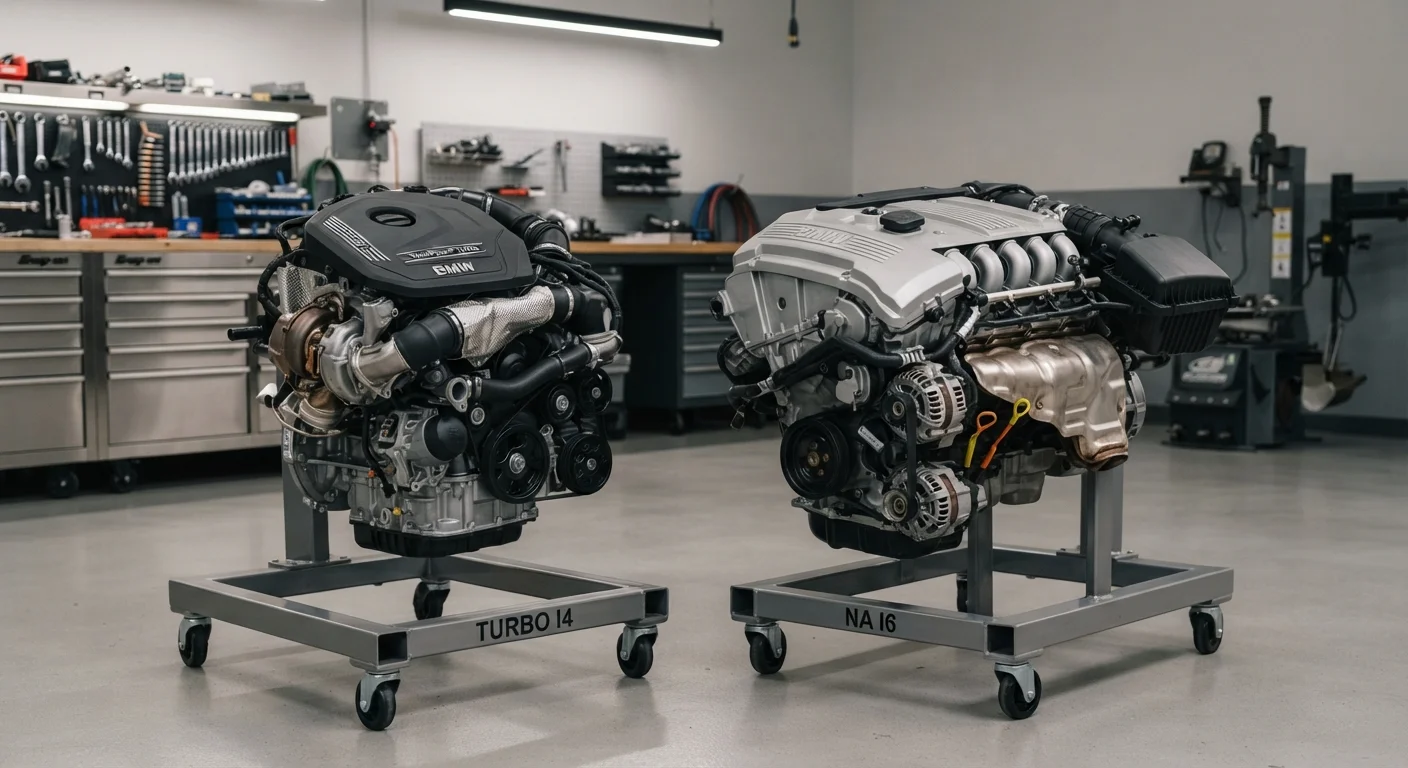
A naturally aspirated six-cylinder (NA six) draws air into its combustion chambers purely through atmospheric pressure. With six cylinders firing in a carefully sequenced pattern, it produces power smoothly across a wide rev range without relying on forced induction hardware.
A turbocharged four-cylinder (turbo four) uses exhaust gases to spin a turbine that compresses intake air, allowing a smaller engine to generate power levels comparable to larger displacement units. The result is a lighter, physically smaller package - but one that introduces additional components including the turbocharger, intercooler, and associated plumbing.
Understanding these fundamentals matters because it explains why two engines with identical horsepower ratings on a spec sheet can feel and behave quite differently behind the wheel.
Performance: Power Figures vs. Real-World Feel
Peak horsepower numbers can be misleading when comparing these two architectures. A turbo four producing 300 hp may reach that figure only within a narrow rpm band, with a noticeable lag before turbo boost builds - a phenomenon called turbo lag. A naturally aspirated six reaching the same peak may get there more gradually but delivers torque in a predictable, linear curve throughout the rev range.
In practical sedan driving - merging onto highways, passing at speed, or navigating elevation changes - the NA six's consistent power delivery often feels more effortless. The turbo four, conversely, can feel energetic and punchy in stop-and-go conditions where boost builds quickly from a standing start.
| Turbo Four-Cylinder | Naturally Aspirated Six-Cylinder | |
|---|---|---|
| Peak Power Delivery | Narrow rpm band, boost-dependent | Linear across broader rev range |
| Refinement / NVH | Good with active mounts; some vibration | Inherently smoother, quieter idle |
| Turbo Lag | Present at low rpm | Not applicable |
| EPA Fuel Economy | Typically higher rated | Moderate, more consistent to real-world |
| Mechanical Complexity | Higher (turbo, intercooler, plumbing) | Lower (fewer forced-induction components) |
| Engine Weight | Lighter, better weight distribution | Heavier, but larger displacement |
| Long-Term Reliability Trend | Improving; maintenance-sensitive | Historically strong, simpler system |
For drivers interested in how chassis tuning shapes the overall dynamic impression, suspension setup plays an equally important role in how a sedan ultimately feels on the road.
Refinement, NVH, and Cabin Experience
Six-cylinder engines - particularly inline-sixes - are inherently better balanced than four-cylinder units. The firing intervals of a six produce less vibration, which translates into a quieter, smoother cabin environment. This is measurable in NVH benchmarks and immediately perceptible to passengers on long-distance drives.
Modern turbo fours have improved considerably through active engine mounts and noise cancellation systems, but they generally cannot fully replicate the acoustic composure of a well-engineered NA six. At idle and light loads, a four-cylinder's vibration signature remains more noticeable. For sedan buyers who spend significant time on highways, this refinement gap is a genuine consideration - not merely an enthusiast preference.
Test Drive Both Under Real Conditions
Spec-sheet comparisons tell only part of the story. When evaluating sedans with these two engine types, request a test drive that includes steady highway cruising, a passing maneuver, and stop-and-go city traffic. The differences in power delivery and cabin refinement become most apparent under those varied conditions rather than in a brief dealership lot loop.
Fuel Economy: Lab Numbers vs. Everyday Reality
Turbo fours are engineered partly to improve efficiency through engine downsizing - replacing a larger displacement engine with a smaller one that produces equivalent peak power. EPA fuel economy ratings often reflect this advantage. However, real-world returns vary significantly based on driving habits.
At steady highway speeds with light throttle, a turbo four can approach its rated efficiency. Under more aggressive driving - frequent acceleration, towing, or sustained high-speed cruising - the turbocharger operates more continuously and fuel consumption rises sharply. Naturally aspirated sixes tend to deliver fuel economy that is more consistent between EPA estimates and real-world use, particularly under highway loads.
The efficiency case for turbo fours is strongest for drivers with mixed urban and suburban cycles who rarely operate engines at sustained high load.
Long-Term Reliability and Ownership Considerations
Naturally aspirated engines have fewer failure points. Without a turbocharger, intercooler, boost control solenoids, or the oil cooling demands of forced induction, an NA six presents a mechanically simpler system. Industry reliability surveys have historically reflected this - though the margin has narrowed as turbo technology has matured.
Modern turbocharged four-cylinders, particularly those from manufacturers with established forced-induction experience, have demonstrated competitive durability over high-mileage intervals. Key maintenance factors include using the correct oil specification and adhering to change intervals, since turbochargers rely on clean oil for bearing lubrication.
Owners who prioritize lowest total maintenance complexity over the vehicle's life may still find naturally aspirated sixes easier to manage, while those comfortable with consistent maintenance schedules will find turbo fours perfectly viable. The sedan body style itself invites a broader conversation about vehicle category - for context on how design language intersects with buyer expectations, see what separates a sedan from a four-door coupe.
~15-20%
Typical real-world efficiency gap under load
Engineering analyses suggest turbo four fuel economy advantages over NA sixes shrink by roughly 15-20% under sustained high-load highway driving compared to EPA test cycles.
6
Cylinders producing inherent balance in inline-six
Inline-six engines are mechanically balanced by their geometry, which is a key reason they are widely referenced in NVH engineering as a benchmark for smoothness.