

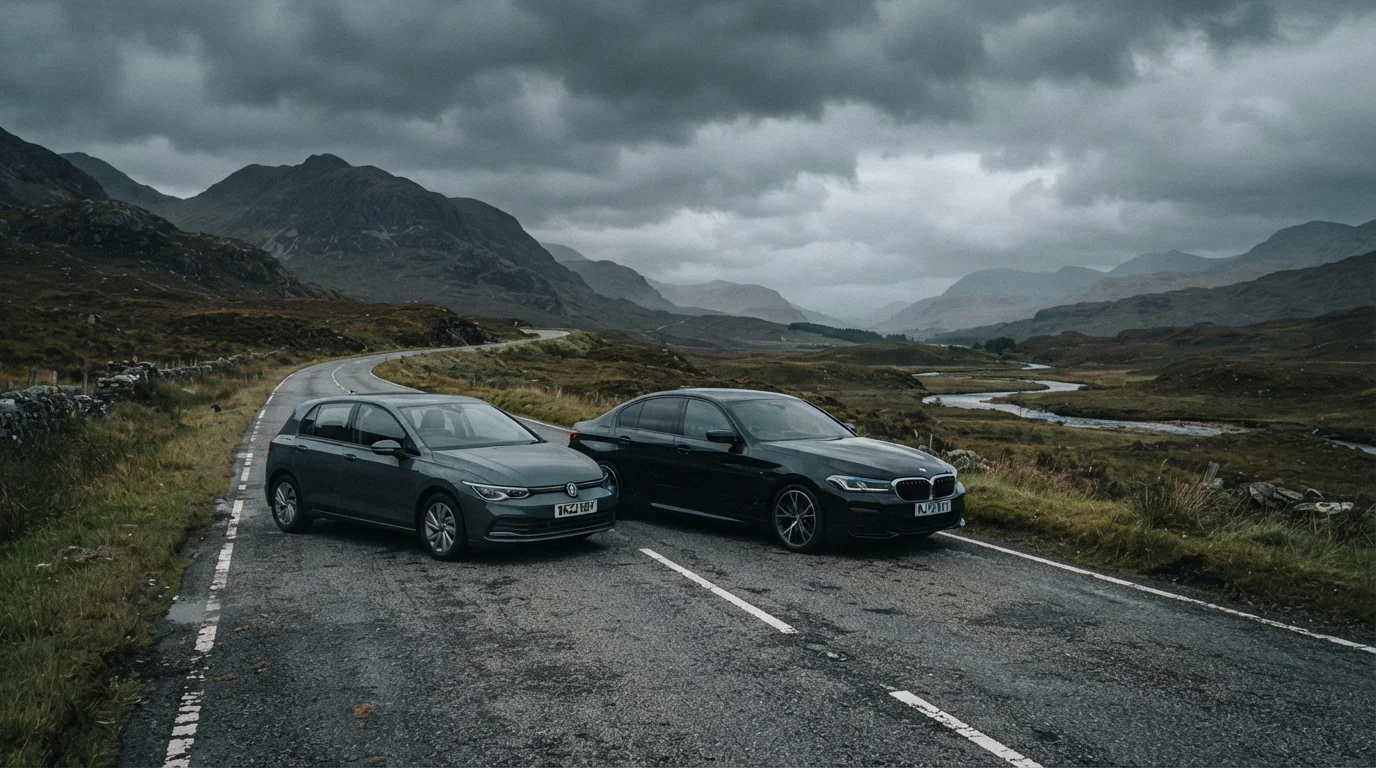
Key Takeaways
Option A
Volume Brand
The accessible, mass-market engineering proposition.
Best for: Buyers prioritising everyday practicality, lower ownership costs, and broad dealer network coverage.
Option B
Prestige Brand
The premium, differentiated ownership experience.
Best for: Buyers seeking advanced technology, elevated cabin materials, brand cachet, and performance tuning.
If you want reliable, low-cost daily transportation
Volume Brand
Volume brands are engineered around cost-efficient ownership, with widely available parts and straightforward maintenance requirements.
If advanced driver assistance and cabin technology are priorities
Prestige Brand
Prestige manufacturers typically deploy cutting-edge safety and infotainment systems earlier in their product cycles, often as standard equipment.
If long-term resale value and brand perception matter
Prestige Brand
Established prestige nameplates have historically held stronger residual values in the US market, though this varies by model and condition.
If you want broad service network access across the US
Volume Brand
Volume brands maintain far larger dealer and independent service networks, reducing the logistical friction of routine maintenance.
If you're electrifying and want proven EV platform investment
Prestige Brand
European prestige brands have generally committed earlier and more heavily to dedicated EV platforms, as outlined in our EV transition analysis.
How European Auto Segments Are Structured
European carmakers don't exist on a single ladder of quality - they operate across carefully defined market segments, each with its own engineering mandate, pricing logic, and target ownership profile. The distinction between a volume brand and a prestige brand is not simply a matter of price. It reflects fundamentally different decisions about where to invest in the product and what kind of buyer experience to deliver.
Volume brands - think Volkswagen's core lineup, Renault, Peugeot, or SEAT - are built around manufacturing scale. Their competitive advantage comes from producing well-rounded, dependable vehicles at price points accessible to the broad middle market. Engineering decisions favor durability, parts commonality, and assembly efficiency. That doesn't mean cutting corners; European volume brands are held to rigorous regional safety and emissions standards. It means that every design choice is filtered through the question: does this justify the cost at scale?
Prestige brands - including the likes of BMW, Mercedes-Benz, Audi, Volvo's higher trims, and Porsche - operate under a different mandate entirely. Their engineering philosophy, explored in depth in our guide to European automaker engineering, prioritizes differentiation: proprietary powertrains, advanced chassis dynamics, premium material sourcing, and technology that creates a tangibly distinct driving and ownership experience.
| Criterion | Volume Brand | Prestige Brand |
|---|---|---|
| Primary engineering focus | Efficiency, parts commonality, scale | Differentiation, dynamics, materials |
| Entry price range (US market) | Typically $20,000-$40,000 | Typically $40,000-$100,000+ |
| Service network density | Wide - many independent options | Narrower - often brand-specific dealers |
| Technology deployment | Adopted after proven at scale | Early adopter, often class-first |
| Ownership cost profile | Lower baseline maintenance costs | Higher parts and labour costs |
| Resale value (general trend) | Moderate depreciation | Varies widely by model and brand |
| Cabin material standard | Durable, cost-optimised materials | Premium leathers, metals, acoustics |
Engineering Focus and Ownership Costs
The engineering divergence between these two tiers becomes most apparent in three areas: powertrain complexity, interior specification, and service infrastructure.
Volume brands design powertrains for broad market appeal and low total cost of ownership. Engines and transmissions are shared across multiple models and model years, which keeps parts readily available and repair costs contained. Prestige brands, by contrast, invest in proprietary drivetrain technology - twin-turbocharged engines, adaptive air suspension systems, and bespoke transmission calibrations - that delivers a more engaging experience but introduces higher servicing costs and longer parts lead times.
Interior specification tells a similar story. Volume brands source materials to hit a quality-per-dollar target; prestige brands increasingly differentiate on genuine leather grades, open-pore wood veneers, and acoustically engineered cabins. These choices affect not just feel but long-term repair costs: replacing a prestige brand's ambient lighting strip or massaging seat motor carries a very different price tag than a comparable fix in a volume model.
2-3×
Higher average repair costs for prestige vs. volume brands
Industry service data consistently shows prestige European vehicles incur significantly higher per-visit repair costs than volume equivalents, driven by parts pricing and labour time.
~60%
Share of European volume brand revenue from fleet sales
Corporate and fleet sales form a substantial share of volume brand revenues across European markets, reinforcing their focus on total cost of ownership over luxury differentiation.
It's worth noting that ownership cost is not a simple proxy for value. A volume brand buyer who services their car on schedule can achieve excellent long-term reliability. A prestige brand buyer who defers maintenance faces disproportionate repair bills. The key variable is whether the ownership experience - including those higher baseline costs - aligns with what the buyer actually values. For a structured view of how to align driving priorities with brand philosophy, see our brand matching guide.
Corporate Families, Distinct Identities
One of the most misunderstood aspects of European auto segments is how corporate ownership interacts with brand positioning. Volkswagen Group, for example, owns volume brands (VW, Škoda, SEAT/Cupra) and prestige brands (Audi, Porsche, Lamborghini, Bentley) under the same roof. Stellantis similarly spans Peugeot and Citroën at volume through DS Automobiles at the premium end.
Shared platforms and component architectures allow these conglomerates to spread development costs. A suspension geometry engineered for a prestige application may appear, in modified form, in a volume product several years later. This trickle-down dynamic is one reason why European volume cars have steadily improved in refinement and safety capability over the past two decades.
However, corporate parentage does not mean interchangeable identities. Brand teams maintain distinct tuning philosophies, design languages, and dealer experience standards precisely because the market rewards differentiation. Grouping all European marques together because they share a parent company leads to exactly the kind of oversimplification that this analysis on European brand differences cautions against.
For US buyers, the practical implication is straightforward: evaluate each brand on its own engineering priorities and ownership economics, not on its badge or its parent company's reputation. A volume badge from a well-managed European group can offer a more coherent ownership experience than a prestige nameplate from a group that has underinvested in after-sales infrastructure for the American market.
If you're interested in how American brands compare in market positioning, that's a useful parallel to draw when calibrating expectations across regions.