

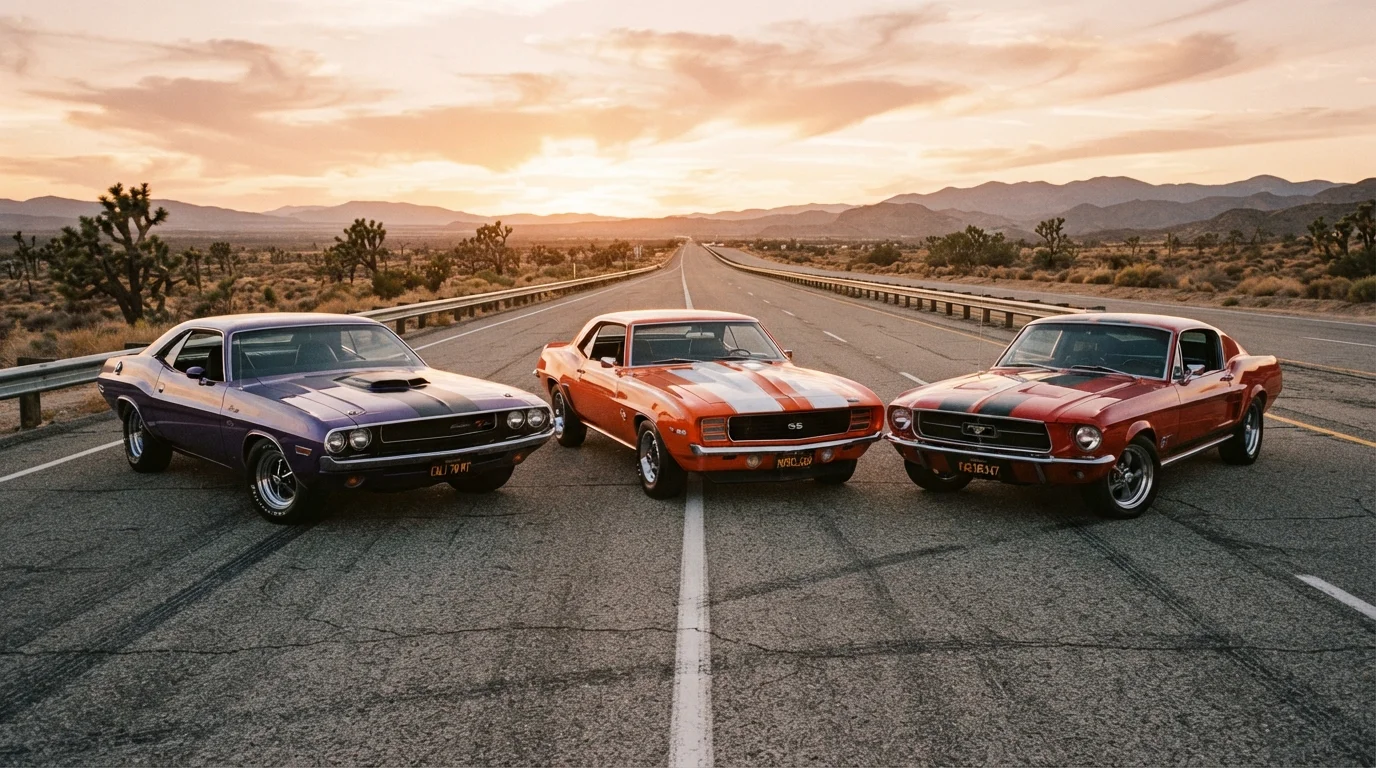
Key Takeaways
What Defines the American Muscle Car
The term muscle car refers specifically to a mid-size or compact American vehicle fitted with a large-displacement V8 engine, intended for straight-line performance at an accessible price point. It is a distinct category from European sports cars, which traditionally prioritize cornering dynamics, or from supercars defined by exotic materials and extreme cost.
This distinction matters because the muscle car was, at its core, a democratic proposition - performance available to working Americans, not just wealthy enthusiasts. That philosophy shaped three nameplates whose stories are inseparable from broader American industrial and cultural history. For a wider look at how performance vehicles fit into each brand's identity, see how American brands built their identities.
1M+
Mustang units sold in first two years
Ford's first-generation Mustang surpassed one million sales faster than any previous American car model, establishing the pony car segment.
840 hp
Dodge Challenger Demon factory output
The 2018 Dodge Challenger SRT Demon was rated at 840 horsepower on 100-octane fuel, making it among the highest-output factory production cars of its era.
1967
Year Camaro and Challenger predecessors debuted
The Camaro launched for model year 1967; the Challenger arrived for 1970, both in direct response to the Mustang's commercial dominance.
The Ford Mustang: Democratizing Performance
Introduced at the 1964 New York World's Fair, the Ford Mustang did not begin as a muscle car in the strict sense - it launched as a compact, affordable sporty coupe targeting young buyers. Lee Iacocca's team at Ford engineered a vehicle around an existing Falcon platform to keep costs low, and it sold over one million units within two years of launch, a commercial result that stunned the industry.
The Mustang's evolution into genuine high-performance territory came with the Shelby GT350 in 1965 and the GT500 in 1967, developed in partnership with Carroll Shelby. By 1968, the Mach 1 package and the legendary 428 Cobra Jet engine cemented the Mustang's muscle credentials. The first-generation cars (1964½-1973) are today among the most studied examples of American industrial design.
After a troubled period in the late 1970s and 1980s - when emissions regulations and oil shocks forced significant power reductions - the Mustang's revival with the 5.0-liter V8 in 1982 restored its performance reputation. The sixth-generation model, introduced for the 2015 model year, added independent rear suspension for the first time, a change that drew both praise and scrutiny from purists. The Mustang also became the first in its segment to offer a factory turbocharged four-cylinder as a primary powertrain option.
When evaluating a classic Mustang, check the VIN's sequence and door-tag codes - not just the badging - to confirm the original engine and options, since many cars have been rebadged or upgraded over decades.
Misrepresented muscle cars are common in the collector market; original documentation dramatically affects both historical accuracy and resale valuation.
If you're considering a modern performance variant of any of these three nameplates, factor in tire wear rates for track-oriented packages - they can be significantly higher than standard configurations and represent a meaningful ongoing cost.
Track-focused trims like the Camaro 1LE and Challenger Scat Pack use performance compound tires that wear faster under spirited driving, a cost that new buyers frequently underestimate.
The Chevrolet Camaro: GM's Calculated Counterpunch
General Motors spent roughly three years developing its answer to the Mustang, and the Chevrolet Camaro arrived for the 1967 model year. GM's approach was methodical: the Camaro was engineered from the outset as a performance platform, with a wider range of engine options at launch than the early Mustang offered, including the high-output SS 396 and the race-focused Z/28 variant developed specifically to compete in SCCA Trans-Am racing.
The second generation (1970-1981) is widely regarded as the design peak of the nameplate, with its long hood and fastback profile influencing sports car aesthetics well beyond GM. The third and fourth generations struggled commercially, and GM discontinued the Camaro after the 2002 model year. Its return in 2010 - built on the Zeta platform originally developed in Australia - demonstrated GM's confidence that consumer appetite for the nameplate remained strong.
The fifth and sixth generations introduced modern engineering benchmarks, with the sixth-generation 1LE track package drawing comparisons to purpose-built track cars at significantly lower price points. GM announced the end of sixth-generation Camaro production in 2024, leaving the nameplate's future uncertain once again. The Camaro's on-again, off-again production history reflects the broader tensions automakers face between heritage and market realities. For context on how this rivalry fits the larger Ford-GM dynamic, see a century of Ford vs. Chevrolet rivalry.
The Dodge Challenger: Mopar's Enduring Statement
Dodge entered the pony car segment later than its rivals. The original Dodge Challenger, introduced for the 1970 model year, arrived at precisely the wrong commercial moment - just as insurance costs on high-performance vehicles were escalating and emissions regulations were beginning to constrain engine output. Despite that timing, the original Challenger produced some of the most powerful factory configurations of the era, including the 426 Hemi and the 440 Six Pack.
Production of the first-generation Challenger ended after 1974, and subsequent vehicles carrying the nameplate bore little resemblance to the original. The modern Challenger, introduced for 2008, took a different strategic path than either the Mustang or Camaro revivals: Dodge deliberately styled it as a direct visual homage to the 1970 original, offering a wider, heavier platform that sacrificed some agility in exchange for a distinctly retro presence and a notably spacious interior by segment standards.
The modern Challenger's Hellcat and Demon variants pushed supercharged V8 output to levels that attracted significant media attention, with the Demon's 840-horsepower rating becoming a benchmark discussion point in performance automotive circles. Dodge announced the end of internal combustion Challenger production for the 2023 model year. For information on what corporate restructuring means for Dodge's future direction, see Stellantis and the reinvention of Dodge.
High-Output Vehicles Carry Higher Ownership Costs
Supercharged variants like the Hellcat and Demon were rated for premium fuel and carry insurance premiums that can substantially exceed those of standard V8 trims. Prospective buyers should obtain insurance quotes before purchase, as these vehicles often fall into higher-risk categories. Maintenance intervals and specialized component costs also differ significantly from base model equivalents.
The Rivalry That Shaped a Segment
The competition between these three nameplates drove genuine engineering advancement. The Camaro Z/28's Trans-Am development program directly influenced suspension calibration techniques that spread across GM's broader lineup. Ford's partnership with Carroll Shelby produced aerodynamic and chassis insights that fed back into production vehicles. Dodge's Hemi engine became a proving ground for combustion chamber geometry that engineers studied widely.
This competitive dynamic - three manufacturers with strong dealer networks and loyal customer bases pushing each other on horsepower, handling, and specification - produced a rate of performance improvement in affordable vehicles that had few parallels elsewhere in the global industry during the late 1960s. The contrast with European performance traditions, which tended toward lower-volume, higher-cost development paths, is notable. Readers interested in that comparison can explore how European automakers approached performance.
“The muscle car era was less about any single car than about a generation of buyers who demanded that performance be within reach - and three manufacturers willing to outdo each other to deliver it.”
— Automotive Historians of America, Nonprofit organization dedicated to the preservation of automotive history
Legacy, Cultural Impact, and What Comes Next
Beyond specifications, these three nameplates achieved something unusual in consumer products: they became cultural symbols that transcended their function as transportation. The Mustang's appearances in films, the Camaro's association with popular music and television, and the Challenger's connection to drag racing culture created layers of meaning that conventional brand marketing rarely generates organically.
That cultural weight has commercial consequences. It explains why Ford continued investing in the Mustang through multiple difficult periods in the company's history, why GM revived the Camaro twice after discontinuation, and why Dodge chose a retro design strategy for its modern Challenger rather than a forward-looking one.
The segment now faces its most significant structural challenge: the industry-wide transition toward electrification. Ford has introduced a Mustang-branded electric crossover, a decision that generated significant debate among enthusiasts about nameplate stewardship. Dodge has signaled an electric performance direction for its next-generation muscle vehicles. How these manufacturers navigate the tension between combustion heritage and electric futures will define whether these nameplates remain culturally meaningful or become primarily nostalgic reference points.
For readers interested in how American brands' reputations have shifted across different eras of manufacturing, the reliability reputation of American cars provides useful historical context alongside current data.
Researching a Muscle Car Purchase
Whether considering a classic or a modern muscle car, independent pre-purchase inspections are strongly advisable. Classic examples especially may carry decades of undocumented modifications. A qualified mechanic familiar with the specific platform can identify issues that a visual inspection alone will not reveal.
The Mustang, Camaro, and Challenger collectively represent one of the most studied case studies in how consumer identity, corporate strategy, and engineering ambition can converge around a vehicle segment. Their histories are not simply automotive history - they are a lens through which broader American industrial and cultural shifts become legible.