

Key Takeaways
Why Suspension Repairs Sneak Up on Drivers
Your vehicle's suspension system does constant work - absorbing road impacts, maintaining tire contact, and keeping handling predictable. Because wear happens gradually, many drivers adapt to subtle changes without realizing something has degraded. A ride that once felt smooth now feels slightly harsh; a car that once tracked straight now drifts a little. These shifts are easy to rationalize as "the road" or "just how it drives now."
The components covered below represent the most common suspension repairs US drivers encounter over the life of a vehicle. Each one has recognizable warning signs worth knowing. As with most mechanical wear, addressing issues early tends to be far less costly than waiting for a secondary failure. Any suspension work, given its direct connection to vehicle control and safety, should be assessed and repaired by a qualified mechanic.
Tire Wear as a Suspension Indicator
Uneven tire wear - particularly feathering across the tread or excessive wear on one edge - is frequently the first measurable sign of suspension or alignment issues. If you notice irregular wear patterns during a tire rotation, mention it to your mechanic and ask whether a suspension inspection is warranted. Checking tires regularly gives you an early window to catch problems before handling is noticeably affected.
Common Suspension Repairs and Their Warning Signs
Worn Shock Absorbers or Struts
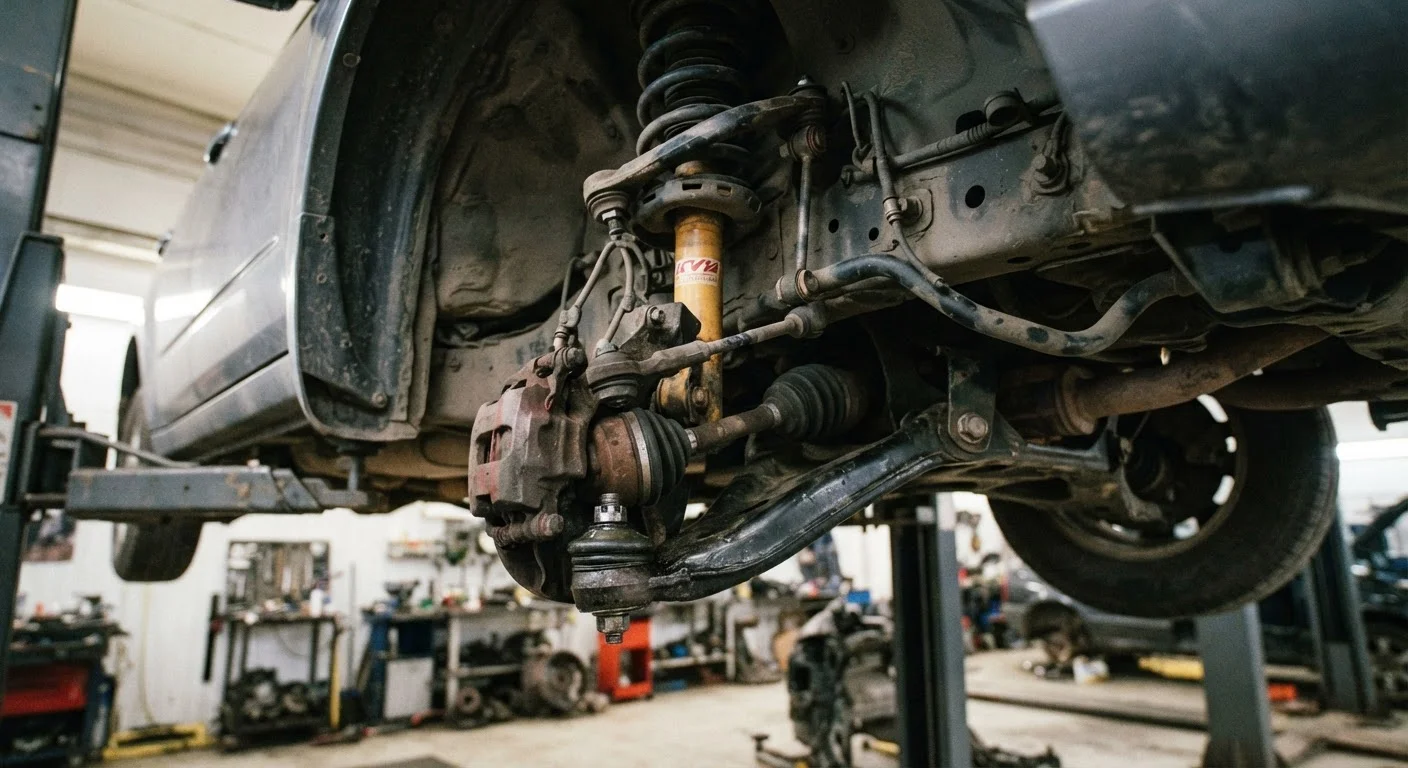
Shocks and struts (struts combine the shock absorber and structural support into one unit) dampen the oscillation of your springs after hitting a bump. As they wear, the vehicle bounces more noticeably, nose-dives under braking, and feels less planted during cornering. A simple test: push down hard on a corner of the vehicle and release - more than one or two rebounds suggests the damper is losing effectiveness.
Most manufacturers recommend inspection around 50,000 miles, though wear varies considerably with road conditions and driving style. Struts are typically replaced in axle pairs to maintain balanced handling.
More than one or two bounces after pushing down on a corner is a classic shock absorber warning sign.
Ball Joint Wear
Ball joints are the pivot points connecting the control arms to the steering knuckle, allowing wheels to move and steer simultaneously. As the joint wears, its socket develops play, producing a clunking or knocking sound - especially over speed bumps or during turns. In advanced cases, handling becomes vague and the vehicle may pull to one side.
Ball joint failure is a genuine safety concern: a severely worn joint can separate, causing sudden loss of steering and wheel control. Mechanics check for play using a pry bar or by lifting the wheel and testing for movement. Early detection is important - see the Warning Signs hub for related symptoms to watch for.
A clunking sound over bumps that worsens during turns is a classic early signal of ball joint wear.
Control Arm Bushing Deterioration
Control arm bushings are rubber or polyurethane sleeves that cushion the connection between the control arm and the vehicle's frame. They isolate road vibration and allow controlled movement. As they crack, harden, or collapse with age, you may notice increased road noise transmitted into the cabin, imprecise steering feel, and clunking over rough pavement.
Bushing wear also causes alignment angles to shift subtly, which can accelerate tire wear on the inner or outer edges. This makes prompt inspection worthwhile - maintenance oversights like this have a way of compounding into larger expenses over time.
Deteriorated bushings allow suspension geometry to shift, quietly accelerating tire wear before other symptoms appear.
Tie Rod End Failure
Tie rods translate steering input from the rack to the wheels. The outer tie rod end, which connects to the steering knuckle, endures significant stress and wears sooner than the inner end. A worn tie rod end causes the steering to feel loose or have excessive play at the wheel, and the vehicle may wander or require constant small corrections to maintain a straight path.
Like ball joints, tie rod ends are load-bearing pivot points. A failed tie rod end can cause sudden loss of steering control, so symptoms of looseness or shimmy at highway speed warrant prompt professional attention.
Loose or wandering steering at highway speed is one of the clearest signals a tie rod end needs attention.
Strut Mount and Bearing Plate Wear
At the top of each strut sits a mount assembly that cushions the strut's load and, on the front axle, contains a bearing that allows the strut to rotate during steering. When the rubber portion degrades, it transmits vibration directly into the cabin. When the bearing wears, it produces a grinding or creaking sound while turning the wheel - sometimes at low speed in parking lots.
Strut mounts are typically replaced at the same time as struts, since labor overlap makes separate replacement inefficient. Ignoring mount wear accelerates bushing and bearing deterioration in surrounding components.
A grinding or creaking sound while steering at low speed often points to worn strut mount bearings.
Sway Bar Links and Bushings
The sway bar (also called an anti-roll bar) connects the left and right suspension to reduce body lean during cornering. Small link arms connect the bar to each strut or control arm, and rubber bushings clamp the bar to the frame. Both wear points are common failure items, particularly in regions with rough roads or extreme temperature swings.
Worn sway bar links produce a rattling or clunking noise over bumps that often disappears at speed. Failed bushings create a low-frequency thud or squeak during body roll. These are among the more affordable suspension repairs, but leaving them unaddressed allows more body lean that stresses other components.
Sway bar link rattles are among the more affordable suspension fixes - and among the most commonly deferred.
Ask for a Full Suspension Inspection
When bringing a vehicle in for any suspension symptom, request a complete undercarriage inspection rather than just the specific component you suspect. Mechanics can often identify adjacent wear that saves you a return visit. Catching multiple worn components in one service visit reduces total labor time compared to addressing each separately.
Putting It Together
Suspension components rarely fail in isolation. A worn strut puts more stress on its mount and spring; a failed ball joint accelerates bushing wear in the control arm. If your vehicle is showing any of the symptoms described above, a full suspension inspection - not just a look at the obvious culprit - is worth requesting from a qualified mechanic.
Pay attention to your tires as well. Uneven or accelerated wear patterns are often the first visible clue that something in the suspension geometry is off. For a broader view of symptoms your car may be sending, the Warning Signs hub covers a range of vehicle alerts worth knowing. Staying ahead of suspension wear protects your tires, your steering, and ultimately the people in your vehicle.
This article is for general informational purposes only and does not constitute professional mechanical advice. Suspension system condition varies significantly by vehicle age, mileage, driving environment, and maintenance history. Always consult a qualified mechanic for inspection, diagnosis, and repair of safety-related components.