

Key Takeaways
Oxygen Sensor (O2 Sensor)
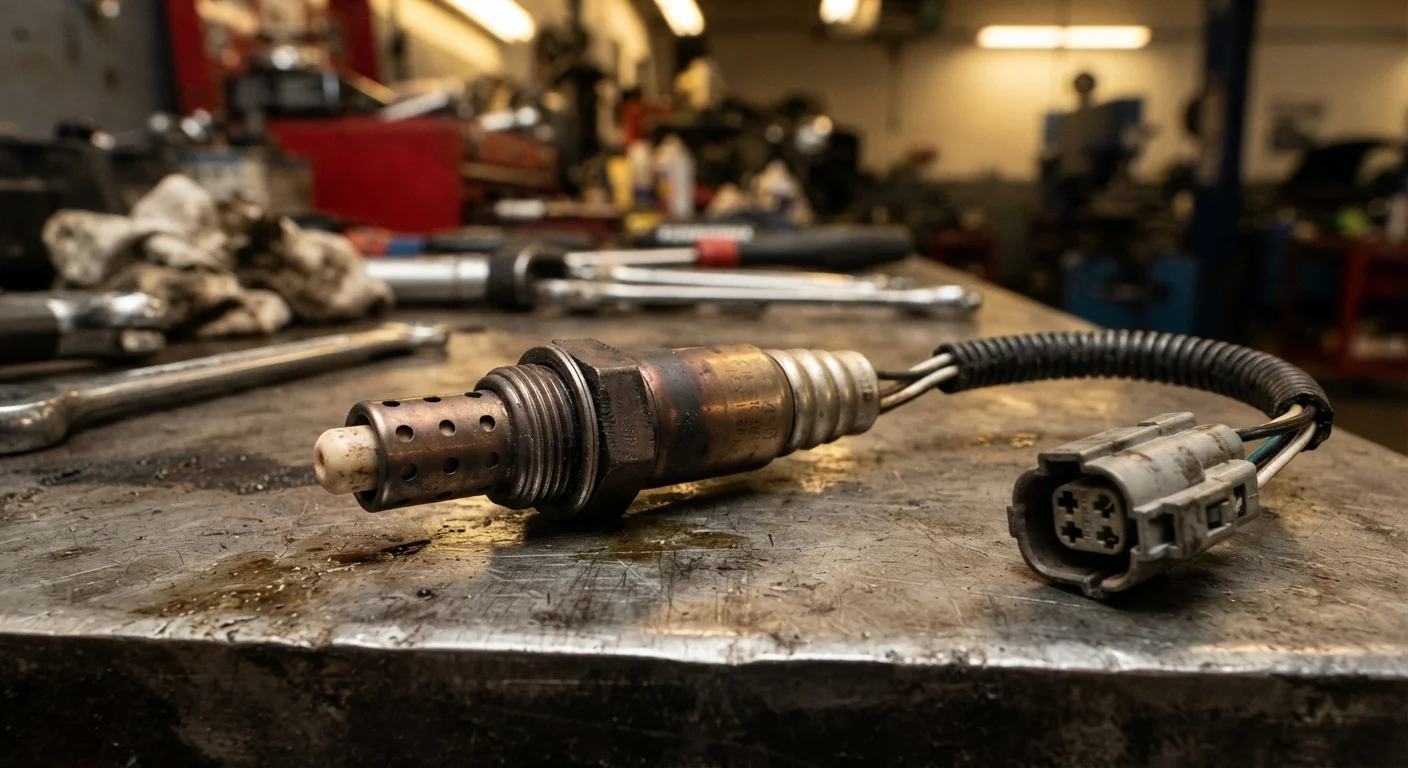
An oxygen sensor is a small electronic device mounted in your vehicle's exhaust system that measures the amount of oxygen in exhaust gases. It sends this data to the engine control module (ECM), which uses it to continuously adjust the fuel-to-air mixture for efficient combustion. Most modern vehicles have two or more sensors: one before the catalytic converter and one after.
The upstream (pre-cat) sensor actively regulates the fuel mixture in a closed-loop feedback cycle; the downstream (post-cat) sensor primarily monitors catalytic converter efficiency. Wideband sensors found in many newer engines provide more precise oxygen readings across a broader range.
What an Oxygen Sensor Actually Does
Your engine needs a precise ratio of fuel to air - roughly 14.7 parts air to 1 part fuel - for complete, efficient combustion. Too much fuel (a rich mixture) wastes gas and increases emissions. Too little fuel (a lean mixture) can cause misfires and engine stress. The oxygen sensor is the feedback device that keeps this balance in check, moment to moment, while the engine is running.
Exhaust gas passes over the sensor's ceramic element, which generates a voltage signal based on how much oxygen is present. A high-oxygen reading signals a lean mixture; low oxygen signals a rich one. The ECM reads this signal dozens of times per second and adjusts fuel injector timing accordingly. Without accurate sensor data, the engine essentially runs blind on fuel management.
Most vehicles also carry a downstream sensor positioned after the catalytic converter. Its role is narrower: monitoring how effectively the converter is processing exhaust gases rather than directly tuning the fuel mixture. If the downstream reading diverges too far from the upstream one, the ECM flags a catalytic converter efficiency problem - another common source of check engine codes. See our guide to decoding the check engine light for help distinguishing urgent faults from minor ones.
How Sensor Failure Shows Up in Real Driving
Oxygen sensors rarely fail all at once. More often, they degrade slowly - the ceramic element ages, the signal becomes sluggish or erratic, and the ECM struggles to maintain an accurate fuel mixture. Drivers tend to notice the effects before they identify the cause.
60,000-100,000 mi
Typical O2 sensor service life range
General industry guidance suggests conventional sensors around 60,000 miles; heated sensors in modern vehicles often exceed 100,000 miles under normal conditions.
Up to 40%
Potential fuel economy reduction from a failed sensor
The U.S. Department of Energy has noted that a faulty oxygen sensor can reduce fuel economy by as much as 40% in some cases, depending on how the sensor fails.
- Worse fuel economy: A sensor sending an incorrect rich signal causes the ECM to over-fuel, burning more gas for the same output. Many drivers first notice they're filling up more frequently.
- Rough idle or hesitation: An unstable fuel mixture produces uneven combustion, which can feel like shuddering at a stop or sluggish acceleration.
- Failed emissions test: Without accurate mixture control, exhaust gases carry higher concentrations of hydrocarbons and carbon monoxide - a common reason vehicles fail state emissions inspections.
- Check engine light: Codes P0136, P0141, P0130, and related variants are frequently linked to O2 sensor faults. The ECM stores these when sensor readings fall outside expected parameters.
Because these symptoms overlap with other issues - dirty fuel injectors, worn spark plugs, or vacuum leaks - diagnosis with a scan tool is the reliable way to confirm an O2 sensor fault rather than guessing.
Why Prompt Replacement Matters
The financial case for timely O2 sensor replacement is straightforward. A sensor itself is a relatively modest repair compared to the components it protects. Running a faulty sensor for extended periods forces the engine to operate with a poorly calibrated fuel mixture, which accelerates wear on the catalytic converter. Catalytic converter replacement is substantially more expensive - making a neglected sensor a costly oversight in the long run.
Check for Multiple Sensor Codes at Once
If one O2 sensor has failed and your vehicle has high mileage, ask your mechanic to assess the remaining sensors at the same time. Sensors of similar age often wear at similar rates, and addressing them together can avoid a repeat labor charge in the near future. This is purely a practical consideration - not all shops recommend it automatically.
Replacement intervals depend on sensor type and vehicle. Older unheated sensors generally wore out around 60,000 miles; the heated sensors standard in most vehicles sold in the past two decades are designed for longer service life, often 100,000 miles or more. Your owner's manual is the most reliable starting point, and a mechanic can assess sensor performance during routine service.
Skipping smaller maintenance items rarely pays off - a pattern explored further in our article on maintenance habits that shorten a car's life prematurely. O2 sensor replacement fits squarely in that category: a small investment that protects a much larger one.
What to Expect at the Shop
When you bring a vehicle in with a suspected O2 sensor fault, a technician will start by reading the stored diagnostic trouble codes from the ECM. Codes alone don't always confirm the sensor itself is the problem - a wiring fault, exhaust leak near the sensor, or fuel system issue can produce similar codes - so a good technician will verify the sensor's live data before recommending replacement.
Once confirmed, the repair involves removing the old sensor from the exhaust pipe (which can be difficult if the sensor has corroded in place over many years) and installing a new one, followed by clearing the fault codes and confirming the system returns to normal closed-loop operation. On most vehicles this is a relatively quick job, though access difficulty varies by engine layout and sensor location.
If you're evaluating a used vehicle and wondering whether deferred maintenance like this might be hiding in its history, our guide on why low mileage doesn't always mean a better used car explains why maintenance records matter as much as the odometer reading.