

Key Takeaways
Vehicle Depreciation
Vehicle depreciation is the decline in a car's market value over time. It reflects the gap between what you paid for a vehicle and what it would sell for today. Every car depreciates, but the speed and severity vary significantly by vehicle type, age, mileage, and market conditions.
Depreciation is typically expressed as a percentage of original MSRP lost over a given period. Residual value — the opposite measure — is the percentage of value retained, widely used in lease pricing calculations.
Why Cars Lose Value From the Moment They're Sold
Depreciation begins the moment a vehicle changes hands from dealer to owner — not because anything physical changes, but because the car's status shifts from new to used. A buyer purchasing the same model from the lot the next day will pay new-car price; a private seller offering yesterday's purchase cannot. That gap is immediate depreciation.
Beyond the new-to-used transition, several forces push values down over time: accumulated mileage, wear on mechanical and cosmetic components, the arrival of updated or redesigned model years, and shifting buyer preferences. These forces don't act at a constant rate — they're front-loaded, which is why the first year or two of ownership produces the sharpest declines.
For used car buyers, this front-loading is actually an opportunity. The original owner absorbs the steepest loss; a buyer who steps in at year two or three acquires a vehicle whose value has already stabilized considerably. Understanding this curve is foundational to buying a used car strategically.
20%
Average first-year value loss for new vehicles
Industry valuation analysts consistently observe that most new passenger vehicles lose approximately 15–25% of their purchase price within the first 12 months.
~50%
Cumulative value lost by year five on average
By the five-year mark, the average vehicle has lost roughly half its original purchase price, though the rate slows significantly after year three.
Year 2–3
Optimal used car buying window by depreciation
Consumer analysts frequently cite two- to three-year-old vehicles as the point where original owners absorb the steepest losses while buyers gain a nearly modern vehicle.
The Depreciation Curve: Where the Steepest Drops Happen
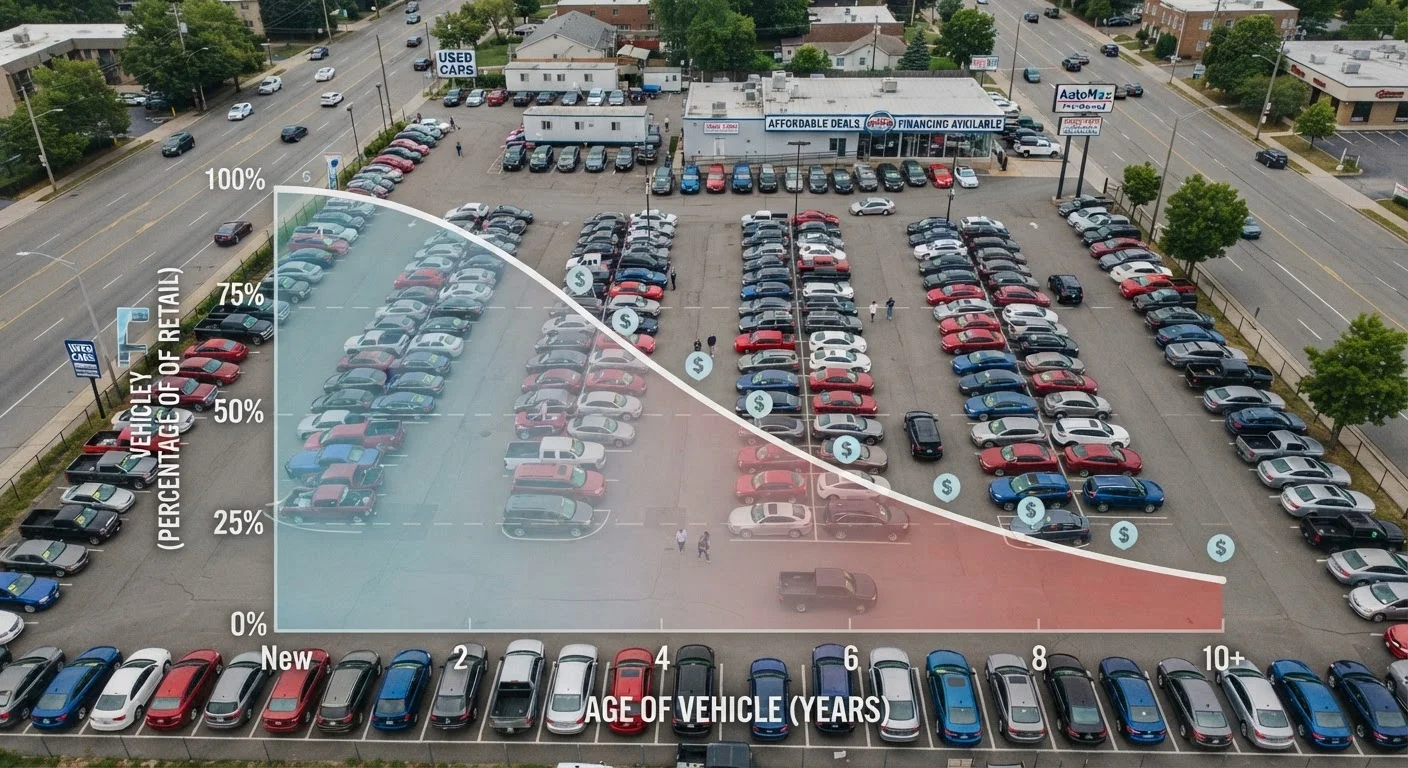
The depreciation curve is not a straight line. It resembles a steep slope that gradually flattens. In the first year, most vehicles shed 15–25% of their original value. By the end of year three, cumulative losses often reach 40–50% of the original purchase price. After year five, annual losses typically slow to single-digit percentages of remaining value.
This curve exists because early depreciation is driven by perception as much as wear. A three-year-old car with 30,000 miles may be mechanically indistinguishable from a new one, yet buyers discount it heavily simply because it isn't new. As the car ages further, that perception premium evaporates and value stabilizes around what the vehicle is actually worth as transportation.
How depreciation shapes the used car market explores these patterns in greater depth, including why some two-year-old vehicles can represent exceptional value while others remain overpriced relative to their actual condition.
“Depreciation is the largest cost of vehicle ownership for most people — larger than fuel, insurance, or maintenance — yet it's the one cost buyers most consistently ignore when comparing new versus used.”
— Consumer automotive research analysts, Vehicle total cost of ownership research
Factors That Accelerate or Slow the Rate of Value Loss
Not all vehicles follow the same curve. Several variables push depreciation faster or slower than average:
- Reliability record: Vehicles with strong long-term reliability data lose value more slowly because buyers trust them at higher mileage. Models with known mechanical issues lose value faster as prospective owners price in repair risk.
- Ownership costs: Vehicles with expensive parts, specialized service requirements, or poor fuel economy depreciate faster because running costs reduce the pool of willing buyers.
- Supply and demand: A model in high demand with limited used-market supply holds value better than one that's abundant on lots.
- Condition and history: An accident on the vehicle history report — even a minor one — reduces resale value independently of actual damage. Service records and clean titles preserve value. Evaluating and inspecting a used car thoroughly is how buyers identify these differences before committing.
- Trim level and options: Popular configurations (common colors, standard feature packages) retain more value than unusual spec combinations with limited resale appeal.
- Segment type: Full-size trucks and utilitarian SUVs have historically depreciated slower than sedans and luxury vehicles in most market conditions.
Check Market Value Before Evaluating Any Listing
Before assessing whether a used car asking price is fair, look up the vehicle's current market value through established valuation tools using the exact year, make, model, trim, mileage, and condition. Depreciation varies significantly by those variables — a price that looks reasonable for one configuration may be well above market for another.
Luxury Vehicles and the Steeper Depreciation Pattern
Luxury vehicles occupy a particular position in the depreciation discussion. Their high new-car prices, combined with elevated ownership costs and a narrower buyer pool at resale, typically produce steeper percentage losses than mainstream models. A luxury sedan losing 50% of value in three years represents a far larger absolute dollar figure than the same percentage decline on a compact car.
This pattern creates a secondary market dynamic: well-maintained luxury vehicles at three to five years old can appear to be bargains compared to their original price — but buyers should weigh ongoing maintenance and repair costs carefully before treating that as straightforward value. Luxury sedan depreciation patterns breaks down the structural reasons behind these trends and what they mean for total cost of ownership.
Depreciation Isn't the Whole Valuation Story
Depreciation curves are useful benchmarks, but market pricing at any moment reflects supply, regional demand, fuel price trends, and macroeconomic factors too. A vehicle may be priced above or below its theoretical depreciated value for reasons unrelated to condition or age. Always benchmark against actual comparable listings in your geographic market, not just published depreciation estimates.