

| Minimum off-road ground clearance | 8.5 inches (General industry threshold for serious trail use) |
| Typical low-range gear reduction ratio | 2.5:1 to 4:1 (Varies by manufacturer and transfer case design) |
| Skid plate material (heavy-duty) | Steel or aluminum alloy (Common spec on purpose-built off-road trim packages) |
| Number of terrain modes (typical) | 4-7 selectable modes (Mid-to-high trim off-road packages across major platforms) |
| Approach angle (capable off-roaders) | 30°-37°+ (Depends on front overhang and suspension lift) |
| Key locking differential types | Front axle, rear axle, center differential (Availability varies by model and trim) |
What Separates a Capable Off-Roader from a Crossover
Not every SUV that says "4WD" or "AWD" on the window sticker is built for serious off-road work. The gap between a trail-capable off-roader and a crossover that handles light snow comes down to three mechanical pillars: ground clearance, drivetrain hardware, and skid plate protection. Understanding what each pillar does - and where compromises live - lets you evaluate any model on its actual capability rather than its marketing language.
Construction type is the foundation. Body-on-frame platforms generally offer greater articulation and the structural rigidity needed to mount heavy-duty suspension and drivetrain components. Unibody crossovers prioritize ride quality and efficiency, which typically comes at a cost to flex and approach angles. Neither is universally superior, but the distinction matters the moment the pavement ends.
| Minimum off-road ground clearance | 8.5 inches (General industry threshold for serious trail use) |
| Typical low-range gear reduction ratio | 2.5:1 to 4:1 (Varies by manufacturer and transfer case design) |
| Skid plate material (heavy-duty) | Steel or aluminum alloy (Common spec on purpose-built off-road trim packages) |
| Number of terrain modes (typical) | 4-7 selectable modes (Mid-to-high trim off-road packages across major platforms) |
| Approach angle (capable off-roaders) | 30°-37°+ (Depends on front overhang and suspension lift) |
| Key locking differential types | Front axle, rear axle, center differential (Availability varies by model and trim) |
Ground Clearance, Approach Angles, and Skid Plates
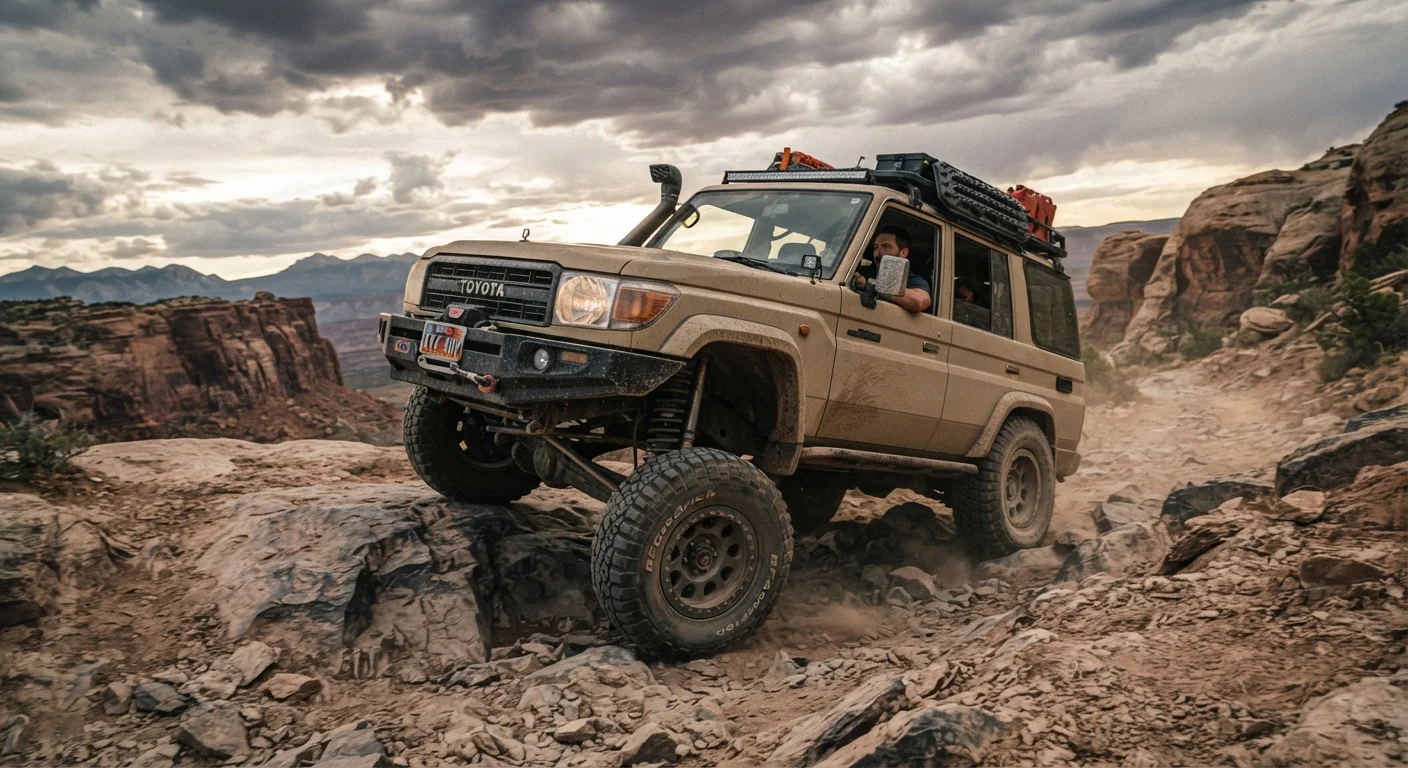
Ground clearance - the measured distance between the lowest fixed point on a vehicle and flat ground - determines what obstacles a vehicle can straddle without contact. Most street-oriented crossovers measure between 6 and 8 inches of clearance. Purpose-built off-road variants typically start at 8.5 inches and can exceed 10 inches with available lift or air-suspension systems.
Clearance alone is incomplete without approach, departure, and breakover angles. The approach angle is the steepest incline a vehicle can climb without the front bumper striking the ground. The departure angle applies the same logic to the rear. The breakover angle describes the peak of a hill the vehicle can crest without the undercarriage making contact mid-vehicle. A low front overhang and a short wheelbase improve all three figures simultaneously.
Skid plates protect the engine oil pan, transfer case, fuel tank, and steering components from rock strikes. Entry-level off-road trims often include partial coverage; serious packages extend steel or aluminum plating to the full undercarriage. When evaluating trim levels, check which components are actually covered - partial protection can create a false sense of security on technical terrain.
Ground clearance
The vertical distance between the lowest fixed point on a vehicle's underbody and flat level ground. Higher values allow the vehicle to pass over taller obstacles without contact.
Locking differential
A differential that can mechanically couple both axle shafts so they rotate at the same speed. This ensures torque is delivered to both wheels even when one loses traction entirely.
Low-range (4LO)
A gear reduction setting in a two-speed transfer case that multiplies torque output while slowing wheel speed, enabling precise low-speed control over difficult terrain.
Approach angle
The maximum angle of an incline a vehicle can ascend from flat ground without the front bumper or undercarriage making contact with the surface.
Breakover angle
The maximum angle of a summit or ridge a vehicle can crest without the undercarriage contacting the high point. Shorter wheelbase vehicles typically have better breakover angles.
Skid plate
A protective plate mounted beneath the vehicle to shield critical mechanical components - such as the oil pan, fuel tank, and transfer case - from rock strikes and debris.
Transfer case
A gearbox in four-wheel-drive vehicles that distributes power between the front and rear axles. Two-speed transfer cases add a low-range setting for technical off-road use.
Terrain management system
An electronic system that allows the driver to select a terrain mode (rock, sand, mud, snow, etc.) and automatically adjusts throttle response, transmission behavior, and stability controls to suit conditions.
Locking Differentials and Transfer Cases Explained
A standard open differential distributes torque to the wheel with the least resistance - useful on pavement, counterproductive in mud or rock where a spinning wheel loses traction entirely. A locking differential mechanically couples both axle shafts so they turn at the same speed regardless of traction difference. When one wheel lifts completely off the ground, a locked differential still drives the grounded wheel with full torque.
Two-speed transfer cases add a low-range gear reduction - commonly labeled 4LO - that multiplies torque output while dramatically slowing wheel speed. This is what allows a vehicle to creep over boulders under precise throttle control without momentum-driven wheel spin. High-range 4WD (4HI) is suited to loose dirt, gravel, and light mud where traction is inconsistent but speed is still possible.
4WD and AWD operate on fundamentally different principles, and the distinction directly affects which terrain a vehicle handles well. Most AWD systems lack low-range gearing and locking capability, limiting their off-road utility compared to a true part-time or full-time 4WD system with a two-speed transfer case.
4:1
Low-range torque multiplication in heavy-duty transfer cases
A 4:1 low-range ratio means the engine produces four times the torque at the wheels compared to the same throttle input in high range, enabling rock crawl precision.
8.5"
Ground clearance threshold for trail-capable classification
Industry analysts and off-road testing standards generally treat 8.5 inches as the minimum for vehicles intended for unpaved trail use beyond gravel roads.
30°+
Approach angle on purpose-built off-road trims
Shorter front overhangs and lifted suspension on dedicated off-road packages commonly achieve approach angles above 30 degrees, versus 17-22 degrees typical of standard crossovers.
Terrain Mode Systems: What the Software Actually Controls
Electronic terrain management systems - marketed under various names across manufacturers - use a single driver-selectable dial or menu to adjust multiple vehicle parameters simultaneously. A typical mud mode, for example, may loosen throttle response to reduce initial wheel spin, adjust transmission shift points to keep the engine in a higher-torque range, and modulate stability control to permit a controlled degree of wheel slip rather than cutting power aggressively.
Common selectable modes include: Rock/Crawl (maximum low-speed torque, aggressive brake-based traction control, full differential lock engagement); Sand (high RPM maintained to prevent bogging, minimal traction intervention to allow momentum); Mud/Ruts (controlled slip allowed, transmission held in lower gears); Snow/Ice (gentle power delivery, maximum stability intervention); and Auto (system self-selects parameters continuously).
These systems raise capability for occasional off-road drivers but do not eliminate the importance of mechanical hardware. A terrain mode cannot compensate for insufficient ground clearance, missing skid plates, or an open rear differential on extreme rock terrain. Think of electronic systems as multipliers on an existing hardware foundation, not substitutes for it.
Terrain Modes Do Not Replace Mechanical Hardware
Electronic terrain management systems enhance a vehicle's response to conditions, but they operate within the limits of the underlying hardware. A vehicle without low-range gearing, adequate clearance, or skid plate protection will still be limited even with every terrain mode engaged. Evaluate the hardware specification first; treat terrain modes as a capability enhancer on top of a solid mechanical foundation.
If you're assessing whether a specific truck's off-road package justifies its premium, matching capability to actual use case is the right next step before committing to a trim level.