

Key Takeaways
EV Range Gap
The difference in driving distance between a short-range electric vehicle (roughly 150-250 miles per charge) and a long-range model (300-400+ miles) comes down to more than just battery size. Engineering trade-offs in pack capacity, motor efficiency, vehicle weight, and aerodynamics all contribute. Understanding these factors helps buyers match a vehicle's real-world capability to their driving patterns.
Range is typically expressed as an EPA-rated figure in the US, measured under standardized test cycles. Real-world range often varies from this figure depending on speed, climate, and driving style.
Battery Capacity: The Starting Point
Battery pack capacity - measured in kilowatt-hours (kWh) - is the foundational variable separating short- and long-range EVs. Think of it as the fuel tank: a 60 kWh pack stores roughly half the energy of a 120 kWh pack, all else being equal.
Modern long-range EVs typically carry packs in the 90-130 kWh range. Short- and mid-range models generally fall between 40-75 kWh. That gap directly sets the ceiling for how far a vehicle can travel before needing a charge.
However, raw capacity doesn't tell the full story. Automakers also manage a battery's usable capacity - the portion accessible to the driver - leaving a buffer at both the top and bottom of the charge curve to protect cell longevity. This buffer means the usable kWh is always somewhat less than the gross figure quoted in spec sheets.
~40 miles
Average US daily driving distance
According to US Department of Transportation data, the average American drives approximately 37-40 miles per day, well within the range of most current EVs.
20-40%
Cold-weather range reduction estimate
Studies by organizations including AAA have found that EV range can drop 20-40% in temperatures near 20°F compared to moderate conditions.
3-4 mi/kWh
Typical real-world EV efficiency band
Most mainstream EVs fall within a 3.0-4.0 miles per kWh efficiency range under mixed driving conditions, with outliers above and below.
Efficiency: Where the Miles Are Won or Lost
Two EVs with identical battery packs can have meaningfully different range figures. The reason is drivetrain efficiency - how effectively electrical energy is converted into forward motion.
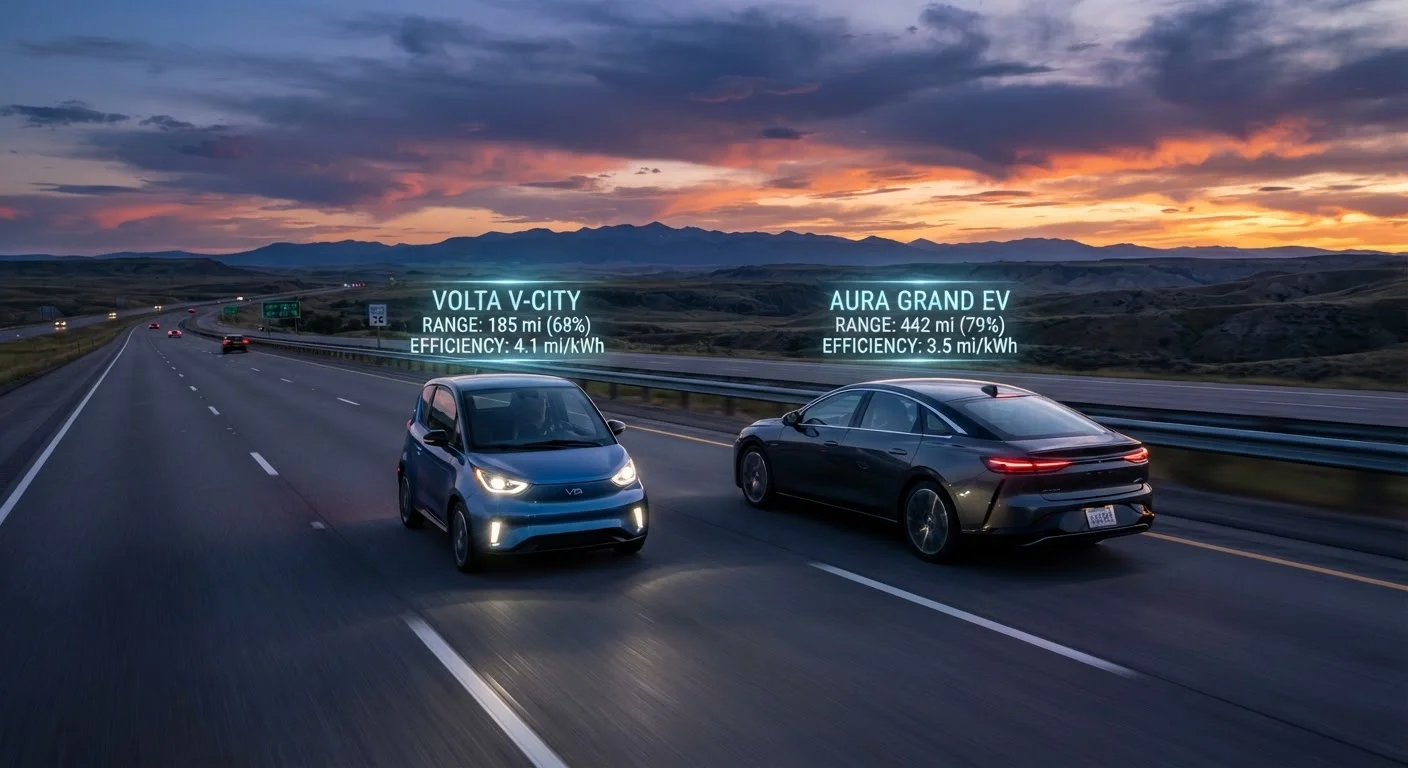
The key metric is miles per kWh. An EV achieving 4.0 mi/kWh will extract 240 miles from a 60 kWh pack. One achieving 3.0 mi/kWh draws only 180 miles from the same energy store. That 25% efficiency gap is large enough to close the distance between a "short-range" and a "mid-range" vehicle.
Several engineering factors govern efficiency:
- Motor design: Permanent magnet motors generally offer higher efficiency at typical road speeds than induction motors, though the gap narrows at higher outputs.
- Inverter and power electronics: Losses in the conversion chain between battery and motor add up, particularly at highway speeds.
- Regenerative braking: Systems that recover more kinetic energy during deceleration meaningfully extend range in urban driving cycles.
For a deeper look at how these variables interact with real-world conditions, the EV range factors reference guide covers terrain, payload, and climate in structured detail.
Aerodynamics and Weight: The Engineering Trade-Off
At highway speeds, aerodynamic drag becomes the dominant energy consumer. Long-range EVs are almost universally designed with low drag coefficients - some achieve a Cd (drag coefficient) under 0.20, compared to 0.28-0.35 for less aerodynamically optimized vehicles. That difference can account for 5-15% of highway range.
Weight works in the opposite direction. Larger battery packs are heavier - a 100 kWh pack can weigh 1,000 lbs or more. That mass increases rolling resistance, raises the energy cost of acceleration, and demands more robust (and heavier) structural components. Engineers managing a long-range platform must balance the gain from extra cells against the efficiency penalty of carrying them.
Efficiency Matters as Much as Pack Size
When comparing two EVs, divide the EPA range figure by the usable battery capacity to calculate miles per kWh. A vehicle with a 75 kWh pack rated at 300 miles (4.0 mi/kWh) is more efficient than one with a 100 kWh pack rated at 300 miles (3.0 mi/kWh). The more efficient vehicle will also be less affected by real-world efficiency penalties like cold weather and highway speeds.
This trade-off partly explains why some purpose-built long-range vehicles achieve excellent range without the largest available battery: they are engineered holistically, with aerodynamics, weight distribution, and powertrain efficiency tuned together rather than simply scaling up the pack.
Understanding how EPA range figures are generated - and why they don't always reflect highway-heavy or cold-weather driving - is explained in our guide to how EV manufacturers report range and efficiency.
Matching Range to Real-World Needs
For most US drivers, the practical question isn't "which EV has the most range" - it's "how much range do I actually need?" A vehicle rated at 220 miles covers the vast majority of daily use cases, provided the driver has access to regular home or workplace charging.
Long-range models (300+ miles) make the most sense for drivers who: frequently take intercity trips, lack consistent access to charging between uses, or live in cold climates where winter range reduction is pronounced. The gap between rated and real-world range also widens in cold weather, which disproportionately affects smaller-pack vehicles.
The financial dimension also matters. Extended-range battery packs are among the most expensive components in an EV, and that cost is passed on in the purchase price. Buyers should weigh the incremental cost of additional range against the realistic frequency with which they'll need it - and factor in range-extending driving habits that can meaningfully stretch any pack's real-world performance.
Range figures referenced in this article reflect general industry patterns. Actual EPA ratings vary by model year and trim. Verify current specifications with the manufacturer or the EPA's fueleconomy.gov database before making any purchasing decision.