

Key Takeaways
Worn Wheel Bearing
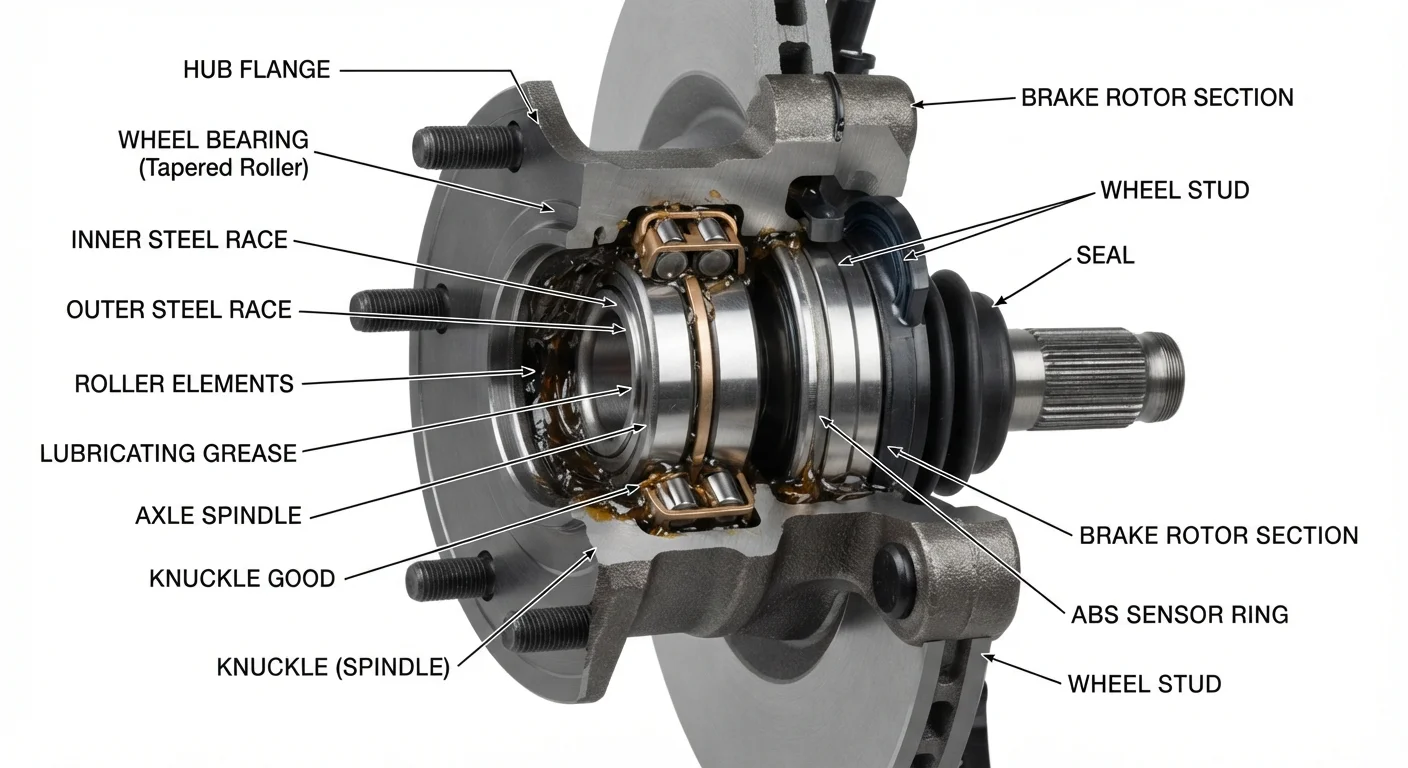
A wheel bearing is a set of steel balls or rollers housed inside a ring that allows your wheel to spin freely around the axle with minimal friction. When a bearing wears out, the protective lubrication breaks down, the metal components develop small pits or cracks, and the once-smooth spin becomes rough and noisy. A worn wheel bearing is one that has deteriorated to the point where it no longer supports the wheel hub cleanly, which can affect steering precision and, in severe cases, vehicle safety.
Most modern passenger vehicles use a sealed hub bearing assembly (also called a wheel bearing hub unit), which integrates the bearing and hub into a single non-serviceable unit that is replaced as one piece rather than repacked with grease as older tapered roller bearings were.
What a Wheel Bearing Actually Does
Every wheel on your vehicle spins thousands of times per mile. The part that makes that possible without generating destructive heat or friction is the wheel bearing - a compact assembly of hardened steel balls or rollers seated between two smooth metal rings called races. Together, they let the wheel rotate freely while supporting the full weight of the vehicle pressing down through the suspension.
Because bearings operate under constant load and are exposed to road grime, water, and temperature swings, the grease inside gradually breaks down over time. Once lubrication deteriorates, the metal surfaces make direct contact during rotation, causing microscopic wear that compounds with every mile driven. That progressive damage is what a mechanic means by a worn wheel bearing.
Sealed Bearings vs. Serviceable Bearings
Older vehicles - particularly trucks and some rear-wheel-drive cars - used separate tapered roller bearings that could be cleaned and repacked with fresh grease at scheduled intervals. Most modern vehicles use sealed hub assemblies that require no periodic repacking. If your vehicle falls into the older category, consult your owner's manual for the manufacturer's service interval recommendations.
The Classic Symptoms - and How to Read Them
The symptom most mechanics reach for first is a humming or droning noise that tracks with vehicle speed. Unlike a tire-tread hum, which stays fairly consistent, a worn bearing typically shifts pitch when the vehicle weight transfers during a gentle lane change or gradual curve. If the noise quiets when you steer slightly to the left, the worn bearing is usually on the right side, and vice versa - because steering shifts load off the compromised bearing momentarily.
Other signs include:
- A grinding or growling sound at lower speeds that worsens as you accelerate
- Subtle steering looseness or a vague, disconnected feel through the wheel
- An ABS or traction-control warning light, caused by sensor disruption inside the hub assembly
- Uneven or accelerated tire wear on the affected corner
These symptoms overlap with other drivetrain issues - see vibrations while driving and unusual car noises for how mechanics work through competing causes.
A Simple In-Car Test Worth Knowing
At a safe, legal highway speed on an empty road, hold the steering wheel lightly and make very gentle, gradual weaves side to side. If the humming noticeably increases when leaning one direction and softens the other, that pattern suggests a wheel bearing rather than a tire noise. Share this observation with your mechanic - it narrows down which corner to inspect first.
How Mechanics Confirm the Diagnosis
Hearing a suspicious hum doesn't automatically mean a bearing is the culprit - tires, CV joints, and even certain brake conditions can produce similar sounds. A trained mechanic will:
- Road test the vehicle - noting how the noise changes with speed, steering input, and load conditions.
- Lift the vehicle and grasp each wheel at the 12 and 6 o'clock positions, then rock it firmly. Detectable play or a clunking sensation indicates bearing looseness.
- Spin the wheel by hand and listen for roughness, grinding, or uneven resistance in the hub.
On sealed hub assemblies, there is no "repack and reuse" option - a bearing that has failed enough to show these signs is replaced as a complete unit. The mechanic will also inspect the knuckle and axle for any secondary damage the worn bearing may have caused.
85,000-100,000 mi
Typical wheel bearing service life range
Most manufacturers and automotive service guides cite this mileage range as a general expectation, though road conditions, loads, and vehicle type affect actual longevity significantly.
4
Wheel bearings on a typical passenger vehicle
Each wheel has its own bearing assembly, meaning a single vehicle has four points of potential failure - each operating under different load conditions depending on drive configuration.
Why Repair Timing Matters
Wheel bearings are a safety-critical component. A bearing that has progressed from noisy to genuinely loose allows the wheel to wobble on the hub - affecting how braking force is applied evenly across the rotor. In advanced cases, a failed bearing can cause the hub to seize or, very rarely in extreme neglect scenarios, allow the wheel to separate from the vehicle entirely.
Beyond the safety dimension, a deteriorating bearing accelerates wear on neighboring parts: the CV axle, brake rotor, and wheel-speed sensor all sit close to the hub and absorb consequences of an unstable bearing. Addressing the repair when symptoms are mild typically keeps the job straightforward and prevents a larger repair bill later. If you have already noticed related symptoms, also review brake warning signs drivers frequently dismiss, since bearing wear can mask or mimic certain brake complaints.
This article is for general informational purposes only and does not constitute mechanical or safety advice for your specific vehicle. Always consult a qualified mechanic for diagnosis and repair decisions.