

Key Takeaways
Option A
The Classic Tune-Up (Pre-1980s)
A precisely defined service for mechanically complex ignition systems.
Best for: Owners of vintage or carburetted vehicles that still rely on points, condensers, and mechanical distributors.
Option B
The Modern Tune-Up (Fuel-Injected Era)
A broader, software-informed maintenance check for today's engine management systems.
Best for: Drivers of contemporary fuel-injected vehicles wanting to maintain performance, fuel economy, and longevity.
If you own a vehicle built before the mid-1980s with a carburettor
The Classic Tune-Up
Older vehicles genuinely need points, condenser, and timing adjustments that define the traditional service. These components degrade on a predictable schedule.
If you drive a modern fuel-injected vehicle and want peak engine performance
The Modern Tune-Up
A current-era service covering spark plugs, air and fuel filters, and an ECU scan addresses the actual wear points on today's engines.
If your check-engine light is on or fuel economy has dropped noticeably
The Modern Tune-Up
A diagnostic scan alongside routine component replacement can identify misfires or sensor faults that a parts-only approach would miss entirely.
What a Tune-Up Originally Meant
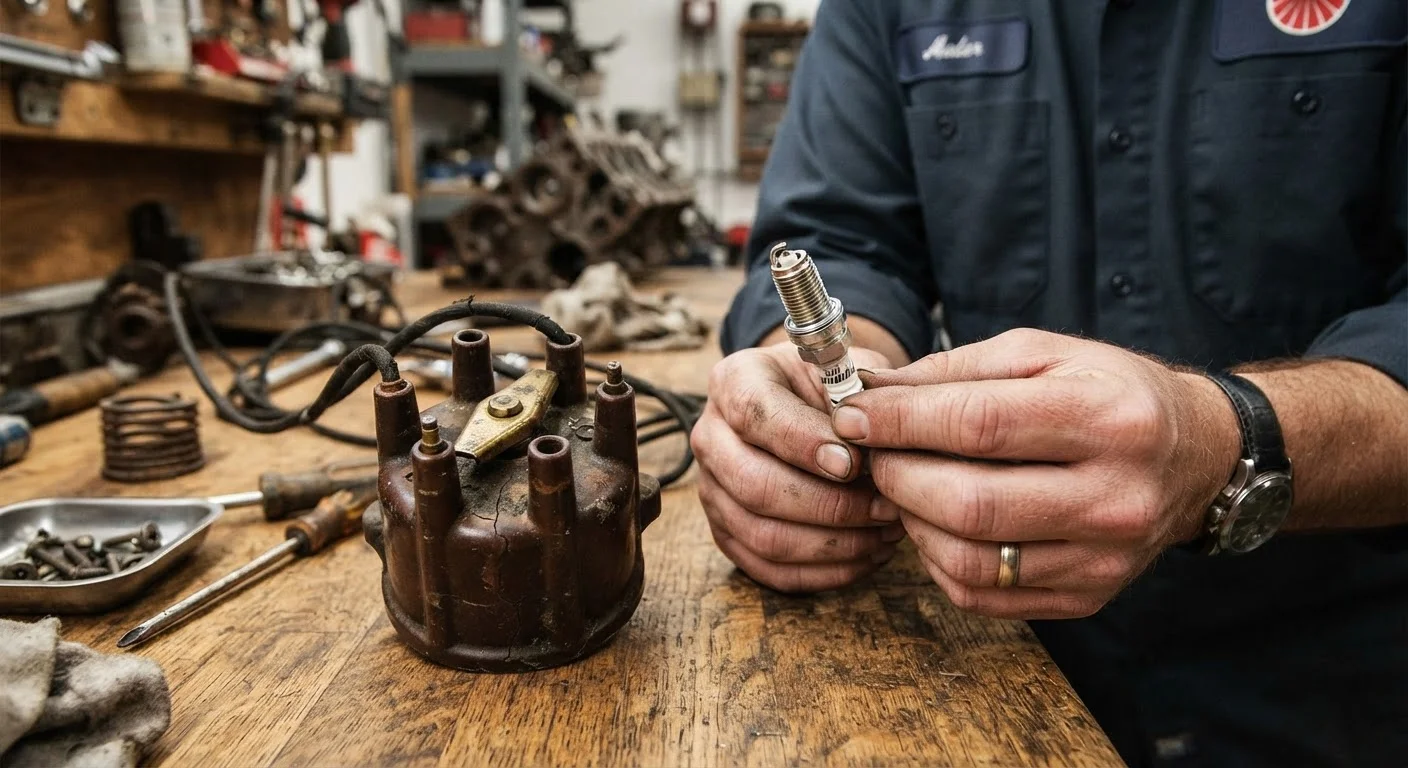
Before electronic ignition became standard, keeping an engine running smoothly required routine attention to a cluster of mechanical parts that wore out on predictable schedules. A classic tune-up - common through the 1970s and into the early 1980s - typically covered:
- Points and condenser replacement: Breaker points opened and closed to trigger ignition; they wore down and required precise gap adjustment every 10,000-15,000 miles.
- Distributor cap and rotor: These distributed the high-voltage spark to each cylinder and cracked or corroded over time.
- Spark plugs: Standard copper plugs needed replacement roughly every 12,000-15,000 miles.
- Carburettor adjustment: Idle speed, air-fuel mixture, and choke operation were all manually set and drifted out of spec with use.
- Ignition timing: Mechanics used a timing light to set the precise moment of combustion relative to piston position.
Each of these tasks was hands-on, measurable, and well-defined. The term "tune-up" had a clear, shared meaning across the industry - and skipping it led to hard starts, rough idling, and poor fuel economy almost immediately.
For more on how routine scheduled tasks build on each other, see the Routine Upkeep hub for a broader overview of core maintenance milestones.
What Changed - and Why the Term Got Fuzzy
Electronic ignition systems arrived in the late 1970s and eliminated points and condensers entirely. By the mid-1980s, fuel injection replaced the carburettor in most new vehicles. The engine control unit (ECU) - essentially a dedicated onboard computer - took over timing, fuel delivery, and idle control automatically, adjusting in real time based on sensor data.
The result: most of what a classic tune-up addressed simply no longer exists on a modern engine. There is no distributor to cap, no points to set, no carburettor to adjust.
| Criterion | Classic Tune-Up (Pre-1980s) | Modern Tune-Up (Fuel-Injected) |
|---|---|---|
| Ignition system | Points, condenser, distributor cap | ECU-controlled, no mechanical points |
| Fuel delivery | Carburettor adjustment required | Fuel injector cleaning, filter service |
| Spark plug interval | 12,000-15,000 miles (copper) | 60,000-100,000 miles (iridium/platinum) |
| Timing adjustment | Manual, using a timing light | Automatic via ECU sensors |
| Diagnostics | Visual and mechanical inspection | OBD-II scanner reads fault codes |
| Idle control | Manually set on carburettor | Managed automatically by engine computer |
| Service frequency | Every 10,000-15,000 miles | Varies; follow owner's manual |
This technological shift is why the word "tune-up" became vague. Shops still use the term because customers recognize it, but what it covers varies widely. A 2010 sedan and a 1972 muscle car both benefit from attention - but to completely different components.
What a Modern Tune-Up Actually Covers
On a contemporary fuel-injected vehicle, a service marketed as a tune-up should generally include some combination of the following - though you should always confirm the specific scope before authorizing work:
- Spark plug replacement: Modern iridium and platinum plugs last far longer than copper predecessors - typically 60,000 to 100,000 miles depending on the manufacturer's specification. Replacement remains the anchor of any legitimate tune-up.
- Air filter inspection or replacement: A clogged air filter restricts airflow and forces the ECU to compensate, affecting efficiency.
- Fuel filter service: Not all vehicles have a serviceable external fuel filter, but where one exists, replacing it on schedule matters.
- Throttle body and fuel injector cleaning: Carbon deposits can accumulate and affect spray patterns; cleaning restores proper atomization.
- Diagnostic scan (OBD-II): Plugging into the vehicle's onboard diagnostics port can surface stored fault codes and pending misfires that aren't yet triggering a warning light.
- PCV valve inspection: The positive crankcase ventilation (PCV) valve manages combustion gases; a stuck valve can cause rough idle or oil consumption.
Your Owner's Manual Is the Starting Point
Manufacturer maintenance schedules are specific to your engine type, fuel system, and operating conditions. A shop's generic recommendation may not align with what your vehicle actually requires. Pulling up the maintenance section of your owner's manual - or the automaker's online maintenance guide - takes minutes and gives you a reliable baseline to compare against any service quote you receive.
The interval for this type of service varies considerably by vehicle. Always consult your owner's manual rather than defaulting to a generic mileage rule - manufacturer guidance is your most reliable benchmark.
Understanding what's included also helps when evaluating other related services. For context on how terminology differs across repair types, the Transmission Service vs Transmission Repair explainer shows how similar confusion plays out in another area of maintenance.
How to Ask the Right Questions at the Shop
Because the term "tune-up" carries different meanings in different shops, the most effective thing any vehicle owner can do is ask for a written itemized list of what the service includes before work begins. Useful questions include:
- Which specific components will be inspected or replaced?
- Are the spark plug part numbers consistent with my manufacturer's specification?
- Does this service include an OBD-II diagnostic scan?
- What is the mileage interval you recommend for this vehicle specifically?
A reputable shop will answer these questions without hesitation. If the response is vague - "we just do the standard tune-up" - that's a signal to press for specifics. Informed owners who ask clear questions are less likely to pay for services their vehicle doesn't need, and less likely to miss the ones it does.
This article is for general informational and educational purposes only. Maintenance needs vary by vehicle make, model, year, and condition. Always follow your vehicle manufacturer's recommendations and consult a qualified mechanic for diagnosis and repairs specific to your vehicle.