

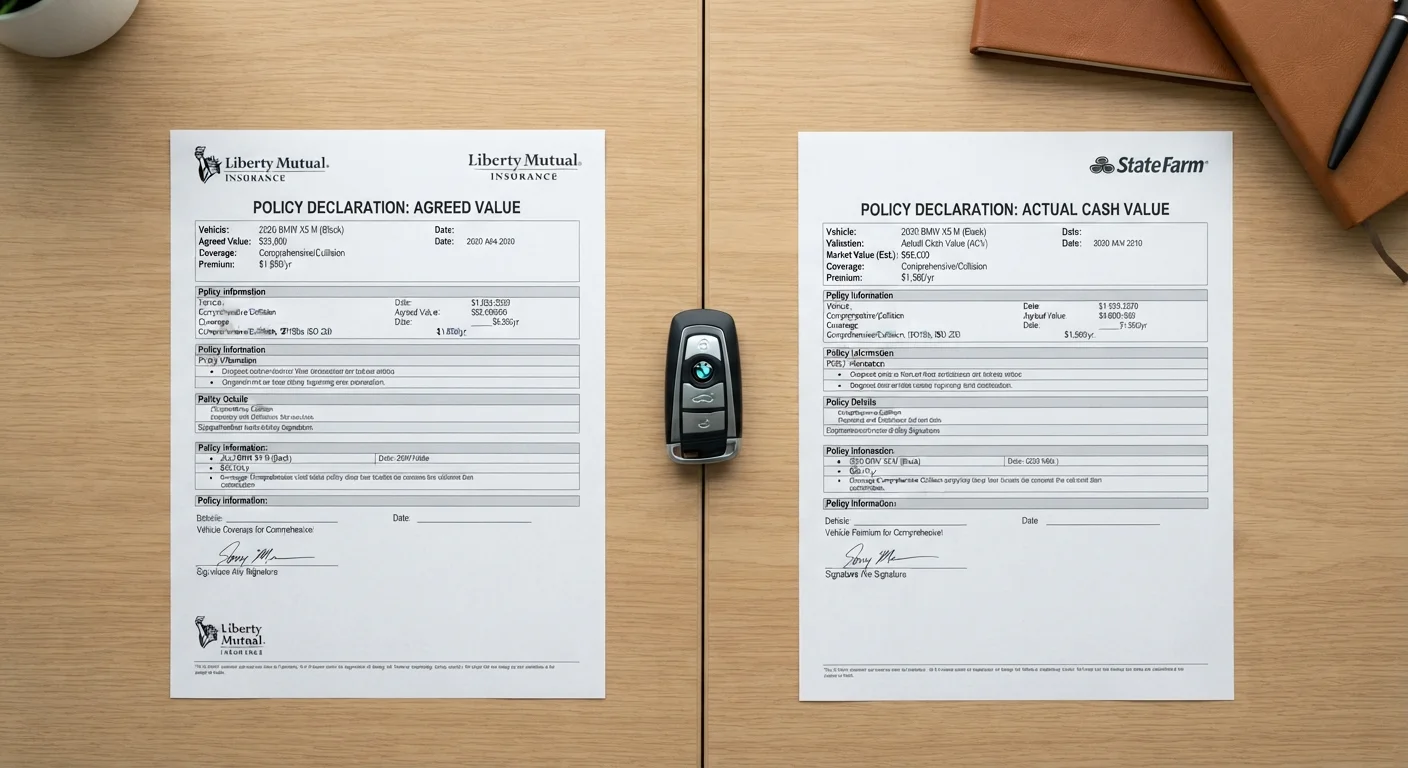
Key Takeaways
Option A
Agreed Value
A locked-in payout figure set when you buy the policy.
Best for: Owners of classic, collector, or modified vehicles where market depreciation tables don't reflect true worth.
Option B
Actual Cash Value (ACV)
A depreciation-adjusted payout calculated at the time of loss.
Best for: Drivers of standard late-model vehicles who want broadly available, typically lower-premium comprehensive or collision coverage.
If you own a classic, collector, or heavily modified vehicle
Agreed Value
Standard depreciation formulas rarely capture the true market value of rare or restored vehicles. An agreed value policy ensures you receive a pre-negotiated amount that reflects the car's actual worth.
If you drive a standard late-model daily commuter
Actual Cash Value (ACV)
ACV coverage is widely available and aligns with realistic resale market pricing for everyday vehicles, typically at a lower premium than agreed value alternatives.
If predictability in a total-loss payout matters most to you
Agreed Value
Because the payout is fixed at policy inception, there are no depreciation disputes with an adjuster at claim time - you know exactly what you'd receive.
If minimising your monthly premium is a priority
Actual Cash Value (ACV)
ACV policies generally cost less to carry because the insurer's maximum exposure decreases as the vehicle depreciates over time.
Why the Valuation Method in Your Policy Matters
Most drivers don't think about how their insurer values their vehicle until after a total loss. At that point, the valuation method written into the policy - not the amount you paid for the car, and not what you feel it is worth - determines your settlement. The two most common methods are agreed value and actual cash value (ACV), and they can produce meaningfully different payout amounts for the same vehicle.
Understanding the distinction before you need to file a claim gives you the ability to choose coverage that matches your vehicle's situation. See our overview of the claims review process for context on how valuations fit into the broader settlement workflow.
| Criterion | Agreed Value | Actual Cash Value (ACV) |
|---|---|---|
| Payout amount set | At policy inception | At the time of loss |
| Depreciation applied | No | Yes |
| Payout predictability | High - fixed figure | Variable - depends on market at time of loss |
| Typical premium level | Generally higher | Generally lower |
| Most common vehicle type | Classic, collector, modified | Standard late-model vehicles |
| Deductible still applies | Yes | Yes |
| Risk of payout gap vs. loan balance | Lower (if value set correctly) | Higher as vehicle ages |
How Each Valuation Method Works
Agreed value is a figure that you and the insurer negotiate and document at the time you purchase or renew the policy. If the vehicle is later declared a total loss, the insurer pays that exact amount - less your deductible - without applying any depreciation adjustment. The figure is fixed for the policy period. This is particularly common for collector cars, antiques, and restored vehicles, where standard market data often fails to reflect real-world value.
Actual cash value works differently. Rather than locking in a number upfront, the insurer calculates the vehicle's value at the moment of loss. The general formula is replacement cost minus accumulated depreciation. Depreciation accounts for age, mileage, condition, and prevailing market pricing. Because most vehicles lose value over time, the ACV settlement is almost always lower than what the owner originally paid - sometimes substantially so.
To understand the factors that feed into an ACV calculation, see how insurers calculate actual cash value after a total loss.
~15-25%
Typical first-year depreciation for a new vehicle
Industry estimates commonly place new vehicle depreciation in this range in the first year, illustrating how quickly ACV can diverge from purchase price.
~50%
Average depreciation over five years
Many mainstream vehicles lose roughly half their original value within five years, according to widely cited automotive valuation research, widening the ACV vs. agreed value gap significantly.
Depreciation: The Dividing Line Between the Two Methods
Depreciation is the single most consequential difference between the two methods. A vehicle that was worth $35,000 when purchased may carry an ACV of $22,000 three years later - meaning an ACV total-loss settlement would be roughly $13,000 less than what you paid, before your deductible is applied. An agreed value policy set at $35,000 at purchase would pay $35,000 minus the deductible, regardless of how much time has passed.
This gap matters most when a loan or lease is involved. If you owe more on your vehicle than its depreciated ACV, an ACV settlement may not cover the outstanding balance - a situation sometimes addressed through separate gap coverage. Neither valuation method eliminates the role of your deductible; see how deductibles affect your out-of-pocket cost after a claim for more on that interaction.
Stated Value: A Third Option Worth Knowing
Some policies use a 'stated value' approach, where the owner declares a value at policy inception, but the insurer pays the lesser of that stated value or the ACV at the time of loss. This is different from agreed value, which guarantees the pre-set figure. If your policy references 'stated value,' verify whether it includes an agreed value endorsement or defaults to ACV at claim time.
Choosing the Right Valuation Structure for Your Vehicle
For the vast majority of standard passenger vehicles - sedans, SUVs, trucks driven daily - ACV coverage is the norm and aligns reasonably well with what the vehicle would actually sell for. Agreed value coverage is less commonly offered for everyday cars and may not be available from all insurers for standard vehicles.
For classic cars, antiques, kit cars, and heavily customised vehicles, agreed value coverage is generally the more protective option because depreciation tables don't apply meaningfully to vehicles whose value may be stable or appreciating. A comparison of agreed value, ACV, and stated value provides additional context on a third method - stated value - which sits between the two and carries its own trade-offs.
Premium cost is a practical consideration too. Agreed value policies typically cost more because the insurer commits to a fixed payout irrespective of depreciation. ACV coverage is generally less expensive for that reason. Reviewing the main coverage types available can help you understand how valuation methods interact with the broader structure of your policy. Always verify which method applies to your vehicle by reviewing your policy declarations page, and consult a licensed insurance agent if you are uncertain which structure fits your situation.
This article provides general educational information about auto insurance valuation methods. It is not personalized insurance, financial, or legal advice. Coverage terms, availability, and payout calculations vary by insurer and state. Read your actual policy documents and speak with a licensed insurance professional for guidance specific to your circumstances.