

| Typical safe-driver lookback period | 3-5 years (Industry standard; varies by insurer and state) |
| Common multi-vehicle threshold | 2 or more vehicles (Varies by carrier; vehicles usually must share a garaging address) |
| Good student GPA benchmark | B average (3.0 GPA) or above (Common threshold; individual insurer criteria differ) |
| Telematics data typically collected | Braking, acceleration, mileage, time of day (Specific metrics vary by programme) |
| Discount application scope | Often per coverage line, not whole policy (Check declarations page for line-level detail) |
How Auto Insurance Discounts Work
Auto insurance discounts are reductions applied to one or more components of your premium - the amount you pay for coverage. Insurers offer them as incentives tied to measurable risk factors: statistically, a driver with certain characteristics is less likely to file a claim, so the insurer prices the policy accordingly. Discounts are not guaranteed; eligibility criteria, discount amounts, and availability vary by insurer and by state.
Before diving into specific categories, two foundational points worth understanding:
- Discounts stack, but not without limits. Most insurers allow multiple discounts on the same policy, but total savings are rarely unlimited. The math often works on a base premium, so a 10% safe-driver discount and a 5% paperless discount reduce the base sequentially, not additively on the full original figure.
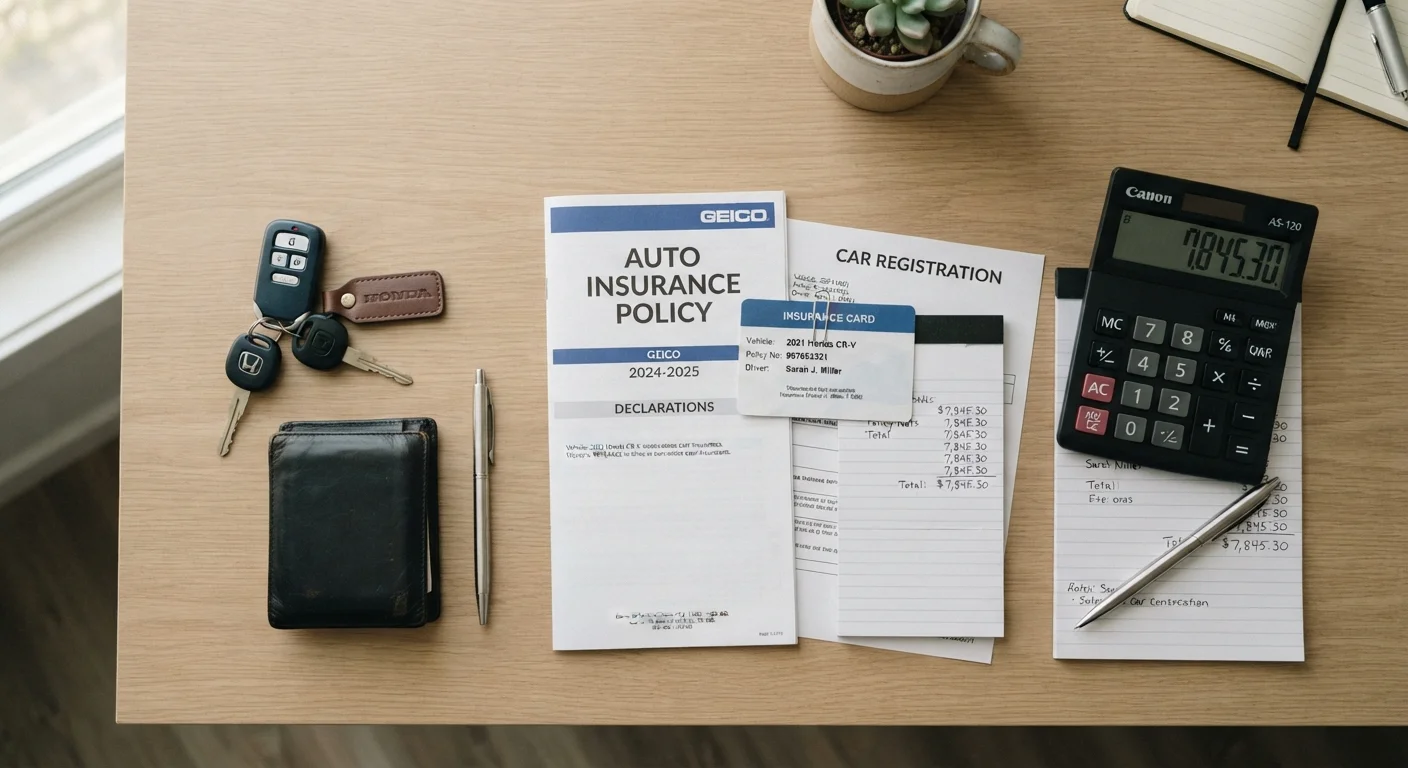
- Discounts apply to specific coverage lines. A multi-car discount might reduce your liability premium but not your comprehensive or collision premium. Reading your declarations page carefully clarifies where each discount is applied. See our policy structure explainer for how declarations pages are organized.
This article is for general informational purposes only and does not constitute personalized insurance or financial advice. Coverage, discount availability, and eligibility criteria differ by provider and jurisdiction. Always read your actual policy documents and consult a licensed insurance agent for guidance specific to your situation.
Premium
The amount a policyholder pays - monthly, semi-annually, or annually - for an insurance policy to remain in force.
Declarations Page
The summary page of an insurance policy listing the named insured, covered vehicles, coverage types, limits, deductibles, and applied discounts.
Telematics
Technology that collects real-time driving data (speed, braking, mileage, time of day) and transmits it to the insurer, often as a basis for usage-based pricing.
Lookback Period
The window of time - typically three to five years - during which an insurer reviews a driver's record for accidents or violations when determining discount eligibility.
Bundling
Placing multiple insurance policies (e.g., auto and homeowners) with the same carrier to qualify for a multi-policy discount.
Affinity Discount
A discount made available to members of a qualifying group - such as a professional association or alumni network - through an arrangement with the insurer.
The Major Discount Categories Explained
The industry organizes discounts into a handful of recurring categories. The definitions below reflect widely used frameworks; your specific insurer may use different names or combine criteria.
| Typical safe-driver lookback period | 3-5 years (Industry standard; varies by insurer and state) |
| Common multi-vehicle threshold | 2 or more vehicles (Varies by carrier; vehicles usually must share a garaging address) |
| Good student GPA benchmark | B average (3.0 GPA) or above (Common threshold; individual insurer criteria differ) |
| Telematics data typically collected | Braking, acceleration, mileage, time of day (Specific metrics vary by programme) |
| Discount application scope | Often per coverage line, not whole policy (Check declarations page for line-level detail) |
Driver Behavior and Safety Record
Safe-driver (or good-driver) discount: Typically requires a clean record - no at-fault accidents and no major violations - for a defined lookback period, often three to five years. Some states mandate a version of this discount by regulation.
Defensive driving course discount: Completing an approved driver safety course can qualify you for a discount, particularly for drivers over a certain age or those with a minor violation on record. Course approval requirements vary by state.
Telematics (usage-based) discount: You permit the insurer to collect driving data - via a mobile app or plug-in device - covering metrics such as braking habits, mileage, and time of day. Safer driving patterns and lower mileage can translate to premium reductions. For a fuller explanation of telematics terminology, see our core terms glossary.
Policy Structure Discounts
Multi-policy (bundling) discount: Insuring more than one product - auto plus homeowners, renters, or life - with the same carrier commonly qualifies for a discount on one or both policies.
Multi-vehicle discount: Placing two or more vehicles on a single policy often reduces the per-vehicle premium. All vehicles typically must be garaged at the same address.
Loyalty or continuous coverage discount: Some insurers reward policyholders who maintain uninterrupted coverage - either with them or, in some cases, with any carrier - over a sustained period.
Vehicle and Technology Factors
Safety feature discount: Factory-installed features such as anti-lock brakes, electronic stability control, forward-collision warning, or automatic emergency braking may qualify for a discount on specific coverage lines. Features that reduce theft risk - such as VIN etching or factory alarms - may similarly reduce the comprehensive portion of your premium.
New vehicle discount: Some insurers apply a discount to vehicles within a certain model-year range, reflecting lower statistical loss rates on newer equipment.
Policyholder Profile Factors
Good student discount: Full-time students who maintain a defined academic threshold - commonly a B average or above - may qualify. Proof of enrollment and grades is typically required periodically.
Affinity or group discount: Membership in certain professional associations, alumni groups, or employer programs can qualify drivers for discounts negotiated by that organization. These are worth asking about even if not prominently advertised.
For a broader look at discount types that often go unnoticed, see discounts drivers often overlook.
Verifying and Maintaining Eligibility
Qualifying for a discount at policy inception does not guarantee it remains on your policy indefinitely. Insurers conduct periodic reviews, and changes in your driving record, vehicle, or household composition can affect eligibility. A few practical considerations:
- Ask at renewal. Discounts are not always applied automatically when you first become eligible. Contacting your insurer or agent at renewal to ask which discounts you currently carry - and which you might newly qualify for - is a straightforward step.
- Document requirements vary. Good student discounts typically require a transcript or grade verification. Defensive driving discounts require a course certificate. Telematics discounts require active participation in the monitoring programme.
- State regulation shapes availability. Some states restrict the use of certain rating factors, which can limit or expand which discounts are permissible. An insurer licensed in your state operates within that regulatory framework.
Understanding how your overall policy is structured - coverage types and how they interact - makes it easier to identify which discount categories are most relevant to your situation.
Discounts Are Not a Substitute for Adequate Coverage
Optimizing for discounts is worthwhile, but it should never come at the cost of carrying insufficient coverage for your situation. A lower premium that leaves significant gaps in protection may cost far more in the event of a serious accident. Review coverage limits and deductibles alongside any discount strategy, and consult a licensed agent if you are uncertain whether your current coverage levels are appropriate.